Ready for Recovery
Protect your software. Stay ready for recovery.
Recovery readiness starts with securing the code, data, and deployment components your software depends on. With the right assets protected, you can quickly return to business as usual.
What is recovery?
Recovery means being able to restore your systems after a disruption occurs. It ensures you can recreate environments, resume functionality, and continue operations when access is lost.
Recovery gives you a defined path back to working software.
Why you need to be ready for recovery
76%
Of organizations are not prepared to recover from major incidences.
$300K/hr
Average cost of downtime for mid-size and large enterprises.
66%
Of outages have been linked to third-party or service-provider failures.
€10M
Maximum fines under NIS2 for failures affecting essential service continuity.
Without secured assets, recovery is impossible. You can't recover what you haven't protected.
How recovery works
Recovery follows a structured process that ensures you have the materials, access, and clarity required to restore your software when systems become unavailable.
Step 1: Store
Protect the essential components required to rebuild your software when access is lost.
Complete codebase and technical documentation
Database structures, data exports, and configurations
Deployment scripts, environment details, and credentials
AI models, model deployments, workflows, agents, and prompts
Step 2: Release
Retrieve your recovery materials quickly and securely when a disruption triggers set release conditions.
Contract-defined events initiate the release
Validation and preparation handled immediately
Recovery assets delivered through a secure process
Step 3: Deploy
Restore functionality using the verified assets prepared for recovery.
Recreate infrastructure and configurations
Follow deployment guidance to restore services
Validate and confirm system readiness
With this process, you have peace of mind that your software is secured, and the evidence to back it up.
Recovery roles and responsibilities
Recovery only succeeds when each party maintains their part of the process. These responsibilities keep assets complete, current, and ready for use.
Depositor
Agrees on recovery requirements with the beneficiary
Provides source code, documentation, and technical components
Keeps deposits updated with new releases
Supplies build, configuration, and deployment details
Supports verification activities
Beneficiary
Confirms recovery requirements jointly with the depositor
Reviews verification results and obtains audit-ready documentation
Ensures recovery aligns with internal continuity plans
Initiates release during a qualifying disruption
Manages redeployment or migration using released materials
Codekeeper
Establishes the legal framework that governs recovery and release
Securely stores, encrypts, and tracks all assets
Verifies completeness and buildability
Processes release requests 24/7
Provides optional technical support during recovery
Issues Software Resilience Certificates as compliance proof
Recovery support when you need it
Our role is to ensure that the technical materials required for recovery are protected, verified, and available when needed.
Complete, current asset protection
We keep your source code, documentation, workflows, and models current through automated deposits so you can rebuild your software when needed.
Verified readiness for real recovery
Our team runs build tests and completeness checks to verify your assets will rebuild successfully. We also supply you with formal certification to prove this.
24/7 release and support
During a recovery event, delays increase downtime. We process release conditions at any time and deliver assets through a secure, audited workflow. When disaster strikes, Assured Recovery experts can also guide you through restoring your software.
Simplified escrow management
Your Codekeeper dashboard provides visibility into version status, deposit history, and verification results. Everything required for recovery is organized and ready to be used when needed.
Let’s keep your software recoverable
Our escrow solutions provide the foundation for recovery, ensuring critical software components are preserved and ready to support restoration.
Software Escrow
Protection scope: On-premises software
Source code
Gives you the core logic needed to rebuild, maintain, or extend the application independently.
Data
Preserves essential databases and exports so the restored system functions with complete business information.
Documentation
Provides the technical clarity needed to configure, deploy, and troubleshoot the software during recovery.
SaaS Escrow
Protection scope: SaaS and cloud applications
Source code
Enables recreating or migrating the SaaS product if the provider becomes unavailable.
Data
Safeguards operational data and schemas to ensure the application and its workflows remain intact.
Documentation
Supports accurate deployment, onboarding, and troubleshooting during restoration.
Intellectual property (IP)
Verifies rights and ownership, allowing compliant continuation or rebuild of the service.
Deployment assets
Provides binaries, containers, and environment definitions to speed up redeployment.
Third-party dependencies
Maps the external services your SaaS relies on so integrations can be reconnected or replaced quickly.
AI escrow
Protection scope: AI applications, assets, and model deployments
Models
Secures the model versions, weights, training data, and credentials so the capabilities of your system stay intact.
Model deployments
Protects the deployment settings, API configurations, routing rules, and access controls needed to redeploy.
Agents & prompts
Provides the instructions, templates, and logic that power your AI platform.
Workflows
Vaults the workflow configurations, integration mappings, and automation sequences so your AI systems continue running.
Software backup
Protection scope: Internal systems to prove compliance
All asset & component types
Stores source code, data, documentation, intellectual property (IP), deployment assets, third-party dependencies, models, model deployments, agents & prompts, and workflows for compliance.
Automated & manual backups
Allows you to choose your preferred method to capture the materials. Set up only takes a few minutes.
Certificates and security controls
Provides you with Backup verification certificates and immutable backup history for compliance proof.
Instant download access
Enables you to retrieve your backed-up assets anytime through your dashboard.
Complete software resilience needs both recovery and continuity
Recovery ensures you can rebuild software after failure. Continuity escrow ensures all dependent environments, credentials, and subscriptions remain active during that process.
E-BOOK
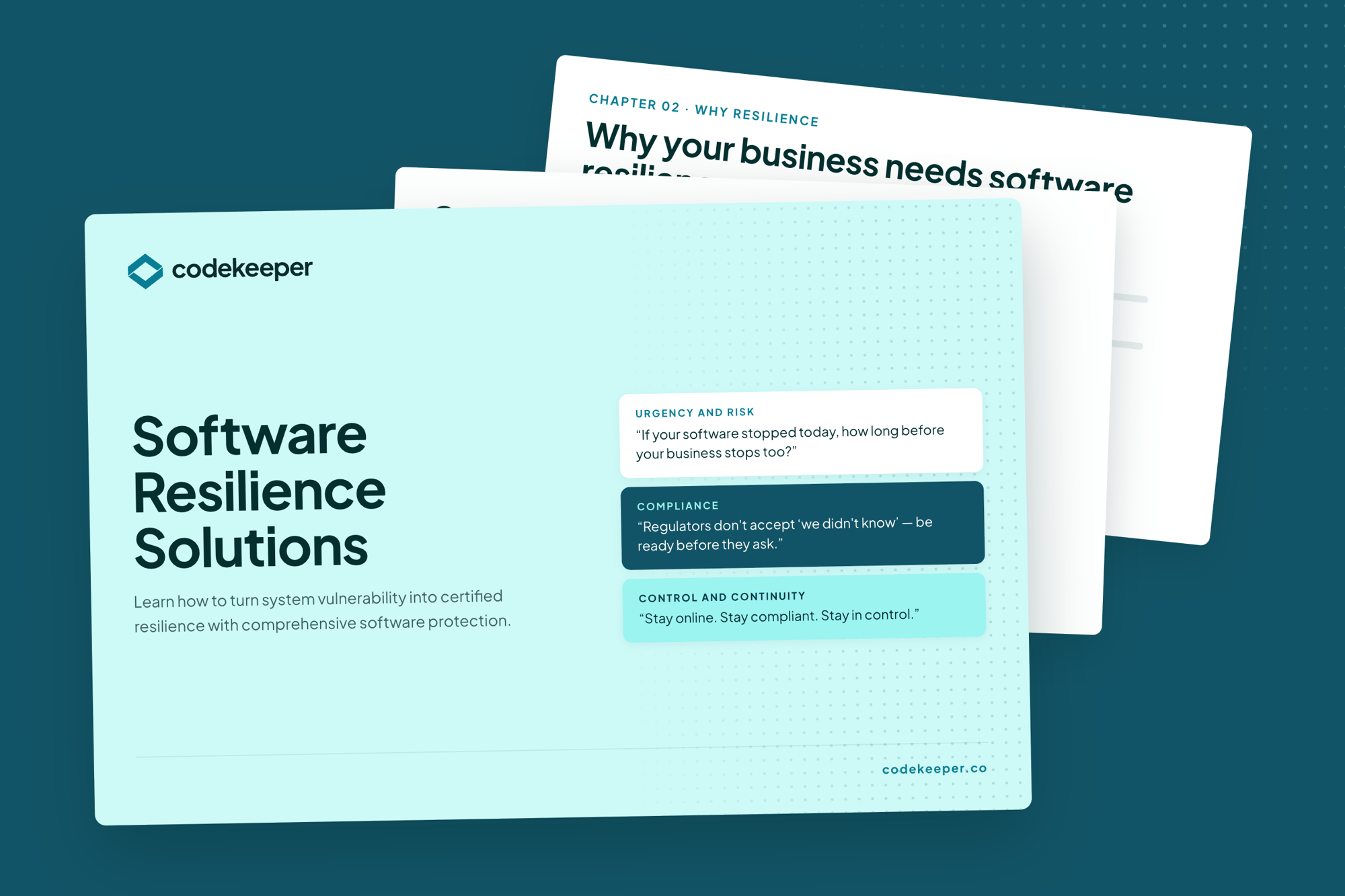
Download our Solution Overview guide
Discover how Codekeeper’s recovery and continuity solutions fit together to help you build bulletproof software resilience.
*E-book available only in English
Get your free solution overview guide
Unprotected software exposes your business to catastrophic risks
When software isn’t resilient, small disruptions turn into major failures.

Outages last longer, recovery slows, costs rise, and customers feel the impact long before systems are restored.
Let's build bulletproof software resilience together.
Join 3 500+ companies that protect their business-critical software with Codekeeper.
All essential assets secured
Clear, validated release paths
Expert support through recovery events