
Continuity Escrow Asset
Credentials escrow
Guarantee your software continuity by securing the credentials required to access, manage, and pay the providers your application depends on.
Pick your platform — we’ll integrate
Depositing credentials should be straightforward. Codekeeper supports 50+ hosting, billing, and infrastructure systems with direct integrations and clear instructions for manual uploads if needed.
View all integrations

What is credentials escrow?
Credentials escrow is a legal agreement where a software provider deposits the logins, billing rights, and authentication materials needed to manage the hosting platforms and services supporting their application.
A neutral third party like Codekeeper secures these assets and activates them only when a contract-defined continuity event is confirmed, ensuring essential services remain stable until control is restored to the provider.
Credentials escrow is part of Codekeeper’s broader Continuity Escrow solution.
Why credentials protection matters
Reliable software doesn’t run in isolation. It depends on hosting platforms, billing systems, infrastructure tools, APIs, and third-party services that must remain accessible at all times.
Who manages these services if your internal access changes?
How do you prevent renewals or subscriptions from lapsing during disruption?
What ensures provider credentials stay organized, current, and usable?
How can all parties stay confident that critical services will continue operating?
When essential credentials are unavailable, your software can’t stay fully operational.
Protect your operational continuity with Codekeeper
A structured safeguard that ensures the services behind your software remain accessible and active.
Secure access to critical platforms
We store the credentials required to manage and renew hosting accounts, billing portals, and third-party platforms that your software depends on.
Maintain payments during continuity events
If a continuity trigger occurs, Codekeeper can use escrowed billing credentials to process renewals and prevent lapses across your essential services.
Independent oversight for reliable continuity
Both beneficiaries and depositors gain assurance knowing the platforms and payments your software runs on are guarded independently.
Dedicated support throughout the process
Our support team assists with setup, continuity planning, and guided actions during a verified event, ensuring everything runs exactly as the agreement defines.
How does credentials escrow work?
1. Identify the providers your software relies on
You outline the hosting, SaaS, and infrastructure services to be included in your escrow, along with update expectations and continuity triggers.
2. Deposit the required credentials securely
Follow provider-specific instructions to add billing users, generate access, or submit your credentials through encrypted channels.
3. Keep your escrow aligned with your environment
As your software and provider stack evolves, Codekeeper captures updates automatically so the escrowed credentials always reflect your current setup.
4. Activate continuity when it’s required
If a continuity condition is triggered, Codekeeper uses the escrowed credentials to ensure essential services remain operational.
See how it works
From software risk to resilience
“Excellent service. This is easily the best way to handle it for both yourself and the client.”

“Codekeeper is a new service for creating escrow agreements for code, specifying the legal circumstances where source code can be accessed.”
“Source code escrow is a great service, and one that ALL developers who do client contract work should look into.”
Guarding access to services you can't afford to lose
Without credentials escrow
Essential provider access becomes harder to coordinate
Services may lapse during transitions or internal changes
Missing credentials delay operational decisions
Trust weakens when no independent safeguard exists
With credentials escrow
Provider access stays safe, structured, and independently held
Services remain active during continuity conditions
Teams respond faster because access remains consistent
Trust strengthens as both parties know essential services won’t be disrupted
Build a complete continuity safety net
Credentials escrow is part of Codekeeper’s Continuity Escrow solution — a framework designed to keep your software’s essential dependencies running by maintaining access, payments, and supporting services while recovery plans are executed.
E-BOOK
Understand how credentials escrow keeps services online
Get a clear, practical overview of how Continuity Escrow guarantees uninterrupted operations if disruption occurs.
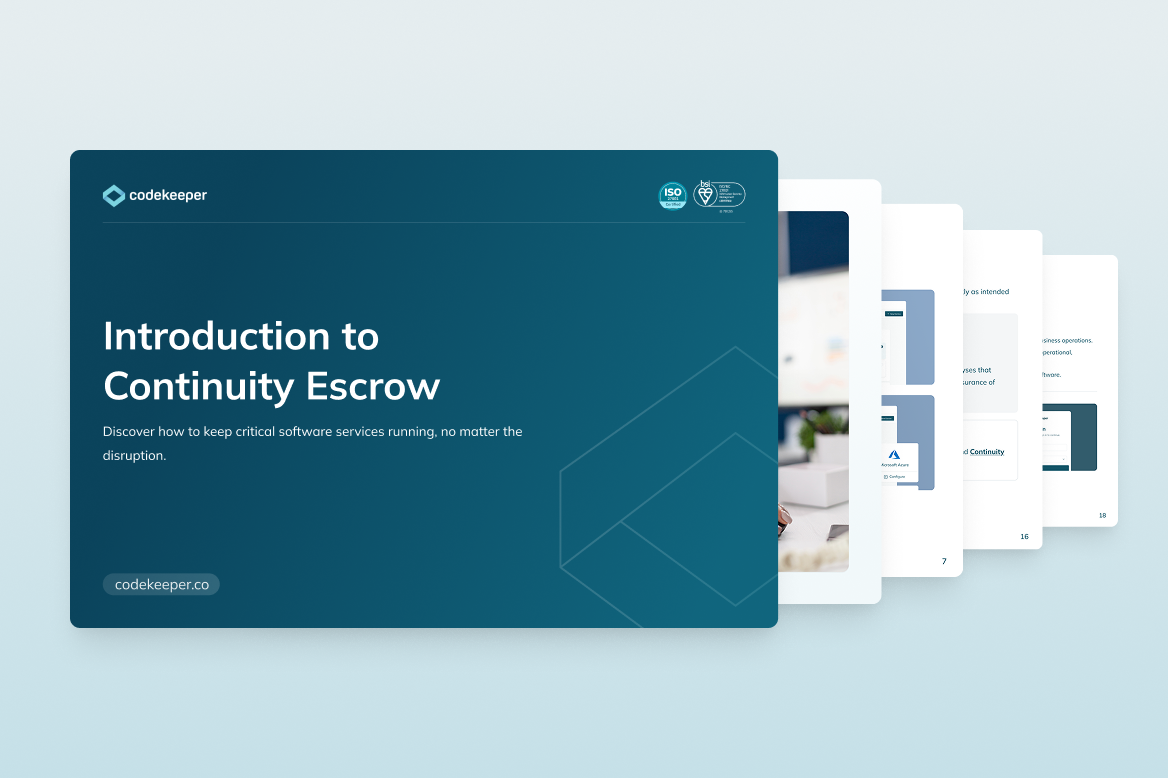
*E-book available only in English
Get your free introduction to continuity escrow
READY FOR Continuity
Never lose access to critical services
Protect revenue by preventing service-related downtime
Maintain customer trust through guaranteed service continuity
Prove service stability through independent verification
Frequently asked questions
What is credentials escrow?
Credentials escrow is a legal agreement where a software provider deposits the logins, billing access, and related account credentials needed to manage the hosting platforms and services supporting their application. A neutral third party holds these credentials under contract, using them only to support continuity when defined conditions are met.
Who needs credentials escrow and why?
Credentials escrow serves software providers and the organizations that depend on them. Providers use it to maintain access to critical platforms during internal changes, while clients gain assurance that essential services will remain operational.
How does credentials escrow work?
The provider deposits the agreed credentials — such as logins, billing-user roles, or API keys — with the escrow agent. These are encrypted, stored securely, and updated over time. Release and use occur only if a validated continuity condition is met under the contract.
What’s included in a credentials escrow deposit?
A deposit may include hosting platform logins, cloud console access, billing portal credentials, subscription management roles, API keys, or any access required to keep supporting services active. The exact contents are defined in the continuity escrow agreement.
Are credentials escrow deposits secure with Codekeeper?
Yes, credentials escrow deposits with Codekeeper are encrypted, access-controlled, and stored in ISO 27001–aligned environments. Access is managed only through strict, contract-defined processes, with all actions logged, limited, and authorized under the agreement.
How much does credentials escrow cost?
Pricing for credentials escrow depends on the number of providers, credential types, and the level of continuity support required. Codekeeper’s Continuity Escrow plans start at $415 per month, with additional options available for more complex environments or enhanced support.
How do I get started with credentials escrow?
Choose a Codekeeper plan or book a demo, identify the providers that fall within scope, and make your first credential deposit through the secure submission process. Credentials escrow is then kept current through scheduled updates and documented reviews aligned to your continuity requirements.
How does credentials escrow fit into the broader Continuity Escrow solution?
Continuity Escrow protects the elements needed to keep software running — credentials, hosting environments, and third-party dependencies. Credentials escrow specifically safeguards the access and billing controls needed to maintain essential services while recovery plans are activated.
Is key escrow part of credentials escrow?
Yes. Key escrow is included as part of credentials escrow whenever authentication keys are required to manage or access your provider accounts. This includes MFA backups, SSH keys, API keys, and signing keys. These materials are stored with the same security controls and release conditions as the rest of your escrowed credentials, and are used only if a contract-defined continuity or access condition occurs.