


 European Union


 Global standards


 US

 UK

 Australia

 Netherlands
Build your software resilience step by step.
Protect the applications you build or rely on from one Codekeeper account. Add each one, choose who handles a recovery, and pick your level. The rest is on us: the deposit stays current, your evidence stays on file, and with Pro, you get proof the application rebuilds.
Plans from $89, billed annually.
- ISO/IEC 27001:2022 certified
- 10+ years securing software

Trusted by 3 500+ teams in over 150 countries, from regulated enterprises to fast-growing software vendors








Step 1 of 3
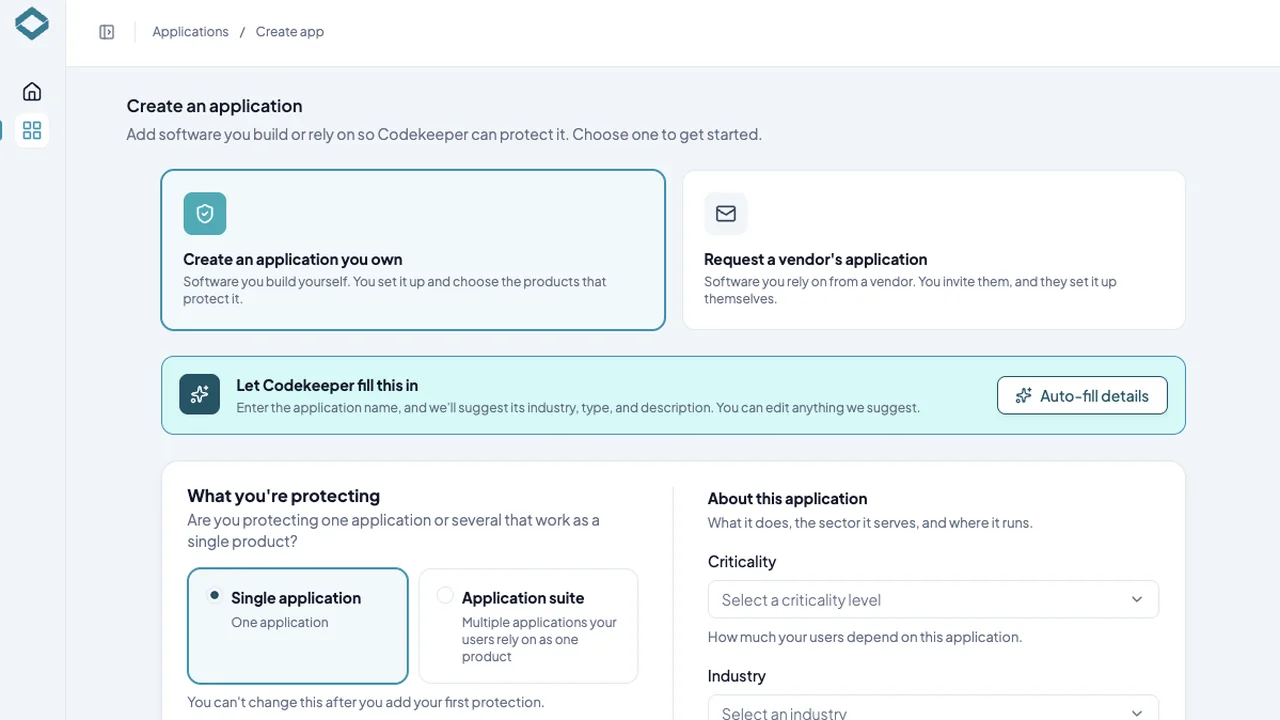
Add your application.
What are you protecting: software, SaaS, or AI?
Each application gets its own agreement and deposit. Its type decides what goes in the vault, and what the plans cost.


Step 2 of 3
Choose your protection.
Who acts on the day the application fails?
All three keep a copy safe in Codekeeper's vault. They differ in who brings it back, and whether the live service stays on while that happens.

Self-Run Recovery
Escrow
For the software your own team can bring back. When agreed conditions are met, the materials are released to your team for recovery.
From $199per month
Explore EscrowOn the day
- Release condition verified
- Deposit released to you
- Your team runs the recovery

Managed Recovery
Resilience
For the software you can't risk rebuilding yourself. Codekeeper's engineers rebuild from the deposit, so the work never lands on your team.
From $399per month
Explore ResilienceOn the day
- Release condition verified
- Deposit comes to Codekeeper
- Our engineers run the recovery

Full Continuity
Continuity
For the services that just can't go offline. Added to Escrow or Resilience: we pay the bills the service runs on during recovery.
From $1,449per month
Explore ContinuityOn the day
- The vendor stops
- Live environment kept paid and switched on
- Your team or ours runs the recovery
 Protecting software you build and run yourself? Software Backup attaches the same way, from $89. Explore Software Backup
Many applications, or several claimants? Talk to us about an enterprise setup, with one proposal covering every application.
Step 3 of 3
Choose your level.
Is a safe deposit enough, or do you want it tested?
Every protection comes in two levels, shown here for Escrow. We recommend Pro: it adds Agentic Verification, so you know the deposit builds before the day you need it.

Pro level
Escrow Pro
RecommendedTest the rebuild before you need a recovery.
Everything in Escrow, plus
- Agentic Verification: up to four rebuilds a year, on supported technology stacks
- Codekeeper's own AI, off public models
- Missing files flagged in each rebuild
- A tested isolated compile, ready to deploy
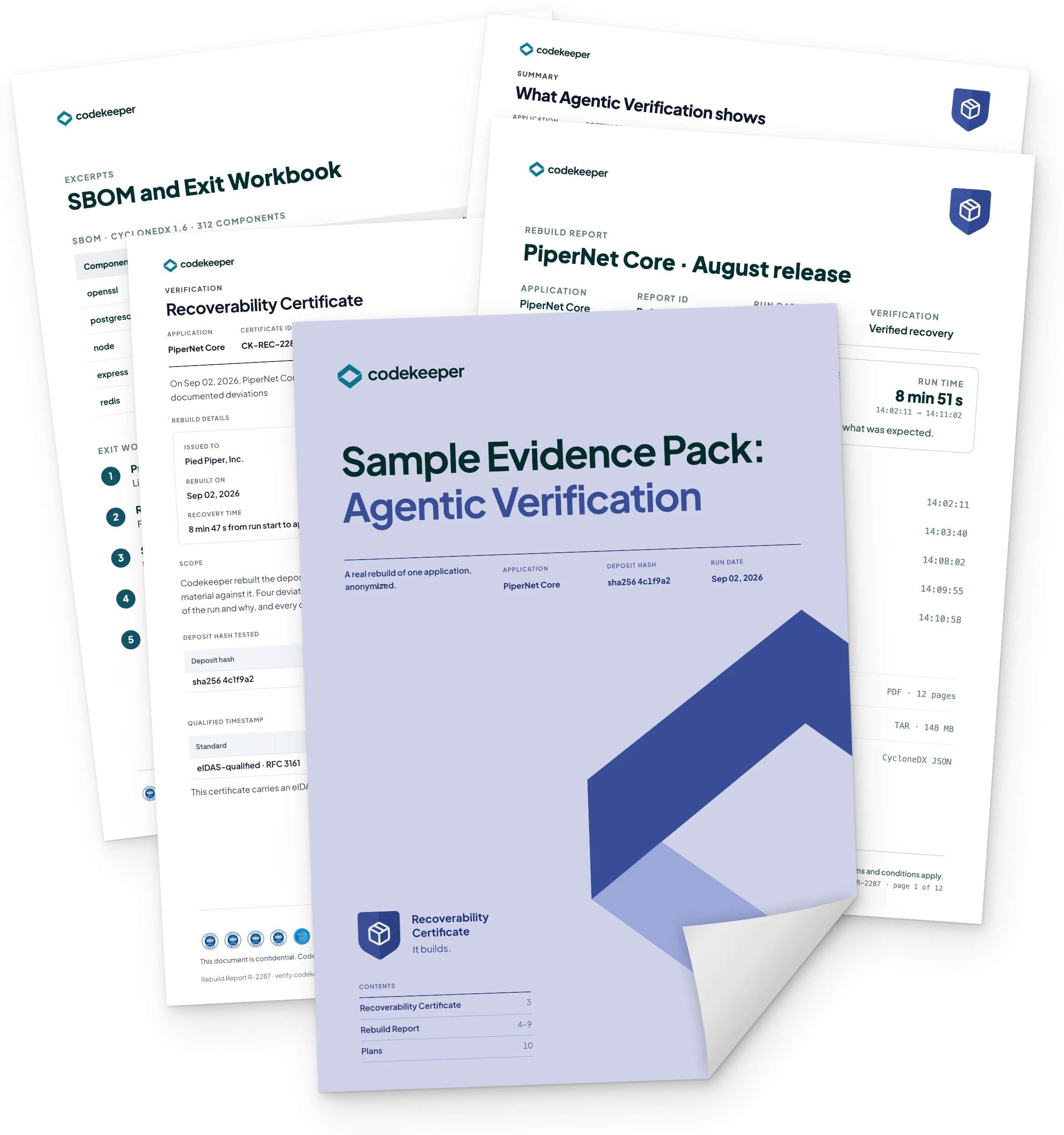
- An exit workbook for the recovery
- Recoverability Certificates and SBOMs
From $449per month
Base level
Escrow
Everything you need to be protected.
Included
- A copy of your software in a neutral vault
- Daily sync through 50+ integrations
- Monthly checks for missing files
- Released to your team to recover
From $199per month

Want people to test your exit plan in practice? The Exit Exercise is an add-on to any plan. Our specialists recover the application from the deposit alone and test the business functions you nominate, and an Exit Exercise Report records how it went. About the Exit Exercise
 What makes Pro possible
Agentic Verification. Proof the deposit builds, before you need it.
A deposit can look complete and still fail to build. The only way to settle it is to rebuild the application, and that is what Agentic Verification does.
- When it runs
- Whenever you start one from your account. Ahead of an audit or after a big release are good moments.
- Where it runs
- In the sealed Codekeeper AI Verification Lab. Codekeeper's AI agents work out how the application is built and rebuild it from the deposit alone, on Codekeeper's own AI that keeps your code off public models.
- If something is missing
- It's flagged, so it can be added to the deposit before a recovery depends on it.
- What you get
- Every passed run issues a Recoverability Certificate, with a Rebuild Report, an SBOM (CycloneDX), an exit workbook, and a tested isolated compile.
After you choose
Then we set it up with you.
Our specialists work with your team on the first deposits, and our in-house counsel takes care of the agreement.
Talk it through.
On a demo call, we go through your applications with you and suggest a protection and level for each one.
Sign one agreement.
Two-party (bipartite), three-party (tripartite), or multi-party, with release conditions agreed at signing.
Connect your tools.
Deposits sync daily through 50+ integrations. Where automation isn't possible, they're uploaded by hand instead.
Build up the evidence.
A monthly automated check with a Vault Report, plus a Vault Certificate and your plan's certificate. With Pro, rebuild tests too.
New to escrow? Read the Getting Started With Software Escrow guide.
Start with the application you can't afford to lose.
Bring the list of software your business runs on. We'll show you how each application would be set up, from the agreement to the first certificate.
Frequently asked questions
Before you add your first application.
What counts as an application?
An application is one piece of software with its own agreement and deposit: an on-premises product, a SaaS platform, or an AI system. Several applications sold as one product can be set up together as an App Suite, quoted on what the suite contains.
Can one application have more than one protection?
Yes, one application can have more than one protection. Continuity always sits on an Escrow or Resilience recovery, and other protections can be combined too. We'll quote the combination with you.
Who runs a recovery, and who pays for it?
Who runs a recovery, and who pays for it, depends on the protection. With Escrow, your own team or a partner you choose runs it. With Resilience, our engineers run it on a best-effort basis, and the recovery work is billed to the claimants who need it. The Pro rebuild tests are part of the plan price.
Is there anything to pay besides the monthly price?
Besides the monthly price, there's a one-time setup fee per agreement: $499 for Escrow and Resilience, and $999 for Continuity, at either level. Release processing is billed at $199 per hour. The plan price covers one claimant; extra claimants are an add-on. Software Backup and Software Backup Pro have a one-time $249 setup fee.
Will Codekeeper make us compliant?
No, Codekeeper can't make you compliant, and no product can do that on its own. What you get is evidence for your file: your plan's certificate shows the deposit is in place, a Recoverability Certificate shows the application builds, and an Exit Exercise Report shows the exit works. Your assessor decides whether that meets a given requirement.