
DORA
Strengthen the resilience of your financial operations: software escrow for DORA and UK operational resilience
When a critical ICT supplier fails, Codekeeper's software escrow keeps your institution covered. It is built for the UK's operational resilience regime (the PRA's SS1/21 and SS2/21, the FCA, and the new Critical Third Parties regime) and for the EU's DORA wherever you operate across Europe.
The DORA deadline has arrived. A failure to comply can bring substantial penalties, closer supervision, and disruption to operations. Move now to safeguard your financial operations.
The EU's DORA: the key facts
What is DORA?
DORA, the Digital Operational Resilience Act, is a regulatory regime built to reinforce the digital operational resilience of financial entities across the EU. It concentrates on ICT risk management and on keeping financial institutions able to deliver services throughout disruptions. UK-regulated firms meet the same expectations under the PRA and FCA's operational resilience rules and the Critical Third Parties regime, and DORA extends directly to any UK firm serving customers in the EU.
Who needs to comply with DORA?
If your business sits within UK or EU financial services, there is a strong chance these operational resilience rules apply to you. That covers:
Insurance companies
Investment firms
ICT third-party service providers
Financial market infrastructures
Payment and electronic money institutions
Crypto-asset service providers
The five pillars of DORA: the core compliance requirements
DORA rests on five central pillars that financial institutions are required to meet in order to reinforce ICT resilience and operational continuity:
1
ICT risk management Institutions must spot, evaluate, and manage ICT risks under clear governance and accountability.
2
Third-party risk management Outsourced ICT suppliers must be overseen and controlled to lower dependency and maintain compliance.
3
Incident management and reporting Significant ICT incidents must be flagged without delay, with lessons captured to stop them happening again.
4
Resilience testing Systems must be examined on a regular basis, scenario and penetration testing included, to demonstrate operational readiness.
5
Information and intelligence sharing Institutions are expected to exchange cyber threat intelligence to reinforce resilience across the sector.
How escrow closes the distance to DORA compliance
Software escrow opens a clear route to DORA compliance by protecting your critical ICT assets should a supplier relationship break down.
01
DORA risk
Dependency on third-party ICT providers
Potential loss of access to critical software
ICT disruptions and operational downtime
Regulatory audits and scrutiny
02
Software escrow solution
Secure critical code and systems
Legal framework for guaranteed access
Verified recovery capabilities
Automated deposit management and compliance reports
03
Compliance outcome
Reduced supplier risk
Business continuity maintained
Strong operational resilience with proven recovery and continuity measures
Audit-ready documentation
Software escrow offers instant access to vital software components during ICT disruptions, maintaining compliance and ensuring critical systems stay available — the foundation of operational resilience.
Your partner through the complexity of DORA
Allow us to help you achieve DORA compliance. With over 10 years' experience, Codekeeper has supported thousands of financial institutions in reinforcing resilience and satisfying regulatory requirements.
We understand the challenges in front of you:
Regulatory standards growing stricter
Compliance deadlines on the horizon
Ongoing dependence on third-party software
The struggle to manage ICT risks
Supported by compliance experts who track evolving regulations and provide best practices, Codekeeper helps your institution stay resilient and audit-ready.

Software escrow solutions shaped around DORA compliance
Codekeeper's software escrow solutions enable financial institutions to satisfy DORA's expectations across digital resilience, third-party oversight, and operational continuity, all while protecting your most critical software assets.
Software Escrow
Protection scope: On-premises software solutions
Ensures core on-premises applications remain available, keeping financial operations running without pause.
Ensures ongoing access to essential software
Reduces exposure to supplier failures
Verified compliance records that regulators can trust
Learn more
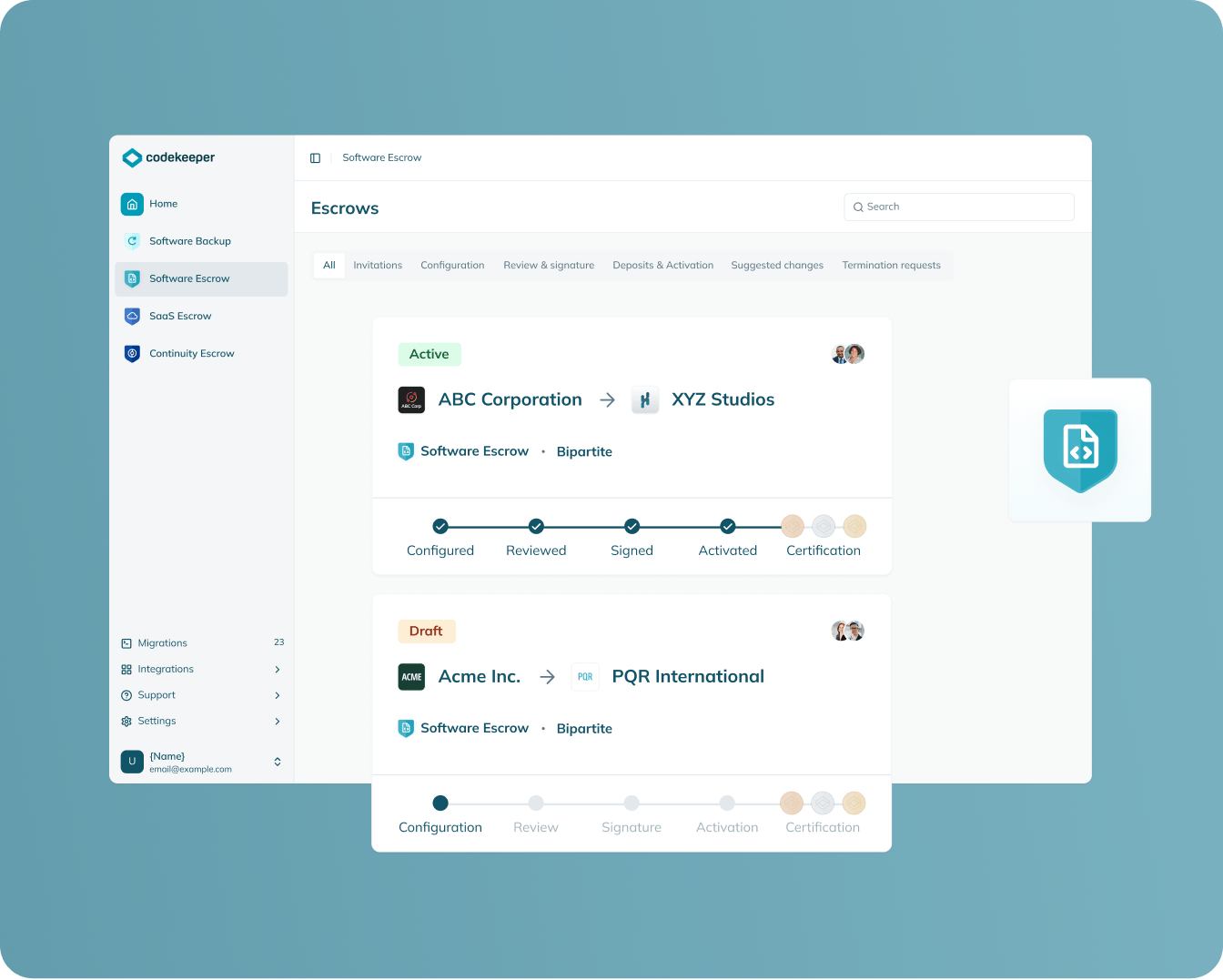
SAAS escrow
Protection scope: Cloud-based applications and solutions
Shields critical cloud platforms and data so they stay available even through service disruptions.
Safeguards reliance on cloud services
Delivers confidence in recovery
Meets DORA's risk management requirements
Learn more
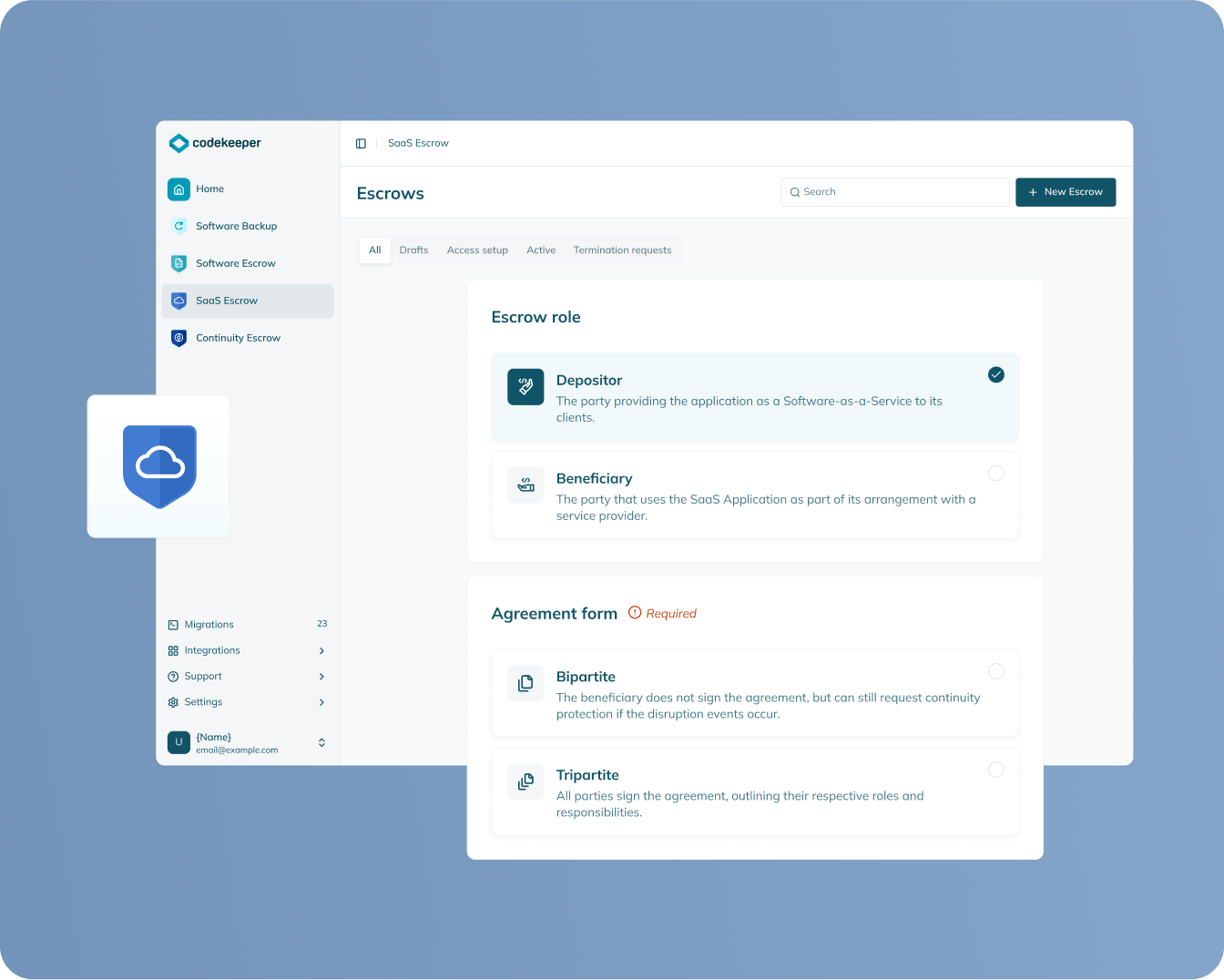
continuity escrow
Protection scope: Supporting services and infrastructure
Extends to infrastructure and payment flows so institutions stay resilient through supplier disruption.
Keeps critical infrastructure within reach
Stops supplier failures from causing disruption
Sits in line with DORA's continuity requirements
Learn more
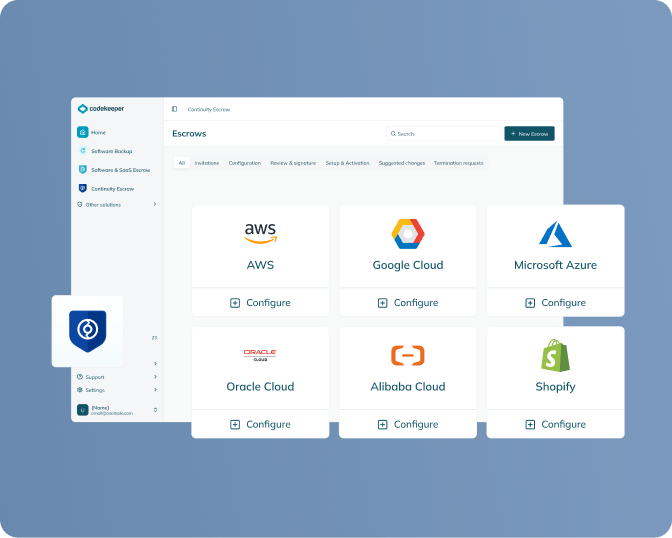
Verification
Protection scope: All escrowed materials
Turns escrow from a dormant store into live assurance by putting deposits to the test and confirming they can be recovered whenever needed.
Checks that escrowed assets are intact
Demonstrates the ability to recover operations
Shows you are ready for audit
Learn more

Lock in DORA software resilience in 4 steps
DORA obliges financial institutions to keep access to critical software and ICT services, even when a supplier fails. Here is how Codekeeper helps you satisfy that obligation quickly and with confidence:
1
Arrange a DORA assessment call
Pinpoint which of your critical ICT services and applications sit within DORA's scope.
2
Select the level of protection you need
Pick the escrow option that fits: Software, SaaS, Continuity, or bolt on Verification, to satisfy DORA's resilience standards.
3
We'll look after setup and management for you
Our team handles supplier onboarding, legal agreements, and deposit automation, so compliance never adds extra burden to your team.
4
Receive your Software Resilience Certificate
Obtain formal documentation that shows regulators your critical assets are protected and your operational resilience is assured.
One call. One solution. Complete software resilience for DORA compliance.
Book a free demo
Relied on by financial leaders across the globe
Codekeeper has already guided thousands of financial institutions towards stronger resilience and regulatory compliance. Our escrow and verification services give you the confidence to clear audits and safeguard operations.
The DORA deadlines worth noting
-
10 January 2023
DORA was finalized by the EU, setting clear standards for ICT resilience in the financial sector. -
24 October 2024
Under DORA, the European Commission adopted the final Delegated and Implementing Acts, detailing requirements for ICT risk management, incident reporting, and third-party oversight. -
17 January 2025
Full compliance is mandatory. All financial entities must demonstrate operational resilience and ICT risk management readiness. -
From 2025 onwards
Supervision and audits are increasing. Institutions must be able to prove resilience with testing, documentation, and third-party oversight, or risk facing financial penalties.
10 January 2023
DORA was finalized by the EU, setting clear standards for ICT resilience in the financial sector.
24 October 2024
Under DORA, the European Commission adopted the final Delegated and Implementing Acts, detailing requirements for ICT risk management, incident reporting, and third-party oversight.
17 January 2025
Full compliance is mandatory. All financial entities must demonstrate operational resilience and ICT risk management readiness.
From 2025 onwards
Supervision and audits are increasing. Institutions must be able to prove resilience with testing, documentation, and third-party oversight, or risk facing financial penalties.
What you stand to lose without DORA compliance
A failure to comply after the 17 January 2025 deadline leaves financial institutions open to:
Fines and penalties
Up to 2% of annual worldwide turnover or €10 million for institutions (whichever is higher), and up to €1 million for senior executives. Critical ICT providers face fines up to €5 million.
Regulatory scrutiny
Supervisors may step up their scrutiny, calling for deeper audits of ICT risk management, supplier arrangements, and resilience testing.
Service disruptions
Where fallback measures go untested, a supplier or system failure could bring critical services to a stop and trigger financial losses.
Reputational damage
Compliance failures and operational weaknesses can wear down the trust of customers, partners, and regulators.
Compliance is not something you can skip; it is mission-critical.
E-BOOK
Ready yourself for DORA: download the guide
Our hands-on guide splits DORA compliance into clear, manageable steps. See how to sidestep penalties, reinforce your ICT resilience, and satisfy EU regulatory expectations. Download it today to keep ahead of 2025 and the years that follow.
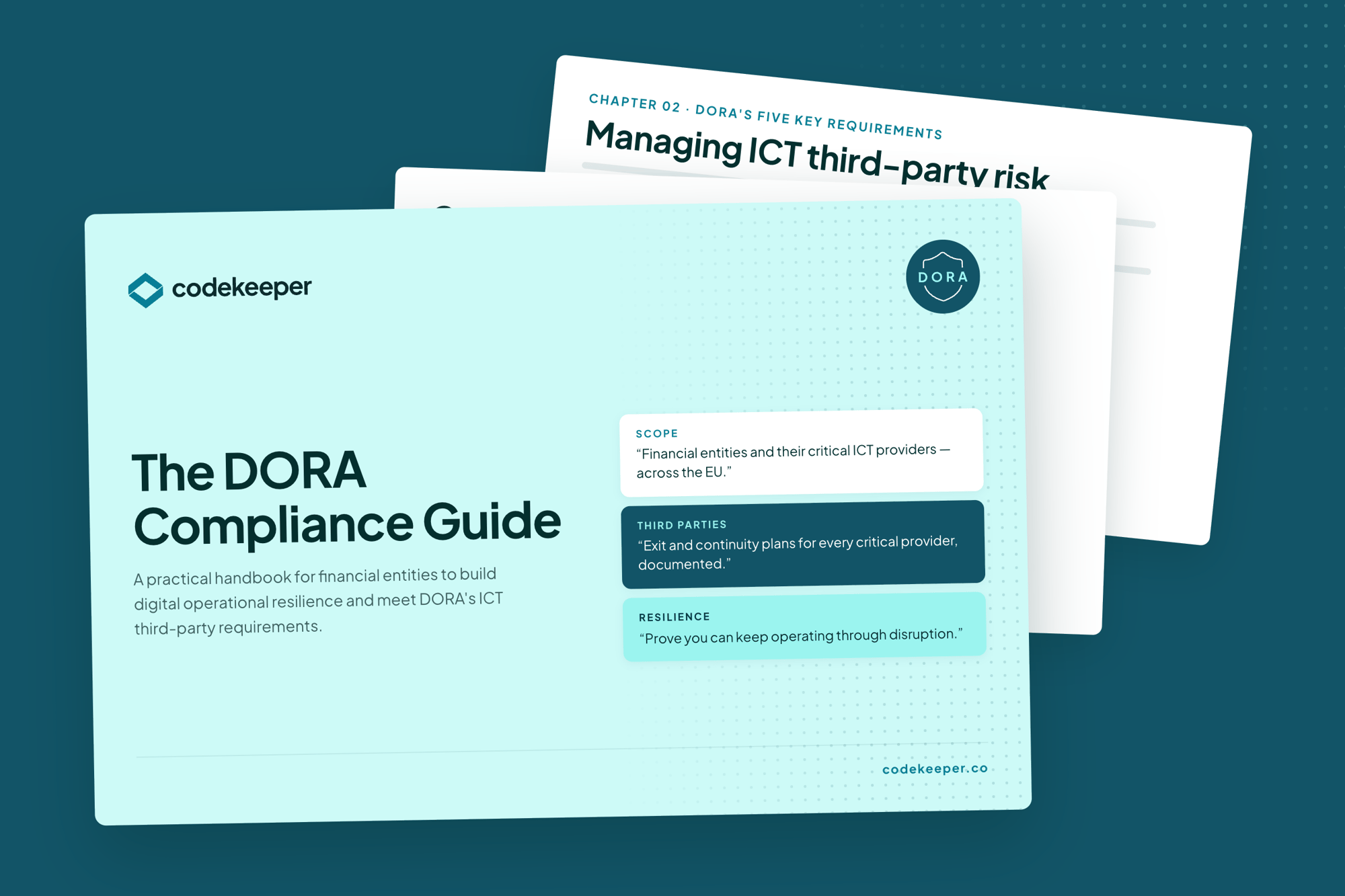
*E-book available only in English
Get your free DORA guide now
Gain peace of mind and operational continuity through DORA compliance
Steer clear of heavy fines and penalties
When you meet DORA requirements, your institution avoids costly enforcement actions and regulatory sanctions.
Keep financial services running without a break
Strong ICT resilience means customers face minimal disruption, even when a supplier or system fails.
Prove accountability and earn trust
Compliance signals to regulators, boards, and customers that your institution treats resilience and governance as priorities.
Give governance firm oversight of risk
DORA compliance underpins stronger governance by imposing structured oversight of ICT systems and third-party suppliers.
Reach DORA compliance with confidence
DORA lays down strict resilience standards across ICT systems and suppliers. Codekeeper helps you satisfy these requirements with tested escrow solutions and audit-proof records.
Request a bespoke DORA compliance assessment
Come away with clear, practical steps matched to regulatory standards
Get hold of audit-ready documentation
Develop resilience that safeguards operations and reputation alike
Frequently asked questions
What is DORA?
The Digital Operational Resilience Act (DORA) is an EU regulation that establishes standards for ICT risk management, resilience, and third-party oversight throughout the financial sector.
Who must comply with DORA?
Banks, insurers, investment firms, credit institutions, and ICT service providers that operate in the EU all fall under DORA.
What are the five pillars of the DORA regulation?
The five pillars of DORA cover ICT risk management, incident reporting, resilience testing, third-party risk management, and information sharing.
Why is DORA necessary?
DORA exists to counter the rising threat of cyberattacks in the financial sector. Its purpose is to keep the financial industry operationally resilient in the face of ICT disruptions and threats.
Why is software escrow relevant to DORA?
Software escrow keeps critical software, cloud services, and infrastructure accessible if a supplier fails, which supports DORA's continuity and resilience requirements.
When does DORA apply?
The regulation took effect on 10 January 2023 and applied in full from 17 January 2025.
What happens if an institution does not comply with DORA?
Non-compliance with DORA can result in regulatory fines, tougher audits, reputational damage, and possible service disruption.
Which jurisdiction governs a Codekeeper escrow agreement?
The jurisdiction is yours to choose; English law is available for UK agreements, and Codekeeper's in-house legal team drafts and returns your agreement within 24 hours.
Does software escrow on its own make an institution DORA compliant?
No. Software escrow is one control that supports DORA's third-party risk and ICT continuity requirements by keeping critical assets recoverable, yet DORA compliance spans all five pillars and calls for a broader programme.