



SaaS Escrow Asset
Deployment assets escrow
Protect the build scripts, packages, and configuration files your teams rely on to deploy and maintain your software.

We sync with the tools your teams already use
Maintaining deployment assets shouldn't disrupt your process. Codekeeper provides a secure, automated safeguard that fits naturally into your existing build and release workflow.
View all integrations







What is deployment assets escrow?
Deployment assets escrow is a legal agreement that protects your software build and deployment material.
A trusted third party like Codekeeper securely stores the technical materials that define how your software is assembled and deployed, and releases them only when agreement conditions are met. This preserves deployment capability for all parties.
Deployment assets escrow is one of the asset types included within Codekeeper’s SaaS Escrow solution.
Why your deployment workflow needs protection
Software delivery relies on many moving parts. When deployment assets are incomplete, outdated, or unavailable, updates become slower, and support work becomes harder.

How do teams release new versions if deployment files are missing?

How do you rebuild an environment without accurate build scripts?

Who ensures deployment materials stay current as your product evolves?

How do you reassure customers that your software can always be redeployed?

Automated deposits keep deployment assets up to date
Connect your build, storage, or container registry tools and let us capture the new versions as they’re produced. Every update is logged automatically, ensuring each deployment asset remains current without adding manual steps to your workflow.

Advanced features that simplify your deployment escrow
Codekeeper supports real-world deployment practices with tools that reduce friction: automated structuring checks, optional verification, and standardized release workflows that make these materials easier to manage and rely on.

Clear, independent access when deployment details are required
In a release event, Codekeeper provides structured access to the stored deployment materials. With these assets, all parties can follow the build and deployment steps, even when technical skill sets differ.

Cost-effective, flexible monthly and annual plans
Codekeeper offers month-to-month billing or annual plans, giving teams an affordable way to safeguard essential deployment assets without the rigid annual-only contracts common in the industry.

Unified online dashboards for clarity across teams
Each party receives an intuitive dashboard to review stored assets, version history, verification results, and agreement details — creating transparency from the beginning of the agreement.

Dedicated customer support for every step
Whether you’re onboarding or updating assets, our support team is available to assist at every stage, ensuring your escrow remains dependable and aligned with your deployment practices.
From software risk to resilience

“Excellent service. This is easily the best way to handle it for both yourself and the client.”

“Codekeeper is a new service for creating escrow agreements for code, specifying the legal circumstances where source code can be accessed.”

“Source code escrow is a great service, and one that ALL developers who do client contract work should look into.”








Without deployment assets escrow
Approval processes slow down
Deployment preparation stalls when materials are incomplete
A single gap can delay build, setup, or onboarding
Operational confidence becomes harder to maintain

With deployment assets escrow
Software decisions are easier and faster to approve
Deployment preparation follows a clear, structured process
Build, setup, and onboarding stay predictable across teams
Operational confidence improves through independent oversight
Cover your full SaaS infrastructure
Deployment assets escrow is part of Codekeeper’s broader SaaS Escrow solution, which protects every asset a SaaS platform relies on — from source code to deployment pipelines.

Source code escrow
Preserve the codebase required to rebuild, maintain, or support your software.
Learn more

Data escrow
Safeguard the application data and configuration files required for restoration.
Learn more

Document escrow
Vault documentation and technical materials needed to rebuild or operate your software.
Learn more

IP escrow
Protect proprietary designs, algorithms, and materials essential to your application.
Learn more

Third-party dependencies escrow
Store the information required to manage external services and integrations.
Learn more
E-BOOK
Want to see how deployment assets escrow reduces risk?
Download our guide to learn how SaaS Escrow protects the build and deployment assets that keep your software deployable.
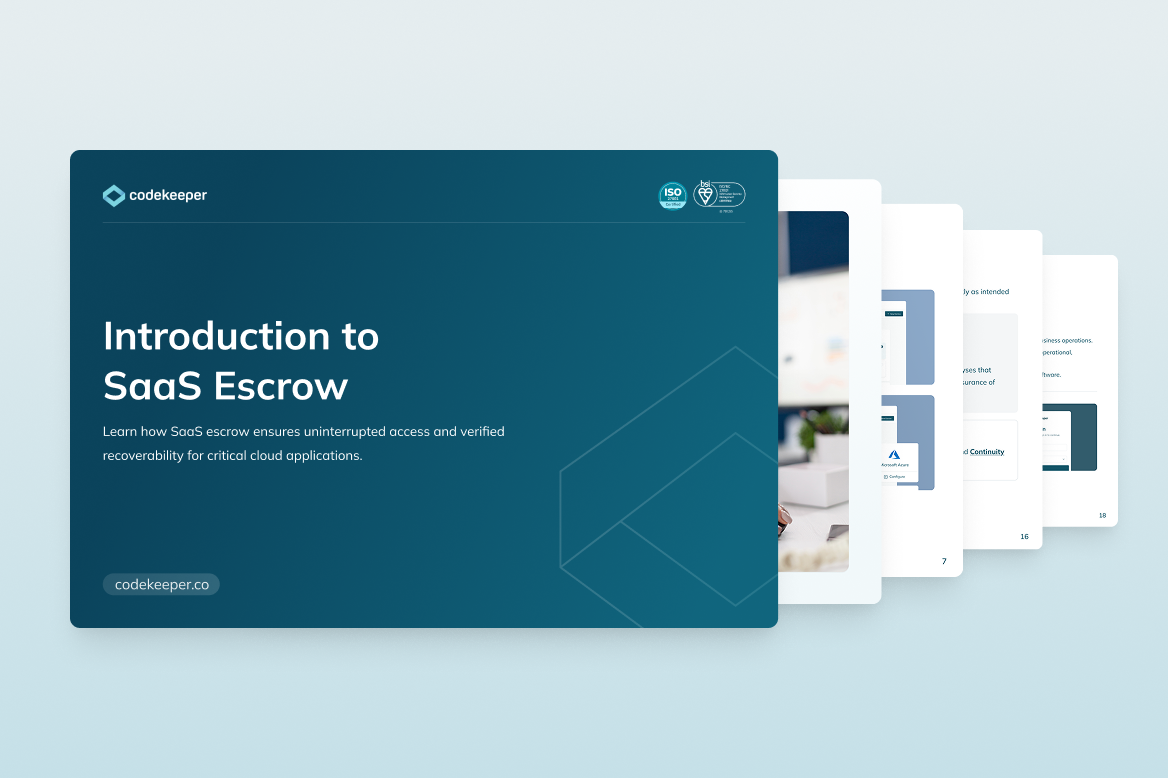
*E-book available only in English
Get your free introduction to SaaS escrow
READY FOR RECOVERY
Protect what makes deployments possible
- Always-current deployment materials
- Clear, predictable release workflows
- Independent assurance for build and deployment assets
