



Solutions Overview
Meet new operational resilience requirements with software escrow
Guarantee software availability and meet NIS2, DORA, and other compliance requirements with Codekeeper's escrow solutions.
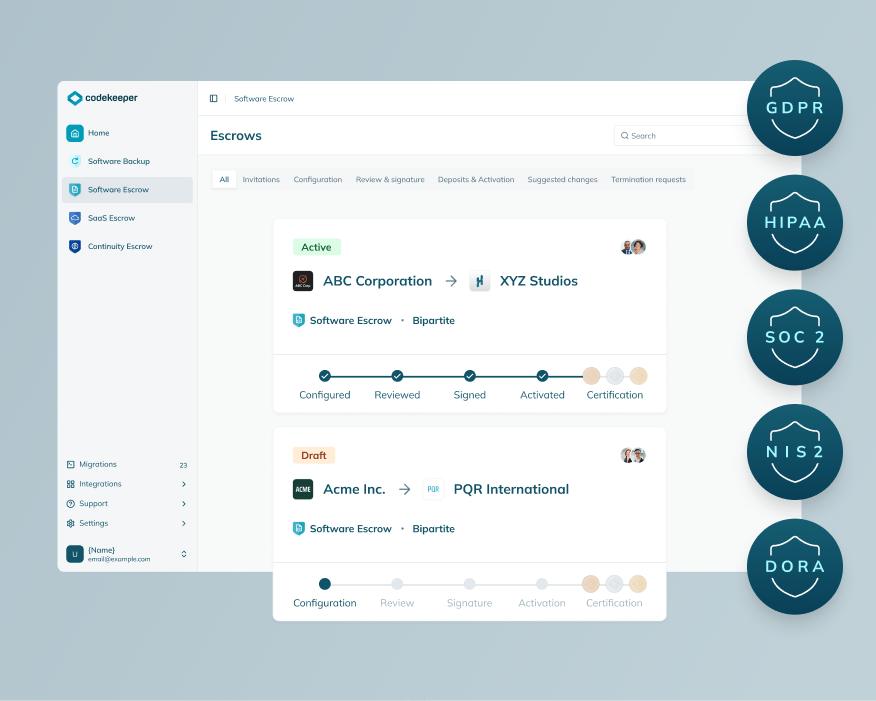
And now, regulators hold you accountable for these vulnerabilities.

Every minute of downtime costs thousands.

Every dependency is a potential weakness.

Every third-party service adds risk.

International standards demand documented business continuity procedures, including measures to protect against third-party vendor failures and maintain access to critical software systems.
Learn more
Top recommended solution set:

Software Escrow

Software Backup
Software Backup
Software Backup + Software Escrow

Certified












Uptime & availability
(99.9% uptime, MTBF metrics, failover systems)
(99.9% uptime, MTBF metrics, failover systems)
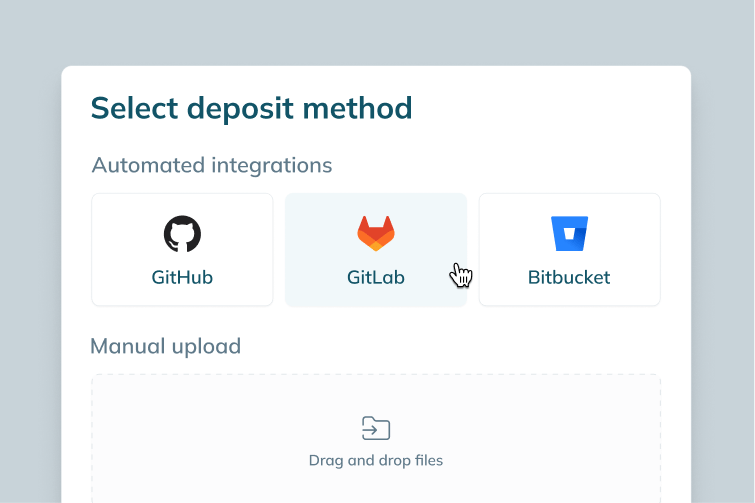
We keep your critical response systems ready for immediate deployment. When incidents occur, your teams have immediate access to everything needed for recovery. This enables the rapid response capabilities mandated by DORA and CPS 230.

Third-party risk management
(vendor assessment, API dependency tracking)
(vendor assessment, API dependency tracking)
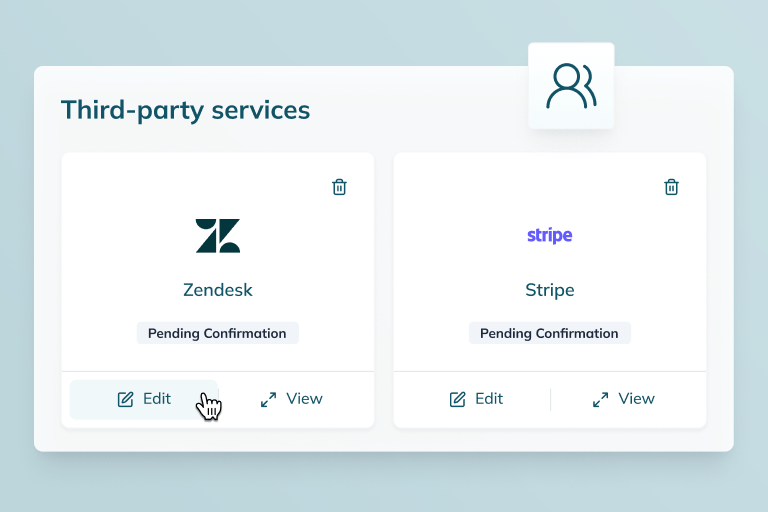
We secure all your critical APIs, libraries, and external dependencies. Stored in escrow, they give auditors concrete evidence of risk mitigation. We run rebuild tests that take it further, confirming the code recovers and mapping the result to your frameworks in an evidence pack.

Business continuity
(BCP testing, failover plans, tolerance levels)
(BCP testing, failover plans, tolerance levels)
Most regulations
We provide essential hosting and supporting services. If service payments are missed due to cash flow issues, vendor problems, or other circumstances, we step in to maintain those payments and keep your critical systems running without interruption.

Backup & recovery
(immutable backups, RPO/RTO controls)
(immutable backups, RPO/RTO controls)
Most regulations
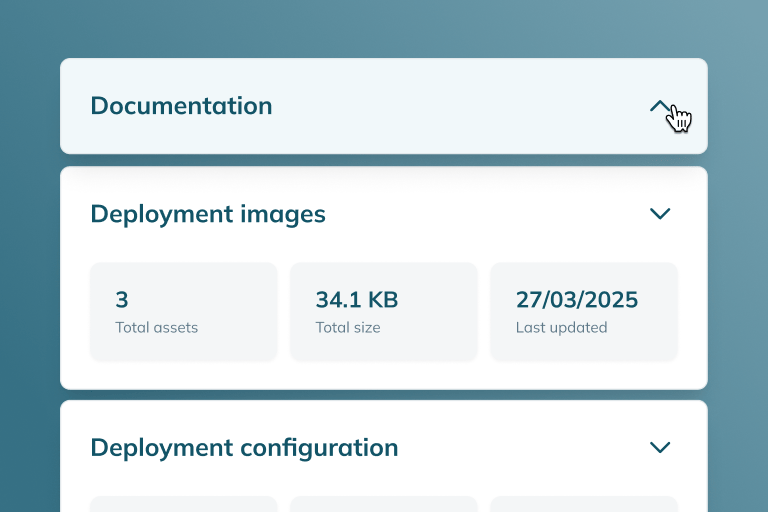
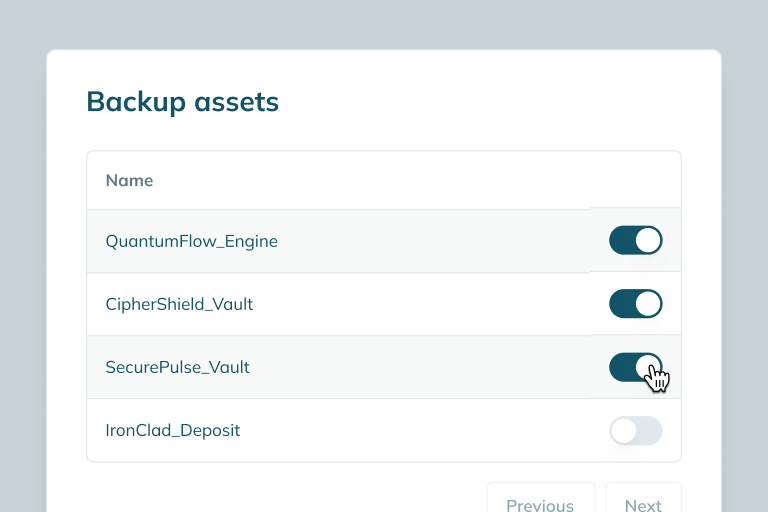
We maintain secure copies of your critical software source code, configs, and deployment documentation in escrow. When disruptions occur, you can access these escrowed materials to restore and maintain your systems independently.

Evidence packs
Build your compliance proof on tested recovery
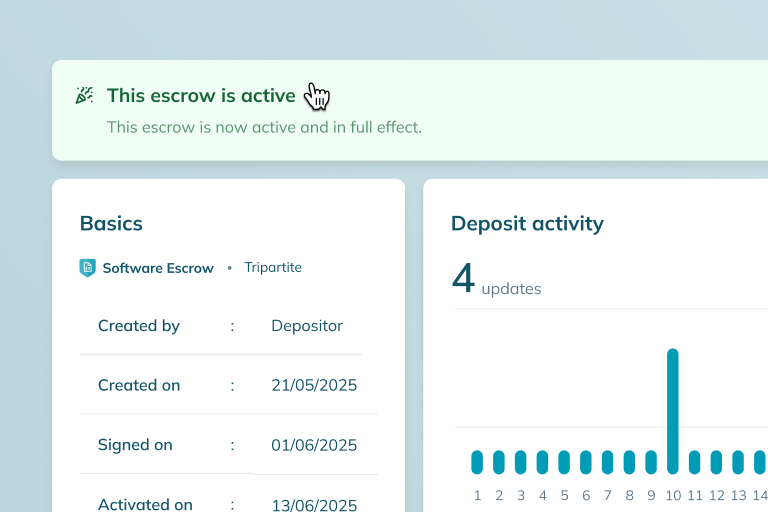
Compliance evidence is tricky to assemble, and getting it wrong can cost you: fines, re-audits, and suspended certificates. We can build that proof for you. You connect your systems; we test recovery from your escrow deposit and map the result to your required framework.

DORA · Article 28
Prove your exit strategy recovers
Article 28 expects a tested exit strategy for critical ICT providers. We rebuild your provider's software, confirm it runs, and certify the result.
- Exit strategy tested for each critical ICT provider
- Evidence aligned to your Register of Information entry
- Retesting scheduled around your review deadlines

NIS2 · ARTICLE 21(2)(D)
Back supplier resilience with tested proof
NIS2 holds your management body accountable for supplier resilience. We prove and document critical software recoverability for in-scope suppliers.
- Recovery proven for the software your suppliers control
- Each direct supplier relationship documented for the record
- Signed continuity records replace scattered supplier correspondence

ISO 27001 · A.5.30
Keep your ISO 27001 certificate valid
Control A.5.30 expects proof your recovery plan works. We rebuild critical software, time the recovery against your BIA targets, and map it to the control.
- Recovery timed against your business impact analysis targets
- Line-by-line evidence mapped to control A.5.30
- Retesting that holds up between surveillance audits

SOC 2 · CC9
Clear CC9 without stalling the report
For SOC 2 Type II reports, auditors test how you'd hold up if a critical vendor failed. We offer the CC9 evidence you need: a verified, signed recovery record.
- Vendor continuity verified for each subservice organization
- Each record cited to the CC9 criterion it satisfies
- Evidence that holds across a Type II observation period

FFIEC · NIST CSF 2.0
Close the recovery gap before the exam
FFIEC exams ask whether you can recover each of the vendor systems you depend on. We run recovery tests and compile the results in one examiner-ready document.
- Recovery mapped to the NIST CSF 2.0 Recover function
- Records tied to the IT Handbook booklets examiners work from
- Evidence scheduled to stay current ahead of every exam cycle
Not sure which pack your auditor will ask for?
Our free compliance scan asks a few quick questions about your business, then sends a list of the regulations you need to answer to.









Your current risk exposure
Your operational resilience plans contain critical blind spots that regulators specifically look for.
When vendors fail, you lack access to source code and deployment configurations needed for recovery.
Auditors flag your third-party risk management as insufficient under DORA and NIS2 requirements.
Your documented RTO/RPO metrics are unachievable when critical vendors disappear.
Financial penalties can reach €10 million or 2% of global turnover under strict EU regulations.

With Codekeeper's software resilience framework
Your operational resilience documentation references actual, verified recovery capabilities.
When vendors fail, you have immediate access to everything needed to maintain operations.
Auditors recognize your comprehensive third-party risk controls across all critical systems.
Your business continuity plans include realistic, tested recovery paths with achievable metrics.
You demonstrate full compliance with even the most demanding regulatory frameworks.
Ready to secure your operational resilience?
See how Codekeeper's escrow solutions get you ready for:


