Get your supply chain resilience ISO 27001-ready with software escrow
Secure vital information assets with Codekeeper's software escrow solutions to build ICT supply chain security that aligns with ISO 27001 standards.
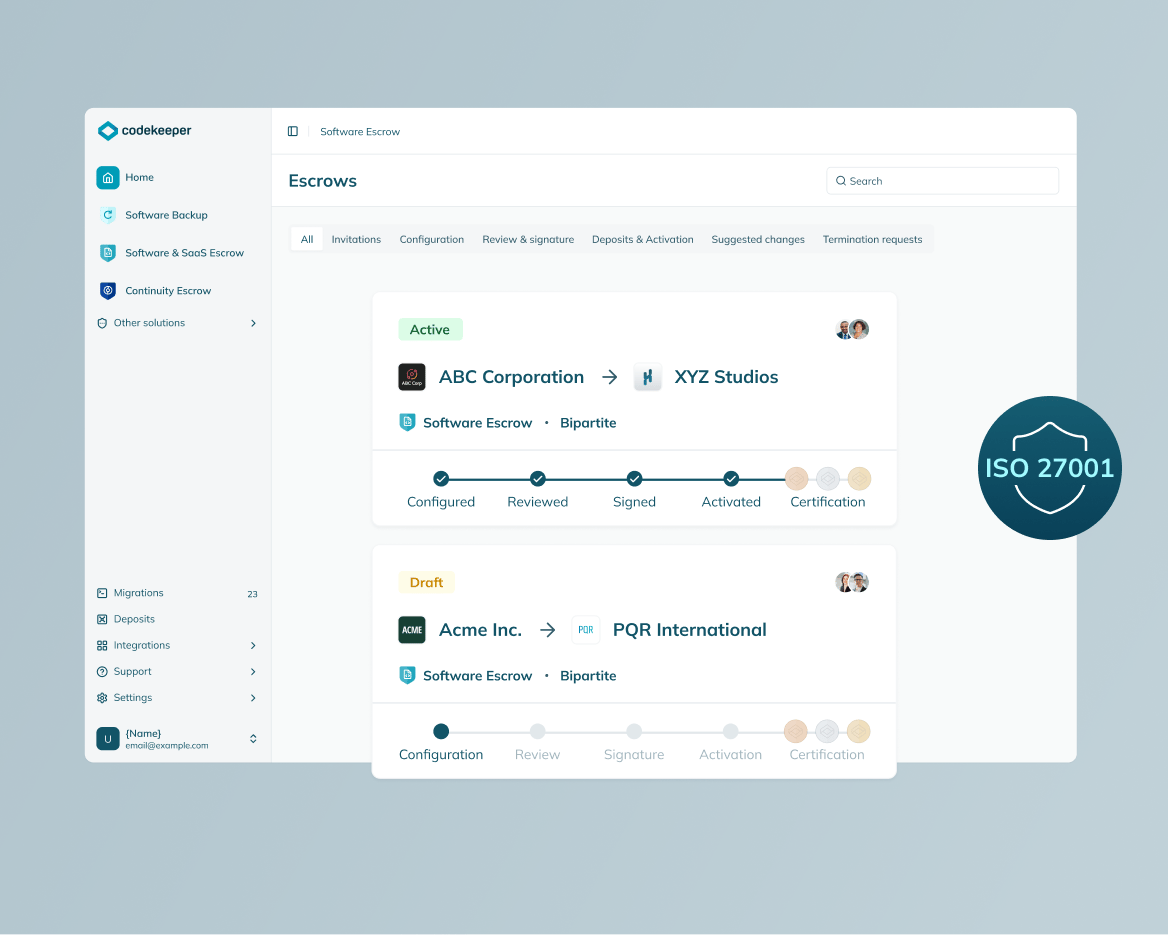
If your critical software suppliers fail, your ISO 27001 controls will fall apart. This cascades into compliance gaps (failing to meet FCA or PRA operational resilience rules), exposed systems, and forfeited certifications that wreck credibility.
ISO 27001: The key facts
What is ISO 27001?
Who's obligated to meet ISO 27001 requirements?
ISO 27001's core requirements
Understanding the software escrow — ISO 27001 link
ISO 27001 risk
Software escrow solution
Compliance outcome
Let us get you ready for ISO 27001
The Codekeeper escrow line-up for your ISO 27001 compliance
Protection scope: On-premises software and applications
Protection scope: Cloud-based applications and services
Protection scope: Supporting infrastructure and services
Protection scope: All escrowed materials
Reach ISO 27001 readiness in 4 quick steps
Book your ISO 27001 assessment call
We'll evaluate your vendor portfolio and pin down which applications need escrow protection to satisfy ISO 27001's supplier relationship requirements.
Choose your escrow protection plan
Pick standard software escrow protection, or layer on verification testing for fuller evidence of recovery capabilities and risk management controls.
Wrap up implementation with our support
Our specialists will handle supplier arrangements, draw up legal frameworks, and set up automated processes — all without adding load to your internal teams.
Collect your compliance documentation
Receive verified proof of your supplier risk management capabilities along with Software Resilience Certificates for audit evidence.
Codekeeper takes the weight off your compliance team
ISO 27001:2022 milestones
-
October 2022
ISO 27001:2022 published, with revised Annex A controlsOrganisations commence transition planning from the 2013 version -
April to May 2024
Last date for new ISO 27001:2013 certificationsAll certification bodies move to the 2022 version for new audits -
31 October 2025
Existing ISO 27001:2013 certificates expireOrganisations required to complete recertification to the 2022 version or lose certification -
Ongoing from 2025
Surveillance audits run against the new control frameworkManagement reviews and risk assessments required to keep certification
October 2022
April to May 2024
31 October 2025
Ongoing from 2025
What poor information security management costs you
Keep supplier failures from derailing your ISO 27001 certification. Secure your supplier risk management now.
The CRA: your full guide to compliance
Close the recoverability gap in your ISMS: Download the ISO 27001 guide
What ISO 27001 readiness does for you
Tighten risk management and avoid incidents
Earn stakeholder trust and market standing
Build operational resilience at the system level
Protect your supplier relationships to safeguard your operational resilience
Good questions to ask first.
What is ISO 27001 in a nutshell?
ISO 27001 is the international standard for information security management. It lays out a methodical framework for protecting your data through systematic risk assessments and security controls. Getting certified is voluntary, but it's the global standard to prove your organisation manages information security in line with established best practices.
What are the three principles of ISO 27001?
The three principles of ISO 27001 form the CIA triad. Confidentiality restricts information access to authorised people, Integrity maintains data accuracy and completeness, and Availability keeps information accessible when needed. All three guide every security control and risk management decision inside your ISMS.
Is ISO 27001 hard to get?
ISO 27001 certification is achievable, typically within six to 18 months. The determining factor is understanding why your organisation needs an ISMS and how it aligns with the standard's requirements. Building an effective one calls for ongoing commitment to continuous improvement and security integrated into every business decision.
What is the difference between ISO 27001 and SOC 2?
ISO 27001 and SOC 2 answer to different scopes and different audiences. Any organisation can pursue ISO 27001, and doing so means standing up a comprehensive information security management system: a risk-based framework with its own policies, procedures, and continuous improvement processes behind it. SOC 2 was written for service companies, and it examines the controls already running against fixed criteria covering security, availability, processing integrity, confidentiality, and privacy.
Why is software escrow important for ISO 27001 certification?
Software escrow matters to ISO 27001 because two of the standard's requirement areas, supplier relationship management and business continuity planning, depend on whether recovery is possible. A deposit keeps source code and recovery materials within reach after a critical software supplier fails, which gives certification bodies auditable evidence of third-party risk mitigation rather than an assurance that the risk was considered.
Can Codekeeper help with ISO 27001 readiness?
Yes. Our specialised software escrow solutions were built around the ISO 27001 control requirements covering supplier relationships and operational resilience. We hold and protect your critical software assets, our in-house legal team drafts the framework for supplier risk management, and the compliance documentation you get back takes in Software Resilience Certificates.
Which jurisdiction governs a Codekeeper escrow agreement?
Jurisdiction over a Codekeeper escrow agreement is set by you, with English law available wherever the agreement is UK-based. Drafting sits with our in-house legal team, who return the agreement within 24 hours, which keeps your solicitors and procurement team on familiar legal ground from the first read.
Does ISO 27001 certification satisfy UK operational resilience rules?
ISO 27001 certification and UK operational resilience rules are separate obligations, so holding one does not discharge the other. Firms under FCA and PRA rules have to identify important business services, set impact tolerances, and manage third-party dependencies, none of which the standard addresses directly. Software escrow is where the two meet. A tested deposit of the software behind an important business service evidences the supplier risk control your ISMS documents, and gives you something concrete to show a supervisor asking how that service would be restored.