What is AI escrow?
AI escrow is a legal arrangement where an AI vendor or user deposits the components of their AI infrastructure — model weights, prompt engineering, training data, workflow configurations, agent logic, and deployment settings — with a neutral third-party agent. If the vendor fails, changes terms in a way that breaks operations, or ceases to support the AI stack, the escrow agent releases those materials so the AI systems can continue to be operated and maintained independently.
It works the same way as traditional software escrow, with a critical difference: the assets being protected are fundamentally different in nature.
Why AI escrow is different from software escrow
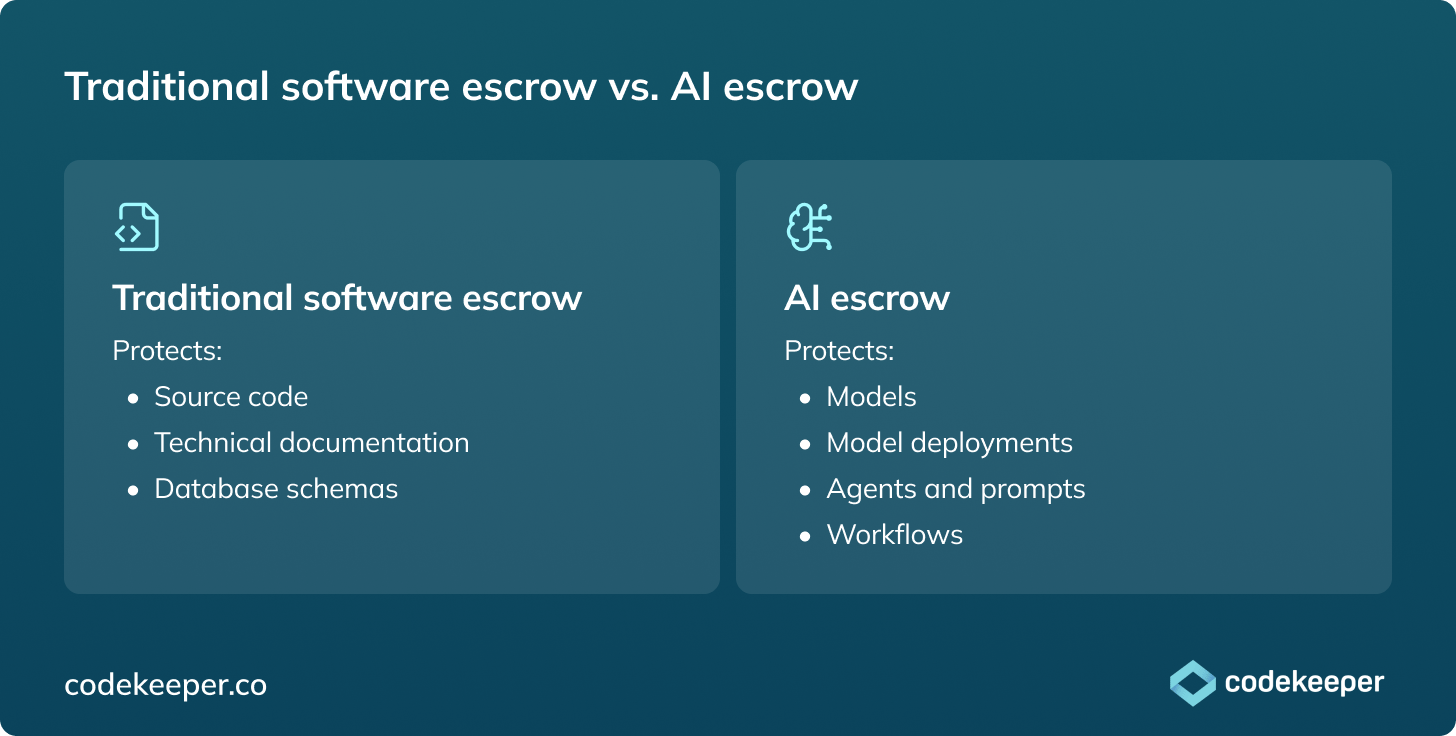
Traditional software escrow protects source code and documentation. SaaS escrow expands that to cover cloud environments, deployment configurations, and live data. AI escrow goes further still, because what makes an AI system valuable isn't just the code running it; it's the intelligence built into it.
Consider what a mature AI deployment actually contains. There's the foundation model — often hosted and maintained by a third-party provider. There's the fine-tuning layer, which is trained on proprietary data and took significant time and compute to develop. There are system prompts, prompt chains, and agent definitions that encode months of engineering judgment. There are workflow orchestrations connecting the AI to other systems. And there are deployment configurations that make all of it accessible to the people and processes that depend on it.
Standard software escrow wasn't built to handle any of this. It doesn't know what model weights are, let alone how to store, verify, or release them. AI escrow is purpose-built for the full stack.

The AI risk businesses aren't accounting for
Most organizations understand, in theory, that vendor risk applies to software. Fewer have thought seriously about what it means for their AI stack.
The problem is compounded by how AI adoption typically happens. Businesses move fast. A team starts using an AI tool, gets significant productivity gains, builds workflows around it, and within a year has dependencies that would be genuinely painful to unwind. By then, the leverage to negotiate escrow terms is gone. The application is already embedded.
The underlying risks are real. AI companies operate on short runways. Platforms get acquired. Pricing changes overnight. Services get deprecated when providers decide to focus on newer models. In every one of these scenarios, the businesses that built on top of these platforms are left to manage the fallout with no recovery plan.
What makes AI dependencies particularly exposed is the non-reproducibility of the assets involved. If an AI vendor fails without escrow in place, what you've lost isn't just access to a service — it's the fine-tuning, the agent logic, the prompt architecture. Starting over means months of work.
What AI escrow deposits cover
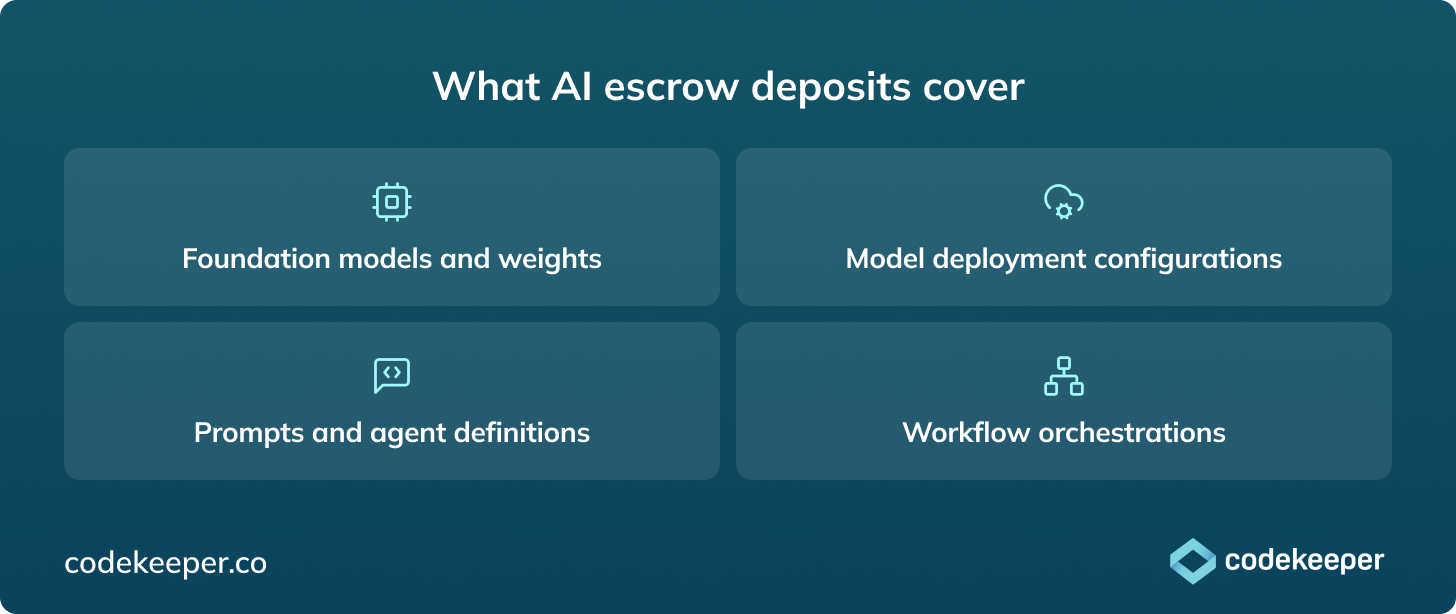
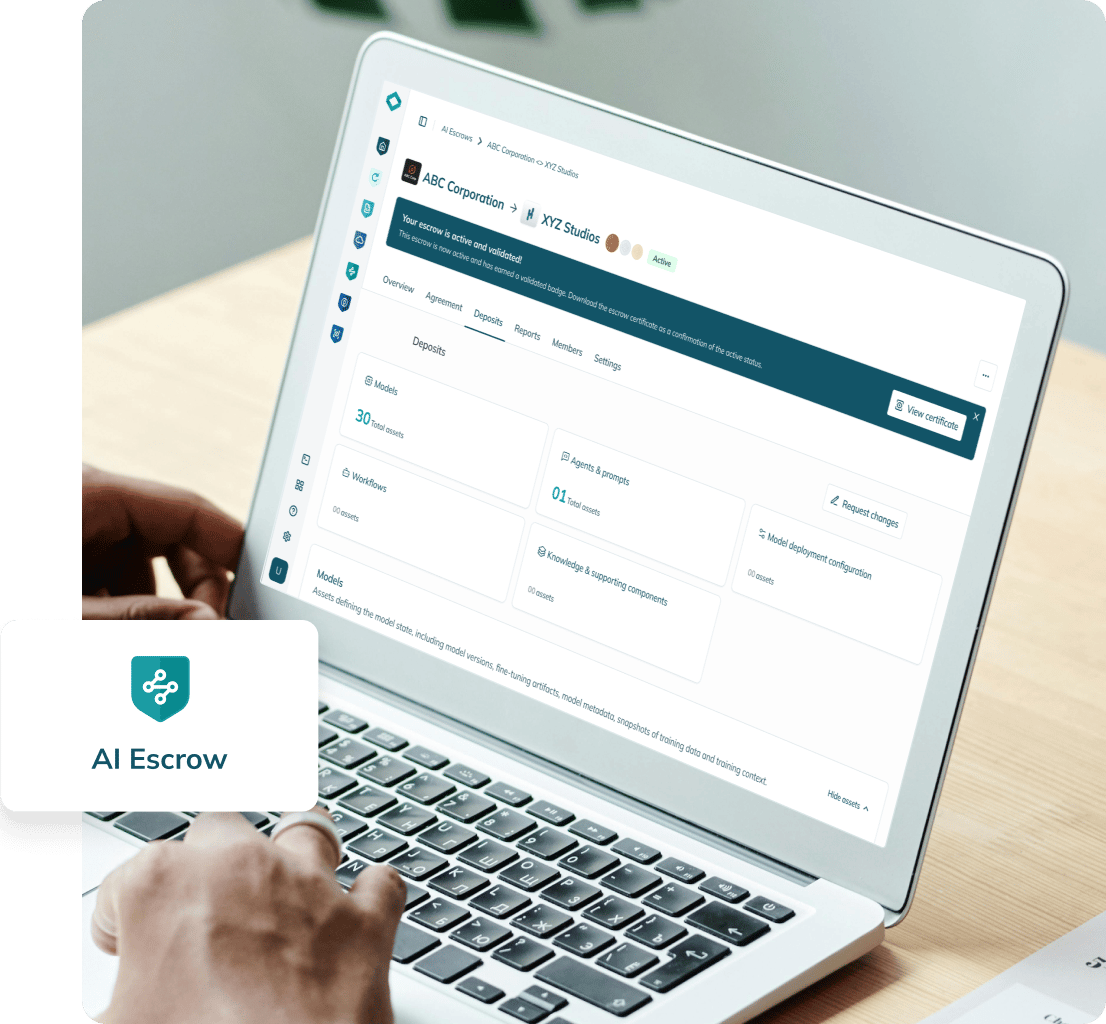
A complete AI escrow deposit covers the four layers of a production AI stack:
- Foundation models and weights: The base model or fine-tuned model versions the AI system depends on, including model weights, version histories, training data, and credentials. This is the intelligence layer — without it, the rest of the stack has nothing to run on.
- Model deployment configurations: API configurations, routing rules, rate limit settings, access controls, and infrastructure-as-code defining how the model is hosted and accessed. These are what allow the AI to be redeployed on different infrastructure if the original provider fails.
- Prompts and agent definitions: System prompts, prompt templates, prompt chains, agent logic, and tool definitions. For organizations that have invested heavily in prompt engineering, this layer represents significant intellectual effort, and it can be wiped out by a vendor decision with no notice.
- Workflow orchestrations: The configurations, integration mappings, and automation sequences that connect the AI to other systems and processes. This includes platform-specific workflow definitions from tools like Zapier, Make, n8n, and similar orchestration platforms.
Not every arrangement needs to cover every layer. The right scope depends on the architecture of the specific AI system and what would genuinely be required to operate independently. Getting this scoping right at the outset is one of the most important parts of setting up an AI escrow agreement.
How AI escrow works
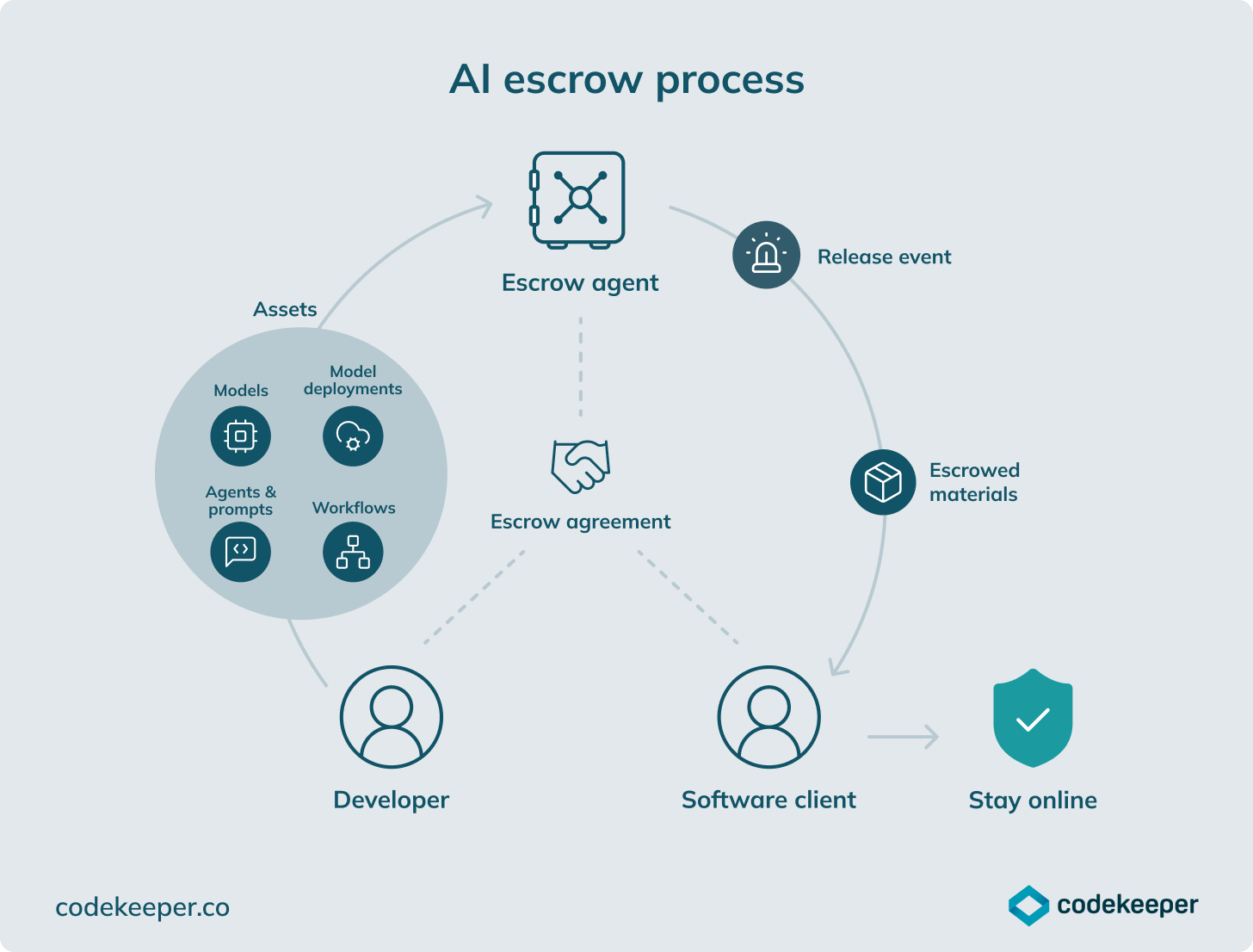
The arrangement follows the same three-party structure as all escrow agreements: the depositor (the AI vendor or the business that has built the AI system), the beneficiary (the business that depends on it), and the escrow agent who manages everything in between.
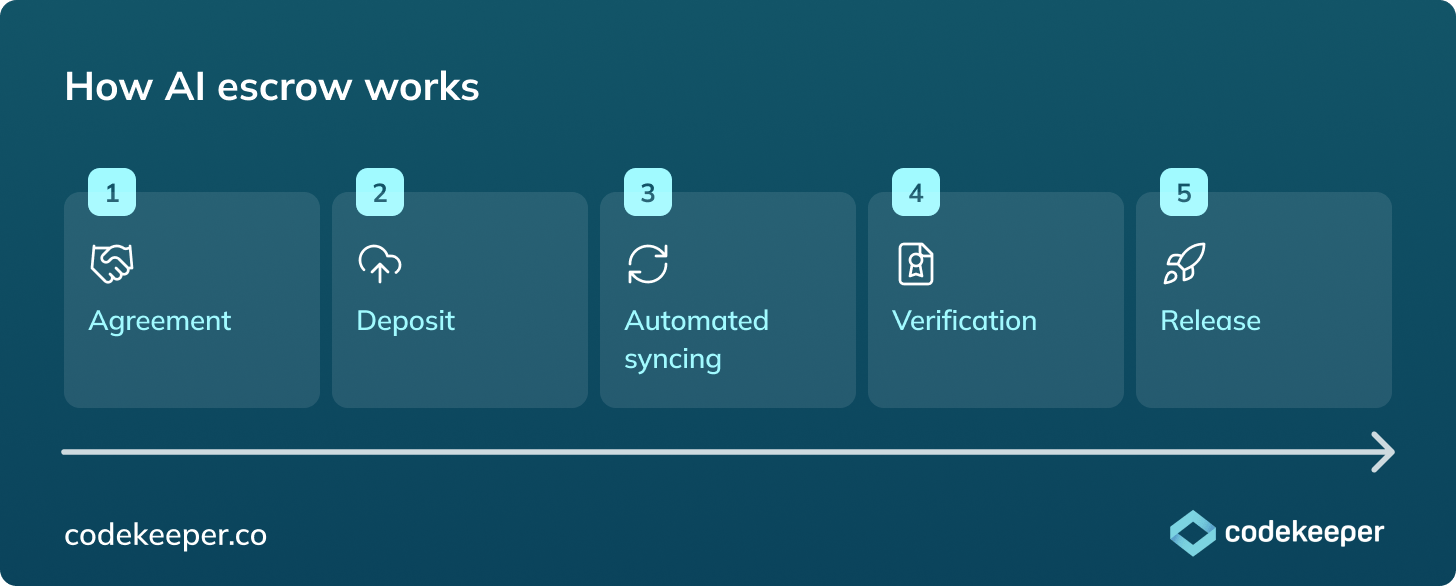
1. Agreement
A legal contract sets out what gets deposited, how often it's updated, and the specific conditions under which materials can be released. For AI escrow, this requires more careful scoping than traditional software escrow. The agreement needs to reflect the architecture of the AI system and account for assets — model weights, training data, prompt libraries — that standard escrow agreements don't typically address. Jurisdiction selection matters too, particularly for organizations with cross-border compliance obligations.
2. Deposit
The AI system owner deposits the full stack: models, fine-tuning data, prompts, workflows, deployment configurations, and credentials. The deposit needs to be comprehensive enough that a qualified team could take these materials and restore full operational capability without the original vendor.
3. Automated syncing
AI systems change constantly. New model versions get deployed. Prompts get refined. Workflows get updated. Keeping an escrow current requires automation — manual deposits fall out of date too quickly to be reliable. Codekeeper integrates directly with the platforms where AI assets live, syncing automatically on a daily basis so the escrow always reflects the current state of the system.
4. Verification
For AI escrow, verification goes beyond file integrity checks to include testing that the escrowed assets can be used to rebuild and run the AI system in a test environment. More on this below.
5. Release
If a qualifying event occurs, the beneficiary notifies the escrow agent and requests a release. The agent manages the process: notifying the depositor, allowing a dispute window, then coordinating secure delivery of the materials. For urgent situations, this process runs around the clock.
What triggers an AI escrow release?
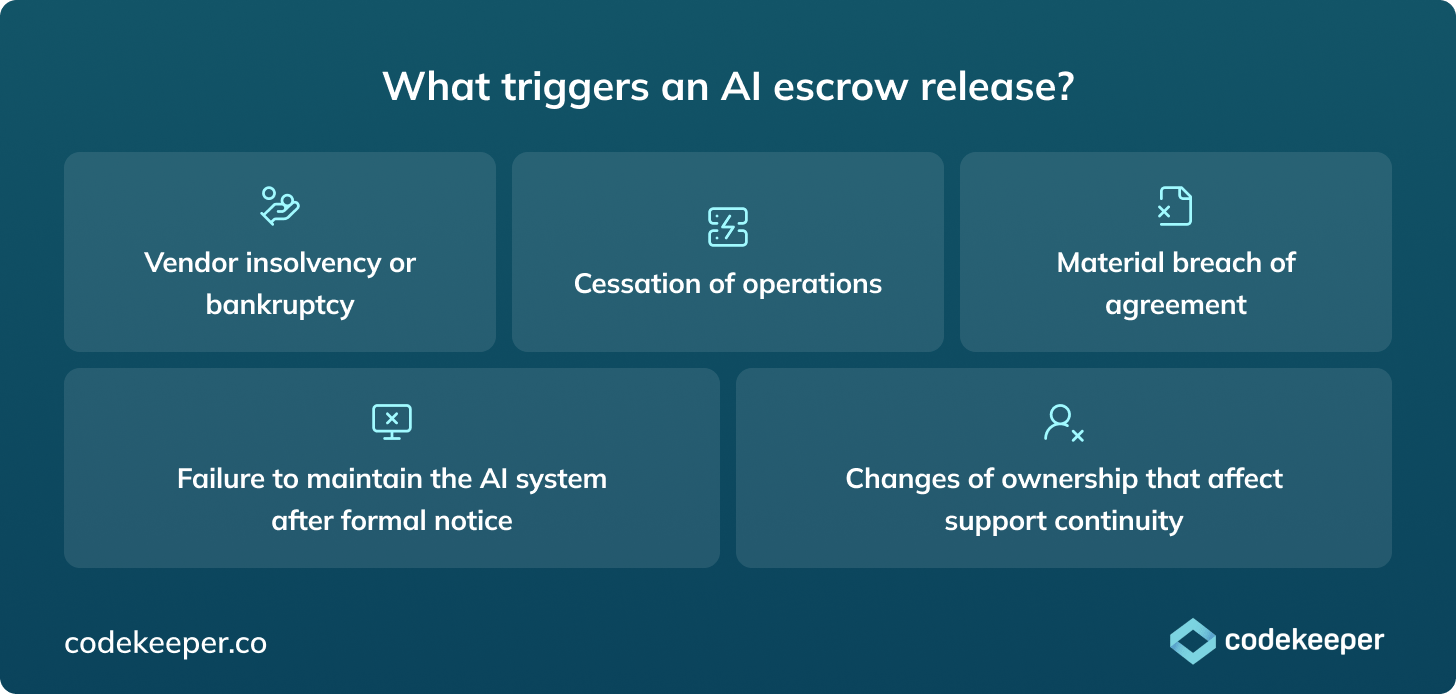
Release conditions are defined in the agreement upfront, and nothing gets released outside of them. Standard triggers apply:
- Vendor insolvency or bankruptcy
- Cessation of operations
- Material breach of agreement
- Failure to maintain the AI system after formal notice
- Changes of ownership that affect support continuity
For AI specifically, it's worth negotiating additional release triggers that account for the ways AI vendor relationships can break down short of outright failure:
- Unilateral model deprecation or replacement that materially affects system performance, without adequate transition time
- Pricing changes that exceed a defined threshold within a specified period
- Terms of service changes that restrict access to or use of fine-tuned models or training data
- Sustained degradation of model performance beyond agreed benchmarks
- Vendor discontinuation of the specific model version or API tier the system depends on
Note: Receiving the deposited materials doesn't transfer ownership of the underlying models or intellectual property. What the beneficiary receives is the right to use those materials for the specific purpose of maintaining and operating their AI system, as defined in the original agreement. Ownership of base models and foundation model weights typically remains with the model provider.
Who needs AI escrow?
The short answer is any organization where AI has moved from experimentation into production workflows needs AI escrow. When it's handling decisions, automating processes, or delivering services that the business depends on, the AI stack is no longer a nice-to-have — it's infrastructure. And like all critical infrastructure, it carries risk that needs to be managed.
For businesses that depend on AI: The key question is what would happen if your primary AI vendor failed or changed terms tomorrow. If the honest answer is "significant disruption," that's the case for escrow. It's especially pressing when fine-tuning or custom training has created AI capabilities that can't easily be replicated on a different platform, when the AI vendor is venture-backed or operating in a market that's actively consolidating, or when you're in a regulated industry where third-party AI risk is starting to attract regulatory attention.
For AI vendors and developers: Escrow works in both directions. Enterprise buyers — particularly in financial services, healthcare, and the public sector — are beginning to ask for AI escrow the same way they've asked for software escrow for years. Having it in place removes a barrier late in the sales cycle and signals something important: that you're confident enough in your own continuity to put it in writing.
AI escrow and regulatory compliance

DORA (EU Digital Operational Resilience Act)

EU AI Act

ISO 42001 (AI management systems)

FFIEC, PRA SS2/21, and other financial services frameworks
The broader trend is the same across jurisdictions: Know your AI dependencies, document your controls, and be prepared to demonstrate resilience if a vendor relationship ends unexpectedly. AI escrow provides the mechanism.
Verification and certification for AI escrow
Setting up an AI escrow agreement gives you the legal right to access your materials if something goes wrong. Verification gives you confidence that when you exercise that right, everything will work.
This is especially important for AI systems because the failure modes are more complex. A source code deposit that passes file integrity checks will probably build. An AI deposit that passes file integrity checks might still fail in practice if model weights are incomplete, if fine-tuning data references external dependencies that weren't captured, or if workflow configurations reference platform-specific features that don't translate to a new environment.
Codekeeper offers three verification levels for AI escrow:
- Validated uses automated scans to confirm all required materials were deposited and checks file integrity. It includes a Basic Software Resilience Certificate and is a solid baseline for lower-risk AI applications.
- Verified adds automated tracking of model changes and training data profiles over time. It includes an Enhanced Software Resilience Certificate and provides ongoing assurance that the deposit stays current as the AI system evolves.
- Certified is the highest level: expert engineers attempt to rebuild and run the AI system from the escrowed materials in an isolated test environment. They verify that models load correctly, prompts execute as expected, and workflows run properly — then issue a Premium Software Resilience Certificate documenting exactly what was tested and confirmed. For mission-critical AI systems where recovery needs to be provable, this is the right choice.
How to set up AI escrow
Most of the work happens upfront. Get the scoping right — which systems, which assets, what recovery looks like — and the ongoing overhead is minimal.
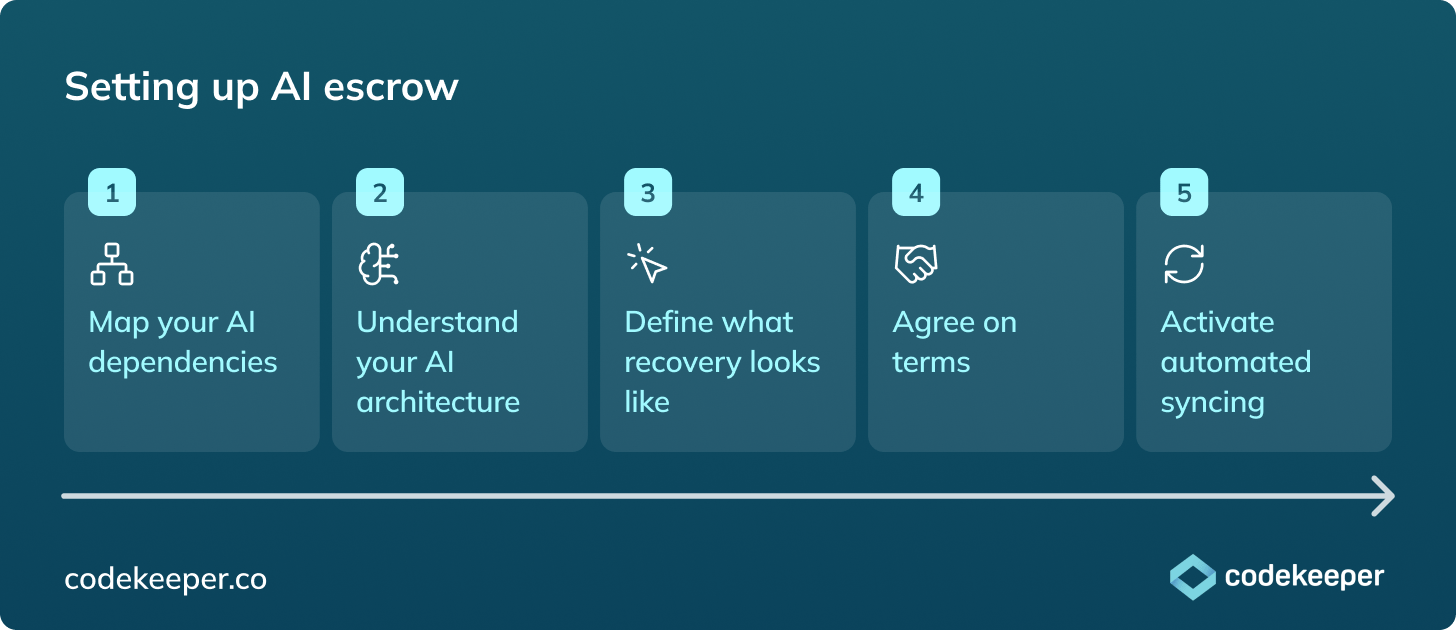
1. Map your AI dependencies
Which AI systems are now critical to operations? Which of those depend on third-party vendors for models, hosting, or orchestration? That's your starting list. If you want a structured approach, Codekeeper's risk assessment walks you through it and produces a report you can act on.
2. Understand your AI architecture
What models are you using, and are they hosted externally or self-deployed? What fine-tuning or custom training has been done? What platform handles orchestration and workflow? How is data structured and stored? These answers determine what the deposit needs to cover.
3. Define what recovery looks like
How quickly does the AI system need to be restored after a vendor failure? What does "operational" mean in that context? For systems where any downtime is unacceptable, this shapes both the deposit scope and the verification level you'll need.
4. Agree on terms
Agree on your AI escrow terms, ideally at the same time as the vendor agreement. It's significantly easier to get alignment before the system is embedded than to retrofit escrow later. AI escrow requires more technical scoping than traditional software escrow, so having an escrow provider involved early helps. Our in-house legal team handles agreement drafting and can facilitate the conversation between parties.
5. Activate automated syncing
Connect your platforms through Codekeeper's integrations. From that point, deposits update automatically on a daily basis without any manual intervention. Also, schedule verification reviews in line with your agreement terms and any audit cycles you're working to.
AI has become infrastructure. Protect it like one.
The vendors and platforms your AI depends on aren't guaranteed to stay operational, stay affordable, or stay cooperative. AI escrow is how you protect the work you've built on top of them.
Codekeeper's AI Escrow is made to protect the full stack — models, fine-tuning, prompts, workflows, and deployment infrastructure — with automated daily syncing and verified recovery certificates that prove your protection actually works.