
What is source code escrow?
Source code escrow is a legal arrangement where a software vendor deposits their source code and related materials with a neutral third-party agent, like Codekeeper. If the vendor goes out of business, fails to maintain the software, or breaches the agreement in a defined way, the escrow agent releases those materials to the customer so the software can continue to be maintained and operated independently.
To understand why that matters, it helps to understand what source code is.
Source code is the human-readable set of instructions developers write to build a software application. It's what sits behind every feature, every workflow, every integration a business depends on. Without it, fixing bugs, making changes, or moving the software to a new environment is effectively impossible. The vendor holds that code, and without an escrow arrangement, neither side controls what happens to it if things go wrong.
Source code escrow is one of the most direct ways to build software resilience into a business: keeping the software at the center of your business protected, accessible, and usable no matter what.
Source code escrow vs. software escrow: What's the difference?
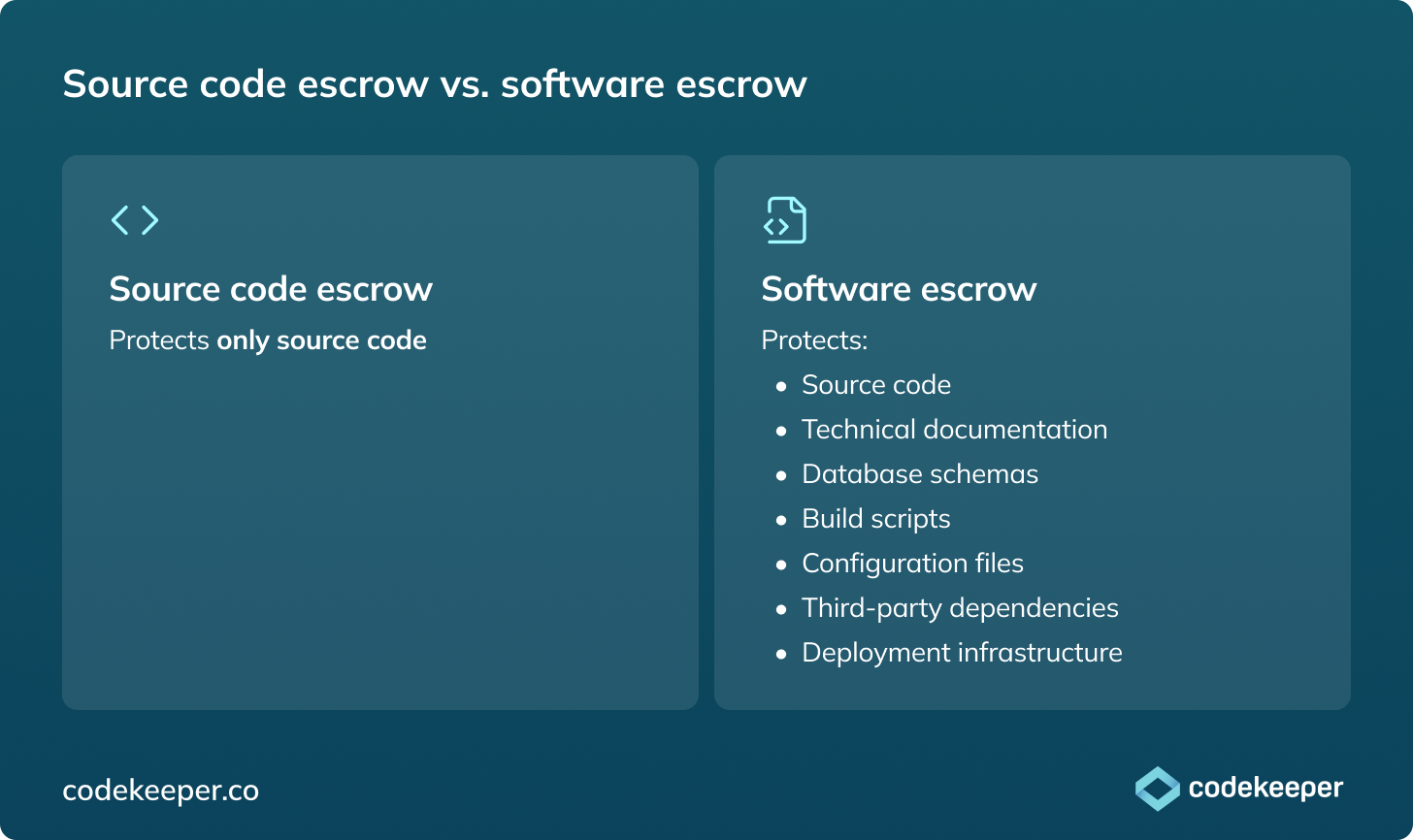
The terms source code escrow and software escrow are used interchangeably in most contexts, and for most purposes, they mean the same thing.
Source code escrow refers specifically to the protection of source code — the core asset at the center of any on-premise software agreement. Software escrow is the broader term. It covers not just source code, but everything else a developer would need to maintain and operate the application independently: technical documentation, database schemas, build scripts, configuration files, third-party dependencies, and deployment infrastructure.
In practice, when someone asks for "source code escrow" in a software contract, they're almost always describing a standard software escrow arrangement where source code is the primary protected asset, surrounded by the supporting materials that make it usable.
The distinction matters most when scoping what a deposit needs to contain. Source code alone is rarely sufficient. More on that below.
A license doesn't fully protect all sides of a software relationship
Most businesses assume a software license covers them if something goes wrong with their vendor. Most vendors assume their license protects their code. Neither assumption holds up in the scenarios that matter most.
A software license grants the right to use the application. It doesn't give the customer access to the source code, and it doesn't give the vendor a structured way to prove what they built, when, or under what conditions it can be accessed. The source code is the vendor's most closely guarded asset — years of development investment, accumulated expertise, and competitive advantage. Handing it over, even to a long-standing customer, is something most vendors resist. That resistance is reasonable. But it creates a gap.
If the vendor fails, the software stops being maintained. The customer has no way to fix bugs, make changes, or keep the application running long-term. Starting over is the only option, which is expensive, slow, and disruptive. And the vendor, if they're navigating insolvency or acquisition, has no controlled mechanism for what happens to their code next.
Source code escrow closes that gap for both sides. The code is held by a neutral third party. The vendor doesn't surrender their IP. The customer gains access only if a defined triggering event occurs, not on request, not out of convenience, only when the conditions written into a legal agreement are met. Both interests are protected.
What a complete escrow deposit contains
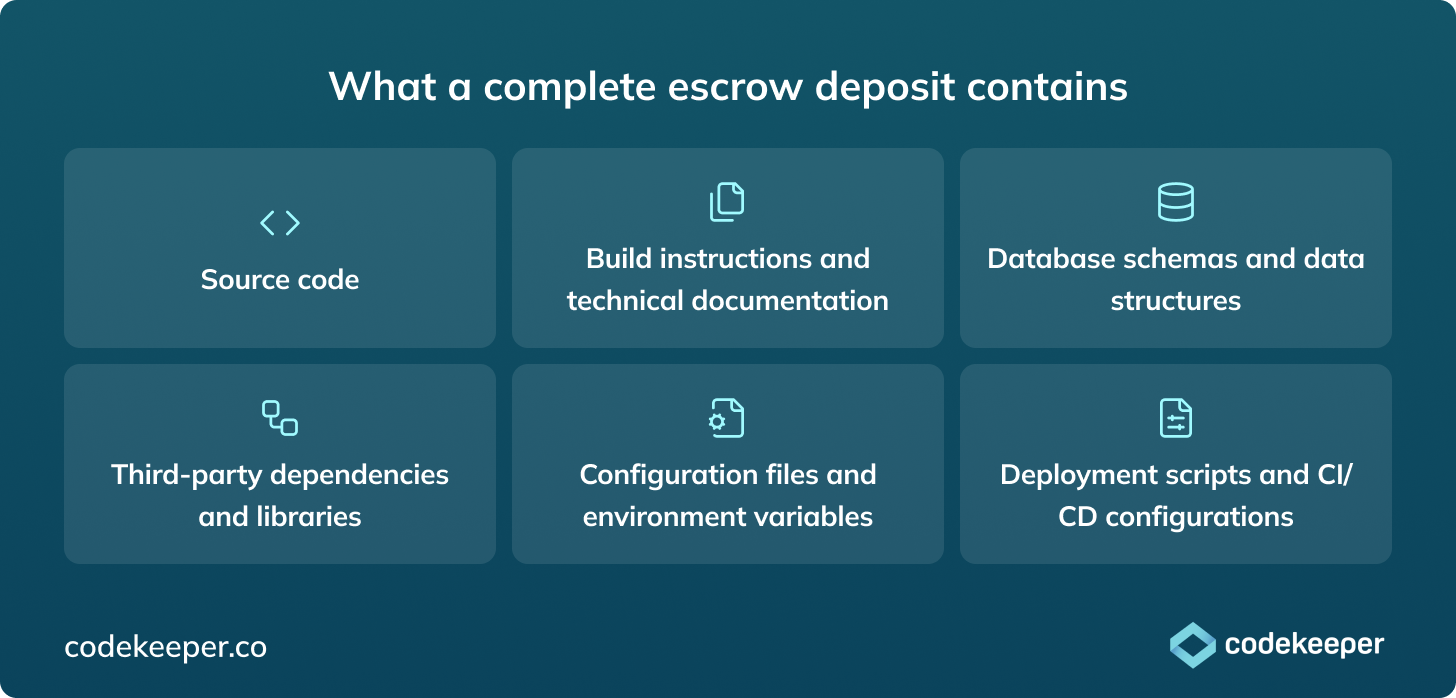
Source code alone is rarely enough to maintain a software application under pressure. A developer handed a codebase without context, documentation, or build tooling would struggle. And a business trying to keep mission-critical software running after a vendor failure would struggle more.
A complete software escrow deposit covers everything a competent developer would need to take over maintenance — and everything you'd need to hand over if it came to that.
- Source code: The deposit should reflect the full development history, including all versions and branches relevant to the customer's version of the software.
- Build instructions and technical documentation: Step-by-step instructions for compiling the source code into a working application.
- Database schemas and data structures: The structure of the data that the application relies on. Without this, the source code may be present, but the application can't be stood up.
- Third-party dependencies and libraries: External components the software relies on. Dependency management is one of the most common failure points in real-world escrow releases. If the versions aren't documented and accessible, the application may not compile.
- Configuration files and environment variables: Settings that define how the software behaves across different environments. These are routinely overlooked in initial deposit scoping and routinely missed when recovery is attempted without them.
- Deployment scripts and CI/CD configurations: The tooling needed to build, test, and deploy the application. In modern software development, deployment pipelines are as important to recovery as the code itself.
Getting this scoped correctly upfront — in the escrow agreement — is one of the most important steps in setting up an arrangement that works for you in practice.
Types of source code escrow agreements
Source code escrow can be structured in several ways. The right approach depends on your software relationship and the nature of the code you're protecting.
Tripartite agreement
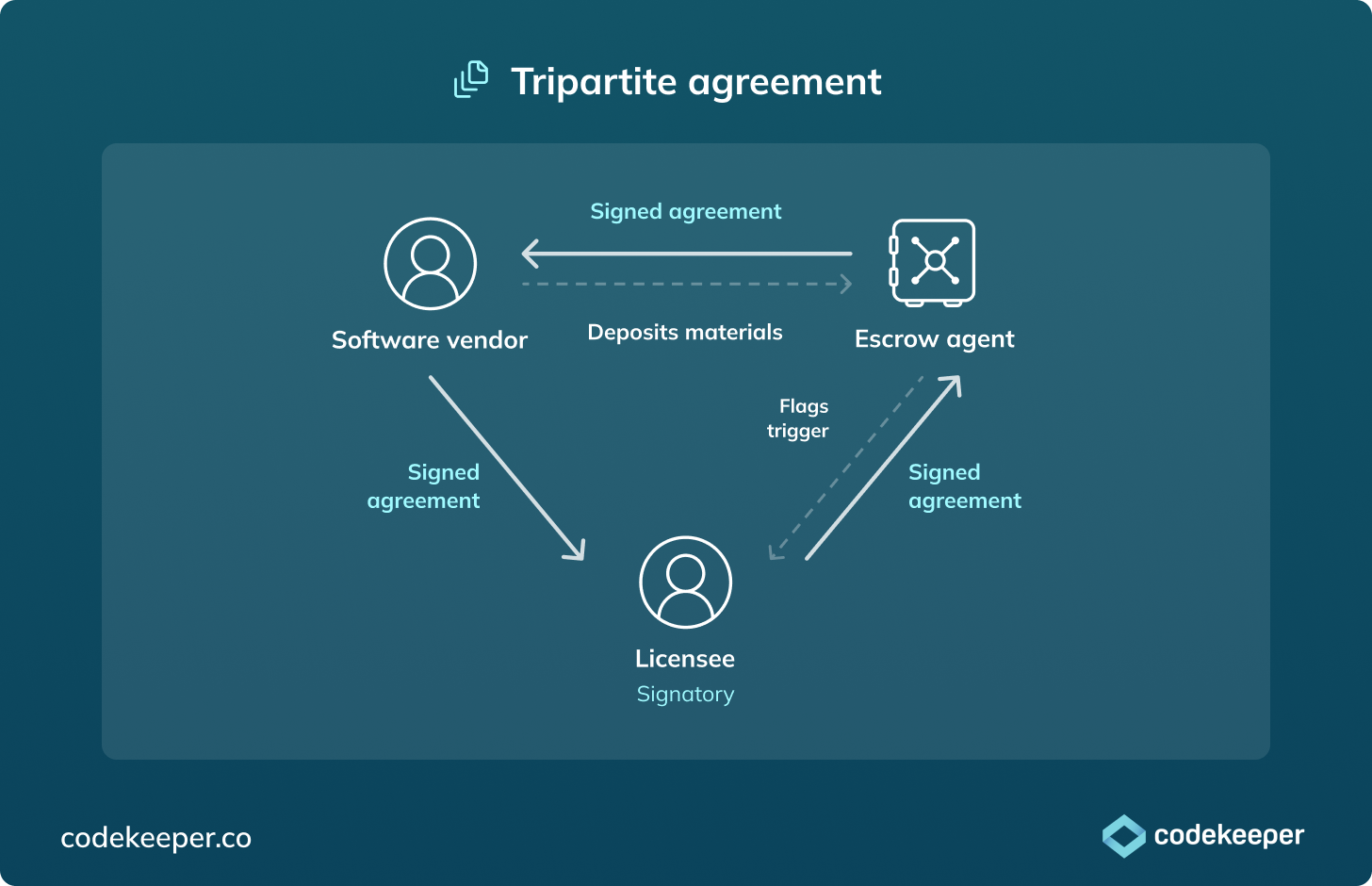
The most common commercial model. A three-party contract signed by the software vendor, the customer, and the escrow agent. The agent takes an active, independent role: holding materials securely, managing deposit updates, and overseeing the release process if a triggering event occurs. This is the arrangement that provides the strongest protection for both parties, because the escrow agent's obligations are contractually defined and independent of either side.
Bipartite agreement
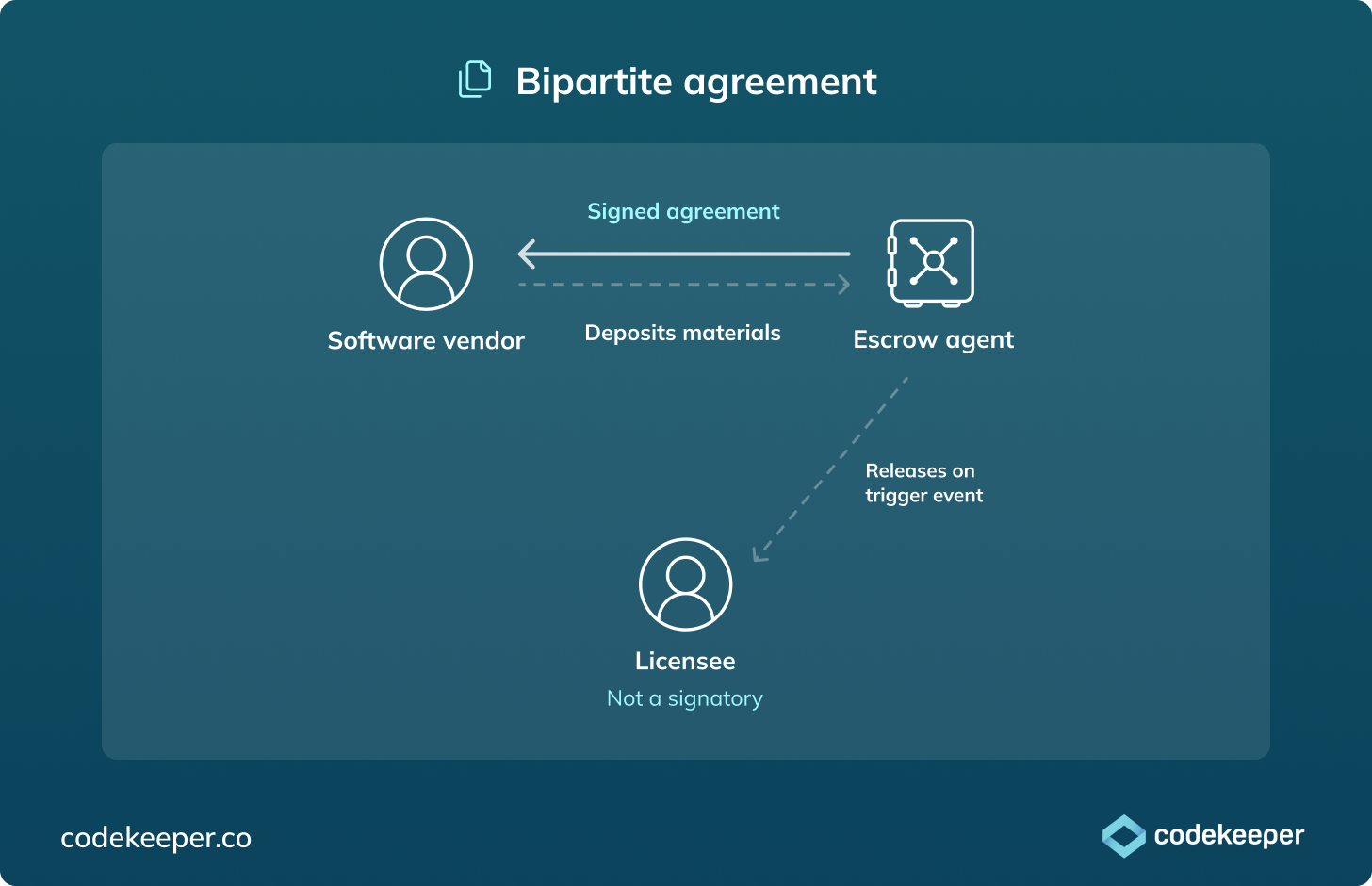
A contract between the vendor and the escrow agent, with the customer named as beneficiary but not a signatory. The vendor and agent manage the arrangement directly, which can streamline setup, but the customer has less formal standing in the process. Common where a vendor needs escrow in place for multiple clients on the same application.
Access clause
A provision embedded within an existing license or maintenance agreement rather than a standalone document. Easier to set up, but typically less robust — the terms are harder to negotiate separately, and the arrangement is only as strong as the underlying contract.
For most enterprise and regulated-market arrangements, a tripartite agreement with an independent escrow agent is the appropriate choice. The independence of the agent is what makes the arrangement credible and enforceable when it matters.
How source code escrow works
A source code escrow arrangement typically involves three parties: the software vendor, the business using the software, and a neutral escrow agent who sits in the middle and manages everything.
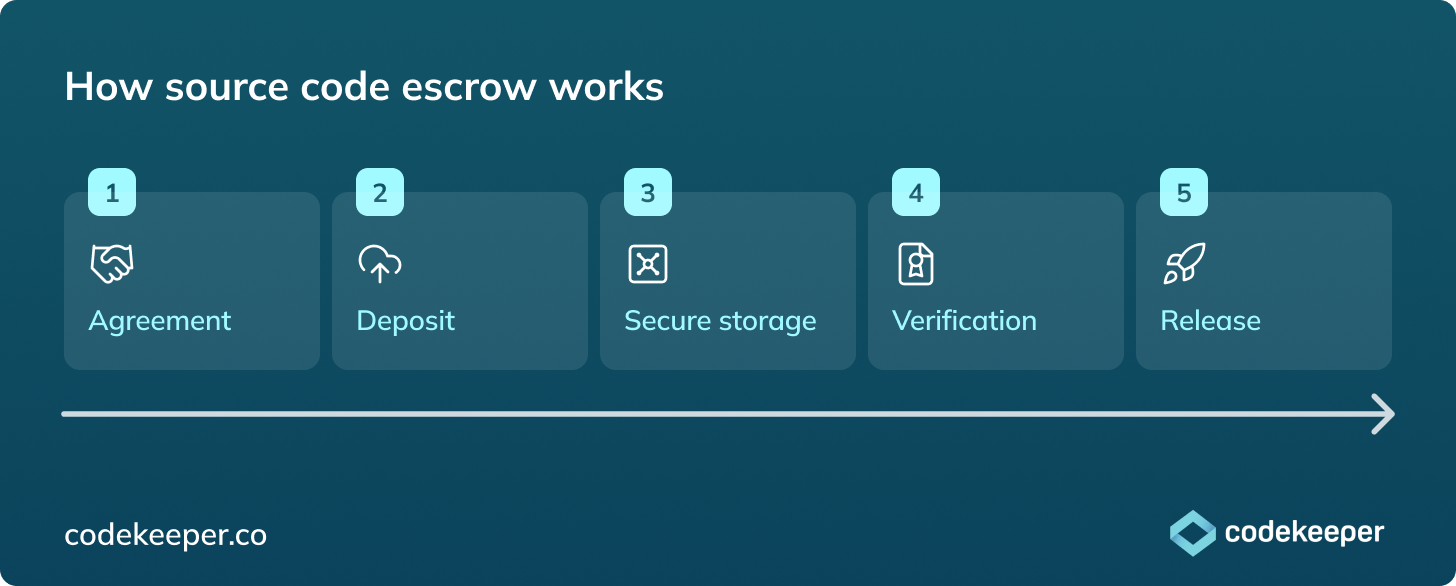
1. The agreement
All parties sign a legal contract that defines what gets deposited, how often deposits are updated, and under what circumstances materials can be released. Release conditions are negotiated upfront and written into the contract. Nothing gets released outside of them.
2. The deposit
The vendor deposits the source code and all agreed-upon supporting materials. For actively developed software, deposits need to stay current. A snapshot from two years ago provides little protection if the software has changed significantly since then. The most reliable approach is automated deposits, integrated directly with your version control system, so updates happen without manual intervention.
3. Secure storage
Deposited materials are held in encrypted, geographically redundant storage by the escrow agent. Neither party can access them unilaterally — that's the point of a neutral third party.
4. Verification
Depositing materials gives legal protection. Verification gives certainty. An independent technical review confirms the deposited materials are complete, current, and sufficient to build and run the software. More on this below.
5. Release
If a qualifying event occurs, the beneficiary notifies the escrow agent and submits a formal release request. The agent notifies the vendor, who has a defined window to dispute. Disputes that aren't resolved directly typically move to arbitration. If undisputed — or resolved in the customer's favor — the agent coordinates secure delivery of the materials.
This process protects vendors from bad-faith release requests while giving customers a clear, enforceable path when something genuinely goes wrong.
Receiving the deposited materials doesn't transfer ownership of the source code or create new intellectual property rights. What the customer receives is the right to use the code for the specific purpose of maintaining and operating the application, as defined in the original license. The vendor retains their intellectual property. The agreement should reflect this clearly.
What triggers a source code escrow release?
Release conditions are the specific events that give a beneficiary the right to request the deposited materials. They're defined in the agreement upfront; nothing happens outside of them.
The most common release triggers are:
- Vendor insolvency or bankruptcy
- Cessation of business operations
- Failure to provide agreed maintenance or support after formal written notice
- Material breach of the software license agreement
- A change of ownership where the new owner doesn't honor existing support obligations
- Persistent, documented failure to meet agreed SLAs
These can be customized. Depending on the nature of the software and the relationship between the parties, additional triggers, such as the departure of key personnel essential to software maintenance, or a vendor's failure to keep the deposit current, can be negotiated into the agreement. Getting the release conditions right at the start, when leverage exists on both sides, is worth the effort.
Verification and certification
Depositing code is not the same as depositing working code. Until someone has tested the deposited materials, there's an open question about whether the source code is complete, the build instructions are accurate, and all the dependencies are present. For mission-critical software, that question is worth answering before a release event forces the issue.
Codekeeper offers three verification levels, plus a tailored option.
- Validated confirms that materials have been deposited and checks file integrity. A solid starting point for lower-risk software.
- Verified adds automated analysis of the deposit's content and development activity — a clearer picture of what's been stored, how current it is, and whether it reflects the actual production version of the software.
- Certified adds expert human review and a full build test. Specialist engineers compile and run the software from the deposited materials to confirm it produces a working application. For mission-critical software, this is the level that makes recovery provable rather than assumed.
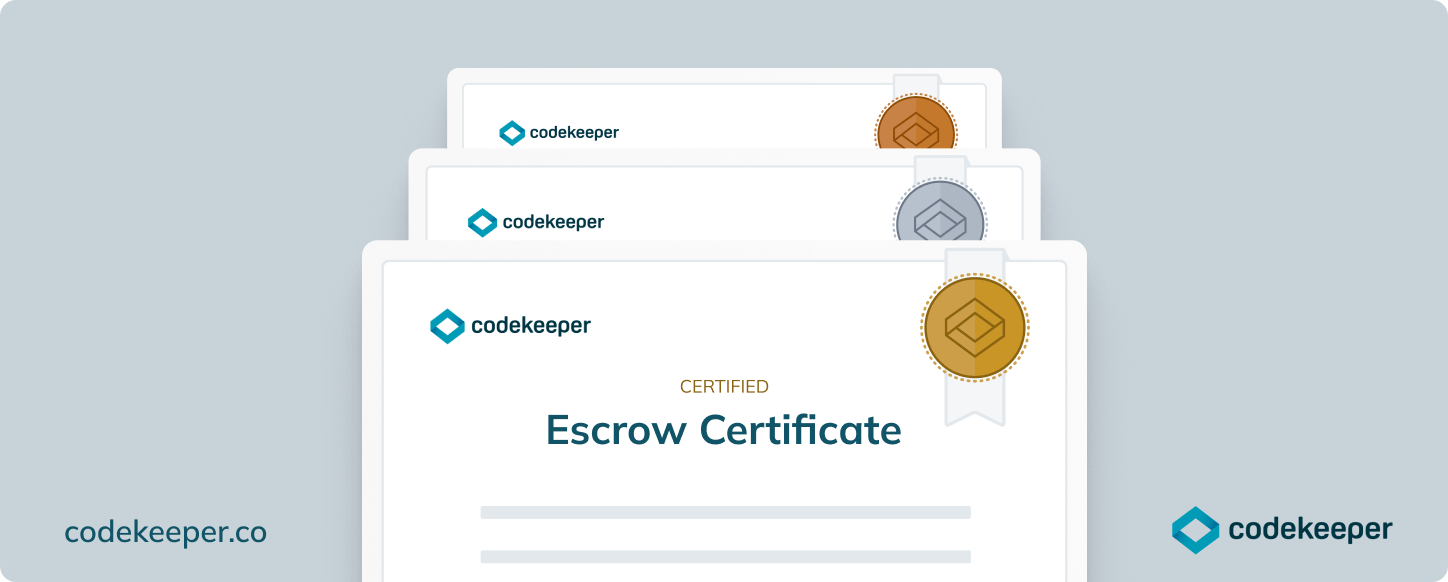
Each verification produces a Software Resilience Certificate — a formal document recording what was tested, what was found, and what the outcome was. For vendors, it's a credible signal to prospective customers that the escrow arrangement is real and tested. For buyers in regulated industries, it's evidence that continuity planning holds up under scrutiny.

Who needs source code escrow?
The short answer: anyone on either side of a software agreement where continuity matters.
If you depend on software someone else built, the question is simple: What happens to operations if that vendor disappeared tomorrow? If the honest answer is "serious trouble," that's the case for escrow. It matters most when the software is mission-critical, when it's been customized for a specific environment or processes, when the vendor is small, venture-backed, or operating in a consolidating market, when there's been a significant implementation investment, or when regulatory obligations around third-party software risk apply.
If you build software for others, escrow serves a different but equally practical purpose. Enterprise buyers — especially in regulated industries — often won't sign without it. Having escrow in place removes a common objection late in the sales cycle and signals something that's hard to fake: that you're confident enough in your own continuity to put it in writing. It's also a way to control how your IP is handled if something does go wrong; the code is released under defined conditions, not seized or lost.
How to set up source code escrow
Setting up escrow can be easy and very straightforward. The main effort is upfront — getting the agreement right and making sure the deposit is properly scoped. After that, it largely runs itself.
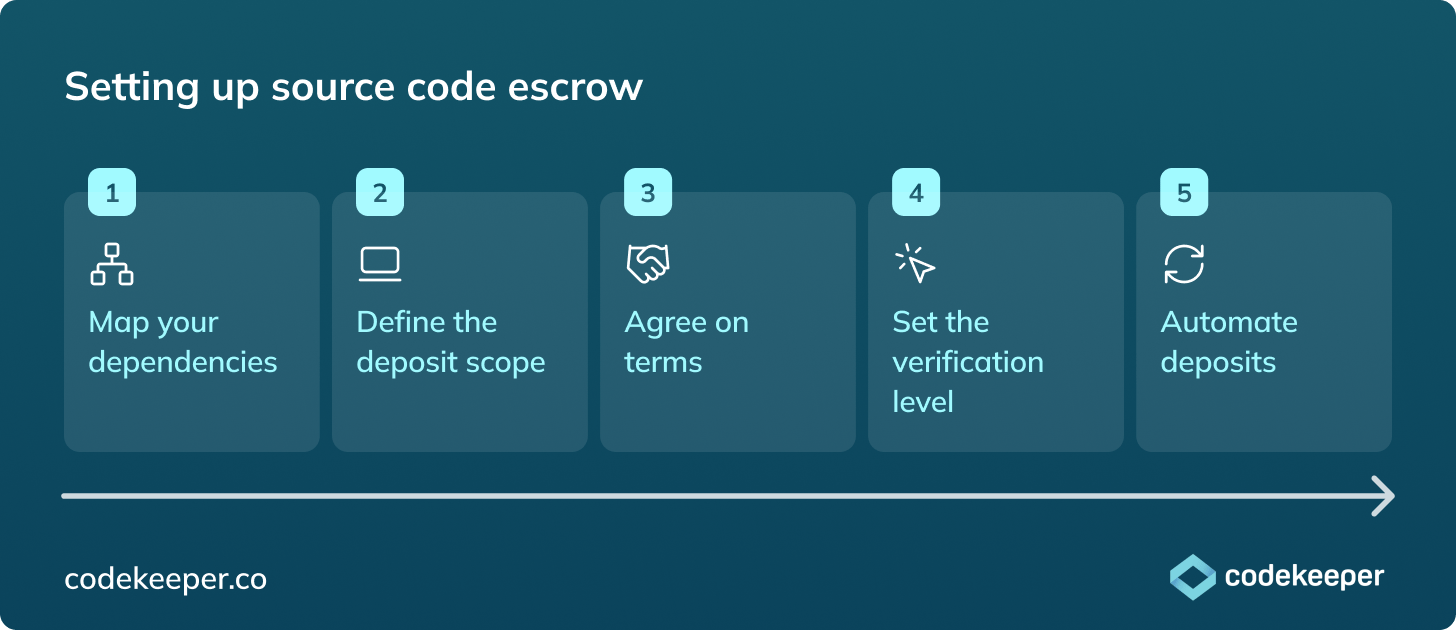
1. Map your dependencies
Which applications would cause serious operational or financial damage if they became unavailable? Which of those are built and maintained by a third party? That's the starting list. Codekeeper's risk assessment walks through this systematically and produces a report to act on.
2. Define the deposit scope
3. Agree on terms
4. Set the verification level
5. Automate deposits