


 European Union


 Global standards


 US

 UK

 Australia

 Netherlands


01 · Software users
You rely on the software.
Asked by auditors, risk teams, and your board.
- Know the software you depend on can be rebuilt
- Answer audit and risk reviews with dated evidence
- Spot gaps while the vendor can still fix them
 Agentic Verification. Proof your software builds. In hours, not weeks.
AI agents take your escrow deposit into a sealed lab, work out how it's built, and build it. Every passed run issues a Recoverability Certificate, with the date on it.
Included in Escrow Pro, Resilience Pro, Continuity Pro, and Software Backup Pro. Up to four runs a year, on supported technology stacks.

Payments Core · Run #11
Escrow Pro · Codekeeper AI Verification Lab
Passed · Sep 3, 2026
Recoverability Certificate issued
Trusted by 3 500+ teams in over 150 countries, from regulated enterprises to fast-growing software vendors







What's new
A manual build test means weeks of specialist work, engineers to book, and quotes to approve, so it was priced for the largest contracts. Agentic Verification runs in hours, whenever you press run, up to four times a year, included in every Pro plan.
Side by side with a typical manual build test
Before
A typical manual build test
Specialists, booked per engagement
Now
Agentic Verification
AI agents, in the Codekeeper lab
Need specialists to recover the software and test the functions you nominate? That's an Exit Exercise.
Inside a run
From your deposit to a certificate, with nobody to book. Up to four runs a year, on supported technology stacks, started whenever you choose.
The agents read the deposit and match each part to a supported technology stack.
A clean environment opens in the lab, for this run only.
Repositories and documents come back as deposited.
The agents study how it's built and resolve its dependencies, private packages included.
The software is compiled from source, inside the sealed environment.
Services start, and health checks confirm the application runs.
Rebuild Report, SBOM, and exit workbook. A pass adds the Recoverability Certificate.
Illustration of a typical run. The exact steps depend on the technology stack.
Not sure your stack is supported? Take the free technical assessment: tell us how your application is built, and our escrow engineers will recommend what to deposit and which verification level you need.
Starting a run
What you get
Every passed run adds a dated set to your record, each document answering a question someone will put to you.
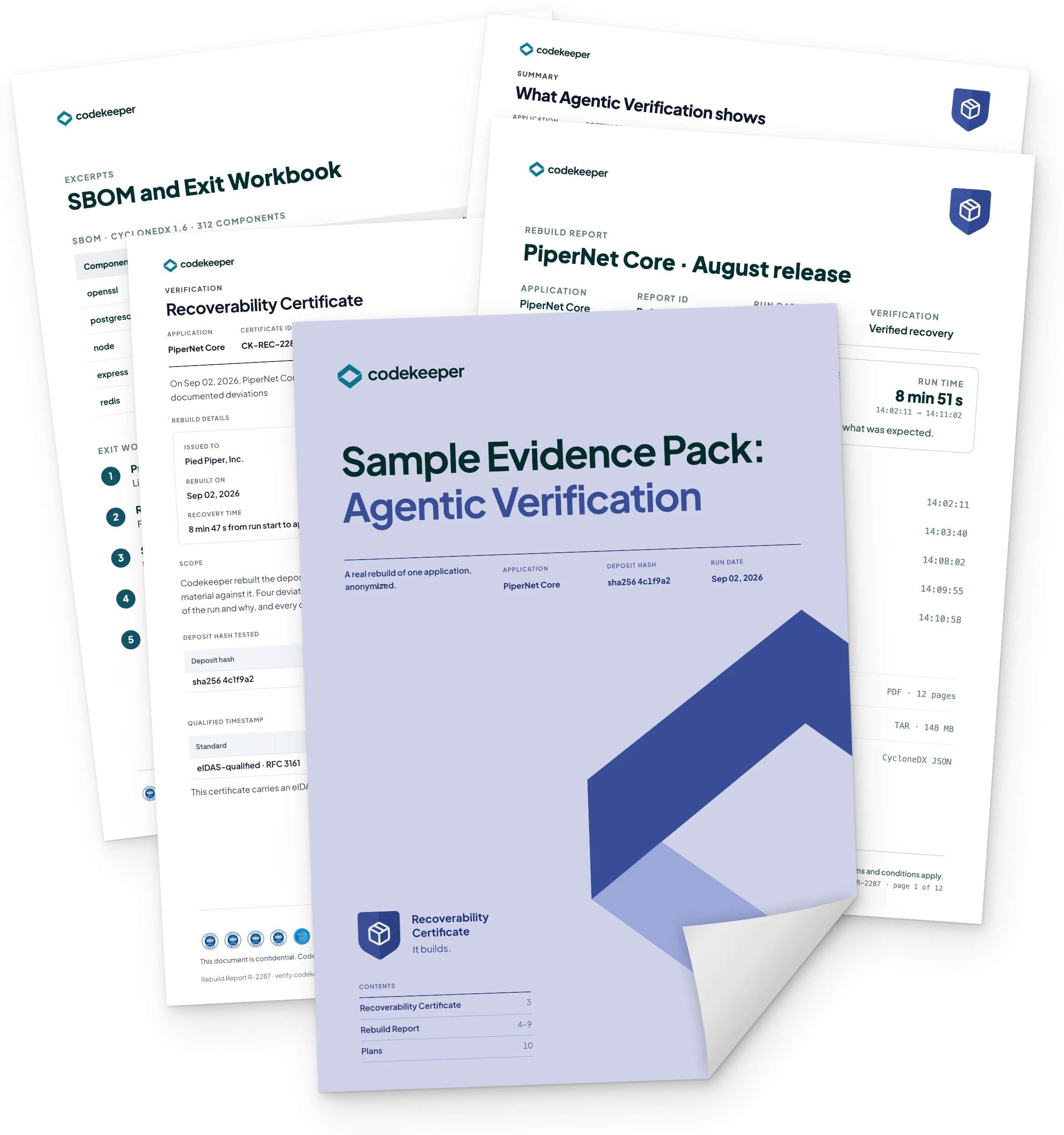
Recoverability Certificate
The application, the result, and the date, on one page you can hand to an auditor or a client.
Rebuild Report
Each step the agents took, what compiled, and anything that was missing.
SBOM
Every component the build used, direct and transitive, with versions and licenses, in CycloneDX.
More about SBOMs →Exit workbook
The recovery, step by step, written from the run: environment, deposit, build, configuration, and checks.
Plus a tested isolated compile
Every passed run also produces a ready-to-deploy build. It's held with the deposit until a release, when the software user gets it.
The sample evidence pack holds the Recoverability Certificate and Rebuild Report from one example run, with SBOM and exit workbook excerpts, all with example values.
Who it's for
The software user and the vendor get the same dated evidence from the same run.
01 · Software users
Asked by auditors, risk teams, and your board.

02 · Software vendors
Asked in client security reviews and procurement.
When a run finds a gap
The Rebuild Report names it, the vendor adds it to the deposit, and you run again.
Example values, the same example as in the sample evidence pack.
Security
Your code stays in Codekeeper's environment. Runs use Codekeeper's own AI, which keeps your code off public models, and each run is sealed off.
Codekeeper AI Verification Lab
A sealed environment for each run. Inside it:
No connection to
The agents run on Codekeeper's models, in Codekeeper's environment.
The vendor can add or remove materials at any point, and a run uses only what's there.
Codekeeper is ISO/IEC 27001:2022 certified.
Plans
Escrow Pro, Resilience Pro, and Continuity Pro, each with up to four runs a year, on supported technology stacks, and the full set of evidence. Choose by how you want to recover. Software Backup Pro includes it too, for the software your own team builds and runs.
| Plan | Softwarefrom | SaaSfrom | AIfrom |
|---|---|---|---|
 Escrow ProSelf-Run RecoveryThe deposit is released to you, and your team runs the recovery. | $419 | $599 | $1,019 |
 Resilience ProManaged RecoveryThe deposit comes to Codekeeper, and Codekeeper's engineers run the recovery. | $599 | $789 | $1,299 |
 Continuity ProFull ContinuityOn Escrow Pro or Resilience Pro, the live environment is kept paid and switched on for an agreed period, with bills recharged at cost. | $1,569 | $1,799 | $2,219 |
 Software Backup ProYour own softwareFor the applications your own team builds and runs, backed up in an immutable vault outside production. | $319billed annually | Not offered | Not offered |
One-time setup: $499 per agreement for Escrow Pro and Resilience Pro, $999 for Continuity Pro, and $249 for Software Backup Pro.
Escrow, Resilience, and Continuity include the monthly automated check, with a Vault Report and a Vault Certificate, but no rebuilds.
See a run on one of your own applications, or start with the sample evidence pack.
Frequently asked questions
Agentic Verification is the rebuild test included in every Pro plan. Codekeeper's AI agents rebuild your deposit in the Codekeeper AI Verification Lab and document what happened, and a passed run issues a Recoverability Certificate.
No, your code doesn't go to a public AI model. The agents run on Codekeeper's own AI and infrastructure, and your code stays in our environment throughout.
The vendor doesn't have to help when the deposit is complete. The agents work from what's deposited, and if something's missing, the run flags it and the vendor adds it.
We confirm which technology stacks are supported for your application in the demo, so tell us what it's built with. Each run's pre-flight check also matches every part of the deposit to a supported stack before the build starts.
You can run Agentic Verification up to four times a year on each Pro plan, on supported technology stacks. You decide when, so a run can land right before an audit or right after a major release.
No, the Recoverability Certificate isn't a compliance certificate. It records that the deposit built, and when. You can add it to the evidence for an audit or a review, but whether it meets a particular requirement is for you and your assessor to decide.
If a run doesn't pass, the Rebuild Report shows how far the build got and what it was missing. Once the vendor adds the missing parts, start a new run.
Agentic Verification and an Exit Exercise answer different questions. Agentic Verification answers whether the deposit builds. An Exit Exercise answers whether you could exit and keep working: Codekeeper specialists rebuild the software independently of the vendor, bring back the data, deploy it, and test the business functions you nominate. You can add one to any plan.