


 European Union


 Global standards


 US

 UK

 Australia

 Netherlands

 Software Continuity. Keep your critical applications online.
If the vendor stops, Continuity keeps the hosting and services behind your application paid and switched on for an agreed period while the software is recovered. Continuity Pro proves the deposit builds first.
From $1,339 /mo
- ISO/IEC 27001:2022 certified
- 50+ integrations, synced daily

- Code in a neutral vault
- Live environment mapped
- Kept paid and switched on
- Rebuild passedPro
Trusted by 3 500+ teams in over 150 countries, from regulated enterprises to fast-growing software vendors








Why Continuity
Open for business while your software is recovered.
When software supports patient care, banking, logistics, or other critical services, downtime isn't an option. Continuity keeps the services your business relies on running while your team, or ours, recovers failed critical software.
Live environment
Claims Portal
- Hosting
Cloud account and serversPaid - Domain
claimsportal.examplePaid - Payment provider
Merchant accountPaid - Email delivery
Transactional email servicePaid
Mapped at setup
Every account it runs on
Hosting, domains, and supporting services, listed before anything goes wrong.
Who recovers it
Your team, or ours
On Escrow, your team runs the recovery. On Resilience, Codekeeper's engineers do.
Downtime risk
Some applications can't wait for a recovery.
When a vendor stops, the live service can stop too. Keeping the service switched on and recovering the application are two different jobs, and Continuity covers both.

A bill goes unpaid.
The vendor pays for the hosting, cloud accounts, and domains your application runs on. When the vendor stops, so do the payments.

One lapse switches off the rest.
A suspended account or an expired domain can take the application offline, along with the services that depend on it.

Recovery takes time.
Bringing an application back from its deposit is real work, and your users and customers still need the live service while the recovery happens.
Stays online
What is software continuity?
Software continuity is a business continuity solution built on a legal agreement between the vendor, their customers, and Codekeeper that keeps a critical application's live service switched on while it's recovered.
- The vendor deposits the software and the details of the hosting and services it runs on.
- Codekeeper keeps those accounts paid and switched on for an agreed period if the vendor stops, with the bills recharged at cost.
- Their customers keep using the live service while the application is recovered, by their own team on Escrow or our engineers on Resilience.
Continuity suits applications on paid hosting and outside services, such as SaaS and AI. Software that runs only on your own servers has no such bills, so Escrow or Resilience is the better fit.

How it works
Mapped in advance. Kept on. Brought back.
-
Our specialists work out what goes in the vault, and map where each application runs and what it relies on.
- Who
- Your team and a Codekeeper specialist, from the first onboarding call.
- In the vault
- Usually the source code, build scripts, documentation, and data, plus credentials and configuration where relevant.
- On the map
- The hosting, accounts, and outside services each application can't run without.
- You get
- A deposit scope for each application, and a map of its live environment.
-
The vendor and their customers sign one agreement that sets the release conditions and the agreed period.
- Who
- The vendor, their customers, and Codekeeper. For vendor software, the vendor signs, since the code can only come from them.
- Your options
- Two-party (bipartite), where the vendor signs once and adds claimants as they come on board, or three-party (tripartite), where one claimant signs alongside the vendor from day one.
- You get
- A software continuity agreement with the release conditions, such as insolvency, discontinued support, or a material breach, and how long we keep the environment on.
-
50+ integrations sync each change daily, and a monthly Vault Report documents which agreed materials are in the deposit.
- Who
- Our specialists, working with your developers to connect the first deposits.
- Then
- Each change syncs daily, the deposit is checked automatically every month, and the live-environment map is kept current.
- You get
- A Vault Report and a Continuity Vault Report each month, a Vault Certificate, a Continuity Vault Certificate, and a Continuity Certificate that shows the arrangement is in place.
-
Launch a build test from your account whenever you choose, and add each certificate to your evidence.
- How
- AI agents in the Codekeeper AI Verification Lab rebuild the deposit in isolation and flag anything missing, without calling on the vendor.
- The map
- We review the live-environment map with each rebuild.
- You get
- Proof it builds: a Recoverability Certificate, backed by a Rebuild Report, an SBOM, an exit workbook, and a tested isolated compile.
-
If the vendor stops, we keep the live environment paid and switched on for the agreed period during the recovery.
- First
- We confirm the release condition, as we would for any release.
- The bills
- Paid by us while the environment is on, and recharged to you at cost.
- The recovery
- Run by your team on Escrow, or by our engineers on Resilience.
Want to see what we'd keep switched on for your applications? Talk it through with a specialist
Continuity or Continuity Pro
Kept on while it's recovered. Proven before you need it.
Continuity keeps the live environment on while the application is recovered. Continuity Pro tests the deposit too: Codekeeper's AI agents rebuild it when you choose, so the recovery starts from a deposit we know builds.
Continuity
From$1,449per month
Full continuity, on the Escrow or Resilience recovery you choose.
Included
- A copy of your software in a neutral vault
- Daily sync through 50+ integrations
- Monthly checks for missing files
- The live environment kept paid and switched on for an agreed period if the vendor stops

Continuity Pro
RecommendedFrom$1,699per month
Full continuity, proven in advance, on Escrow Pro or Resilience Pro.
Everything in Continuity, plus
- Agentic Verification: up to four rebuilds a year, on supported technology stacks
- Codekeeper's own AI, off public models
- The live-environment map reviewed with each rebuild
- A tested isolated compile, ready to deploy
- An exit workbook for the recovery
- Recoverability Certificates and SBOMs
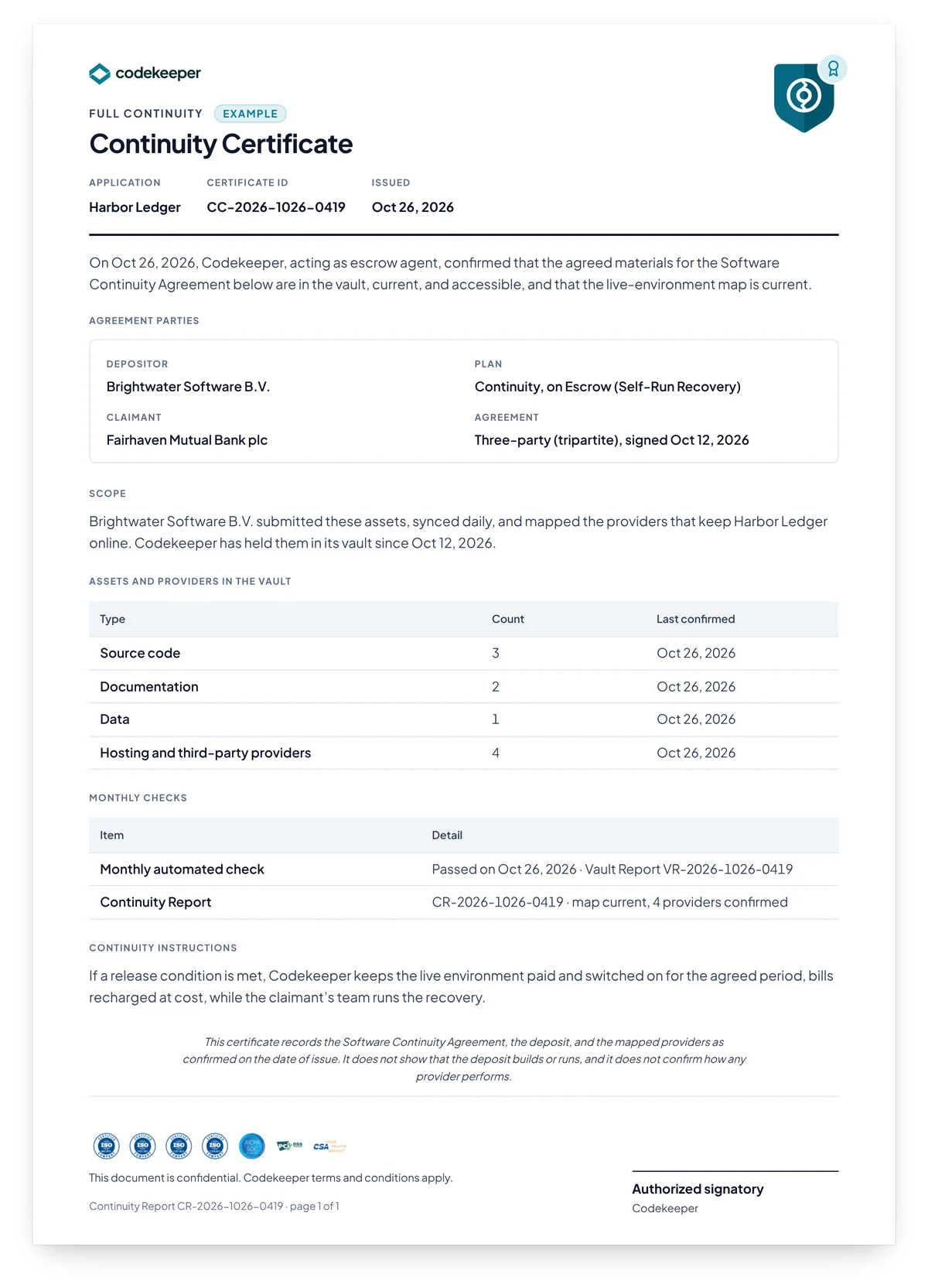 ContinuityContinuity CertificateShows the agreement is in place and the deposit is checked. Example values.
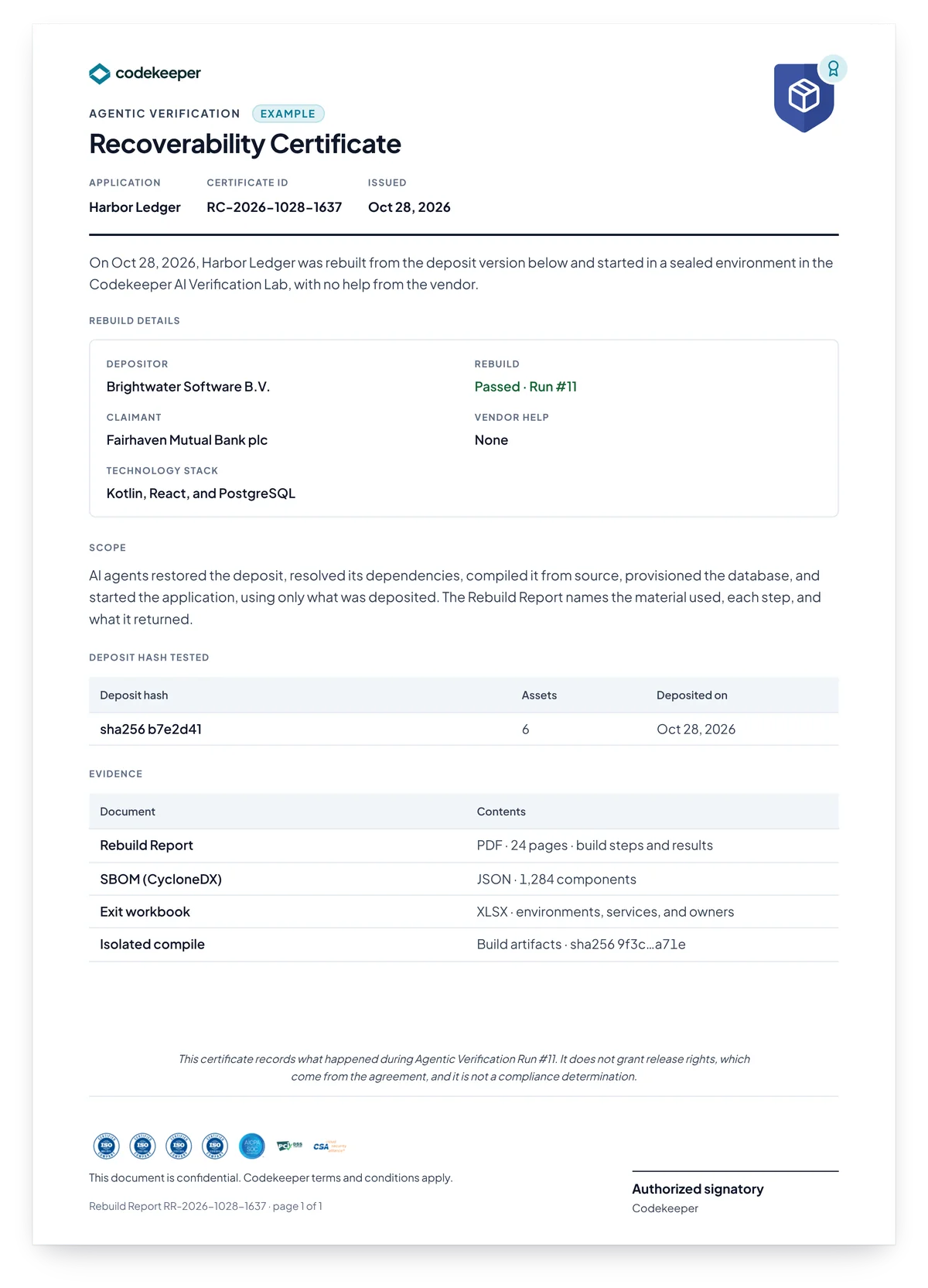 Continuity ProRecoverability CertificateDocuments the rebuild and its result. It doesn't grant release rights; those come from the agreement. Example values.
Every Continuity plan
Agreements, mapping, and security, handled for you.
Agreements drafted and negotiated for you.
Sign a two-party, three-party, or multi-party agreement our in-house counsel drafts and negotiates, under the jurisdiction you choose.
The live environment, mapped.
We map the hosting, accounts, and services each application needs at setup, and keep that map current.
A dashboard for every party.
Follow the arrangement with every change logged, and keep certified software resilience evidence on hand.
Credentials under lock.
Keep the logins and keys the live environment needs under AES-256 encryption and MFA, in storage no one can alter.
Requests checked 24/7/365.
Flag a problem day or night, and our team checks the request against your software continuity agreement.
Recovery files kept current.
Connect your repositories and cloud platforms through 50+ integrations, and every change reaches the vault daily, ready for the recovery.








When the vendor stops
The vendor stops. The service doesn't have to.
When a vendor stops, so do the payments for the hosting and services behind your application. Continuity keeps paying them, so the service stays up while the software is recovered.
We confirm the request.
Our team checks the request against the release conditions in your software continuity agreement.
We keep the bills paid.
Everything on the map stays on for the agreed period.
The application is recovered.
By your team on Escrow, or by our engineers on Resilience. On Pro, from build steps that have worked.

By application
What we keep on, and what we hold, depends on how your application runs.
Software, SaaS, and AI each run on their own mix of hosting and outside services. Find your application type to see what Continuity keeps on, and what it holds for the recovery.

Software
On-premises and installed applicationsKept paid
- Hosted components
- Third-party services
Held for recovery
- Source code
- Data
- Documentation
From $1,449

SaaS
Hosted and subscription applicationsKept paid
- Cloud hosting and storage
- Domains and DNS
- Email and payment services
Held for recovery
- Source code
- Data
- Documentation
- Deployment infrastructure
- Third-party services
- Credentials and access
From $1,599

AI
AI models and AI systemsKept paid
- GPU hosting
- Inference endpoints
- Vector stores and data services
Held for recovery
- Models
- Model deployments
- Agents and prompts
- Workflows
From $1,949
Other protections
Need the recovery, without the live environment?
If the service can go offline while it's recovered, choose between self-run and managed recovery.
Escrow
For the software your own team can bring back. Lock critical software away in a neutral vault, for your engineers to restore once a release condition is met.
From$199
 ExploreEscrow
Resilience
For the software you can't risk rebuilding yourself. Rescue critical third-party software after a failure, while our engineers take charge of the recovery.
From$399
 ExploreResilience
Full continuity for the applications you can't lose.
One missed bill can switch off a whole service. Talk to our continuity specialists about keeping the accounts behind your applications paid and running.
Frequently asked questions
See the full picture on Continuity.
How is Continuity different from Resilience?
The difference is that Resilience brings the application back, while Continuity also keeps its live environment switched on while that happens. We map the environment in advance, and if the vendor stops, we keep the environment paid and switched on for an agreed period while the application is recovered.
Which recovery comes with Continuity?
Continuity comes with the recovery you choose. On Escrow, the deposit is released to your team, and you run the recovery. On Resilience, the deposit comes to Codekeeper, and our engineers run the recovery on a best-effort basis. Continuity Pro sits on Escrow Pro or Resilience Pro, so the deposit is tested with Agentic Verification too.
Does the vendor have to take part?
Yes, for vendor software the vendor has to take part, because only the vendor can deposit their source code, and the vendor signs the software continuity agreement. A two-party agreement lets the vendor set up once and add claimants later, while a three-party agreement brings one claimant in from the start.
What exactly do you keep switched on?
We keep the parts of the live environment the application needs switched on, as mapped at setup: typically hosting, cloud accounts, domains, and critical third-party services.
How long do you keep the live environment switched on?
We keep the live environment switched on for an agreed period, set per agreement. We agree on the length with you when we set up Continuity, and if a recovery could take longer, the Coverage Length SLA add-on extends it.
Who pays the bills during that period?
During that period, we keep the bills paid and recharge them to you at cost.
Does Codekeeper take over the hosting?
No, Codekeeper doesn't take over the hosting. We keep the bills paid, and your existing providers keep hosting and running everything they supply, so nothing about how the service runs has to change.
Will your engineers run the service for us?
Yes, our engineers can run the service for you, as an add-on. Hands-on operation of the live service, such as monitoring, incidents, and fixes, is billed by the hour and done on a best-effort basis, with no guarantee or service level.
Does Continuity come with an uptime service level?
No, Continuity doesn't come with an uptime service level. It keeps the live environment paid and switched on for an agreed period while the application is recovered, without promising uptime. If you need the cost of a recovery covered under an agreed service level, add Cost Coverage, quoted per agreement.
Is there anything to pay besides the monthly price?
Besides the monthly price, there's a one-time setup fee of $999 per agreement, on Continuity and Continuity Pro alike, and release processing at $199 per hour if a release is ever requested. One claimant is included, and you can add more as an add-on. Hands-On Operations and Cost Coverage are optional extras.
What does Continuity Pro add?
Continuity Pro adds Agentic Verification: AI agents rebuild a complete deposit on their own in the sealed Codekeeper AI Verification Lab, up to four times a year, on supported technology stacks. Each successful rebuild issues a Recoverability Certificate, with a Rebuild Report, an SBOM, an exit workbook, and a tested isolated compile, and we review the live-environment map each time. Tell us what you run, and we'll confirm your stack during the demo.
What do you need from us at setup?
At setup, we need the details of the live environment: where the application runs, the accounts it depends on, and the services it needs. We map it with you, agree on the access we hold, and set up the first deposits and integrations together with your team, starting with an onboarding call. Everything you deposit is encrypted at rest, and Codekeeper is ISO/IEC 27001:2022 certified.