Meet Codekeeper's new November 2026 software protection lineup, for restoring the applications you can't be without. From tested rebuilds and managed recovery to keeping services online, it's everything you need to build total software resilience.
Agentic Verification · in Escrow Pro, Resilience Pro, and Continuity Pro
From safekeeping to tested rebuilds. In one click.
AI agents analyze your escrow deposit inside the sealed Codekeeper AI Verification Lab to work out how the app is put together, then rebuild it. Every passed run issues a Recoverability Certificate, with the date on it.
Agentic VerificationExample
Payments Core · Run #11
Escrow Pro · Codekeeper AI Verification Lab
Pre-flight checkStack matched
Seal the environmentSealed
Restore the depositRestored
Work out the build1 private package resolved
Isolated compileCompiled from source
Start and checkHealth checks passed
Write the evidence4 documents
Passed · Sep 3, 2026
Recoverability Certificate issued
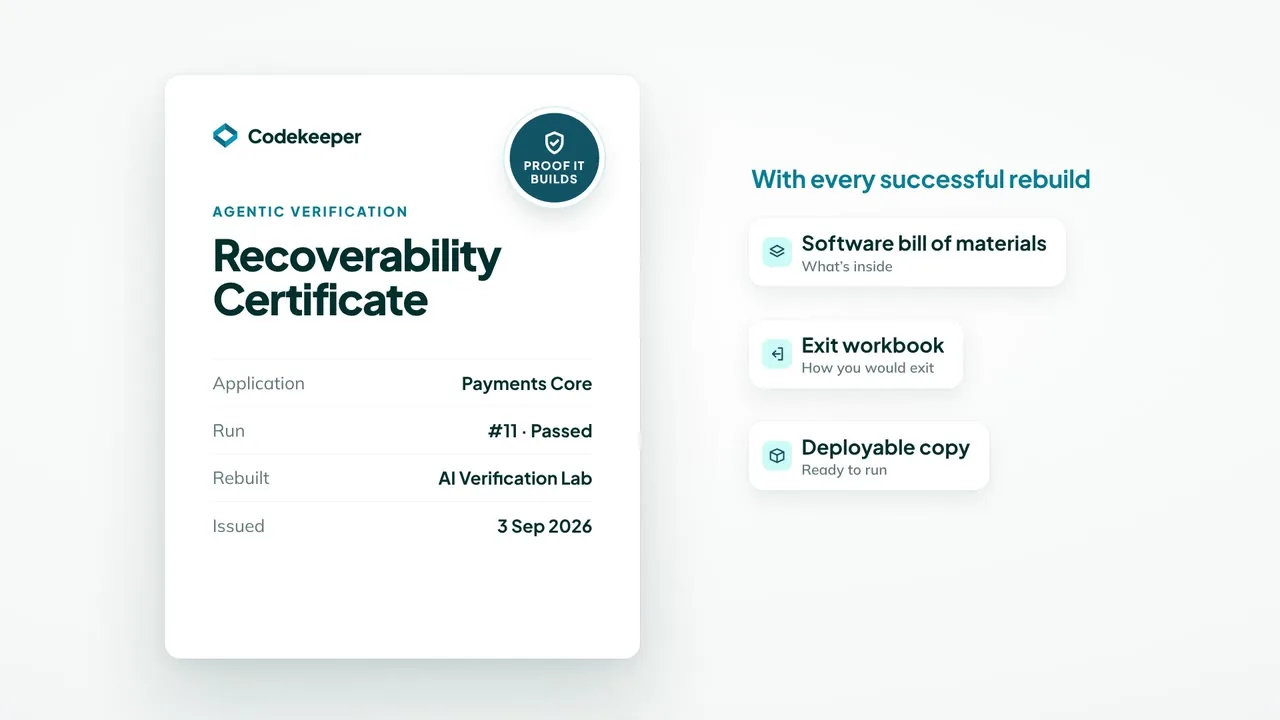
Recoverability Certificate
Payments Core · Run #11 · Sep 3, 2026
Passed
Example run of Agentic Verification for an application called Payments Core, with example values: seven steps from the pre-flight check to the evidence, passed on Sep 3, 2026, with a Recoverability Certificate issued.
Example
Agentic Verification
Recoverability Certificate
On Sep 3, 2026, Payments Core built and started in a sealed environment, from its deposit alone.
Application
Payments Core
Plan
Escrow Pro
Run
#11 · Passed
Issued
Sep 3, 2026
Rebuilt in
Codekeeper AI Verification Lab
Evidence from this run
Rebuild Report
SBOM (CycloneDX)
Exit workbook
Tested isolated compile
This certificate records what happened in one run. It doesn't grant release rights, which come from the agreement, and it isn't a compliance certificate.
Passed
Example Recoverability Certificate for a fictional application, with example values.
Five outputs from every passed run.
1Recoverability CertificateA dated record that the rebuild passed.
2Rebuild ReportWhat the agents built, step by step.
3SBOMIn CycloneDX, regenerated with every successful run.
4Exit workbookThe recovery process, written out.
5Tested isolated compileA ready-to-deploy build, available on release.
Our own lab. Our own AI. Sealed off from the internet.
Agentic Verification runs in the Codekeeper AI Verification Lab, on Codekeeper's sovereign AI, off public models. Each run works from the deposit alone.
2014Codekeeper is founded to keep critical software safe.
2018We build the first automatic deposit sync.
2026AI agents rebuild the deposit, and prove it builds.
50+integrations, synced daily
Monthlydeposit checks, on every plan
Up to 4rebuild runs a year with Pro
ISO/IEC 27001:2022certified
Escrow Pro · New level
Escrow holds the code. Escrow Pro proves it builds.
Every piece of your application, synced daily to a neutral vault and released to your team on terms agreed up front. Add Pro, and Codekeeper's AI agents rebuild the deposit to prove your software builds.
Your sources
50+ integrations, synced daily
Escrow · The vault
Payments Core
Deposit current
Synced today
Source code3 repositories
DatabaseDaily snapshot
InfrastructureAWS config
DocumentationBuild notes
Vault Report · monthly check done
Escrow Pro · The proof
Agentic Verification
Run #3 · AI Verification Lab
Pro
Restore the depositRestored
Isolated compileFrom source
Start and checkHealth checks
PassedRecoverability Certificate issued
Add Pro to prove the deposit rebuilds
Example application. Values are illustrative.
Always current.Synced every day from the tools you already use, with no cap on deposits.
Neutral.Held by Codekeeper and released to your team only on the terms you agreed.
Proven.Escrow Pro rebuilds the deposit with Codekeeper's AI agents, up to four times a year.
Your current plan stays as agreed. When you're ready, your account manager can walk you through what a move would mean for each application you protect today.
The new list prices apply to new customers, not to your current plan.
If you move an application to a new plan, it stays in the same vault, with its deposits and integrations.
Moves can happen at renewal or, if you prefer, before it.
Agentic Verification, in Escrow Pro, Resilience Pro, and Continuity Pro
Continuity Escrow
Continuity and Continuity Pro, on the Escrow or Resilience recovery you choose
A need for an exit test run by specialists
Exit Exercise, an add-on to any plan
Release notes: what changed, plan by plan
Release notes
What changed, plan by plan.
Each entry says what the change replaces, what you get now, and where to read more. The play buttons open the matching chapter of the film.
New levelEscrow
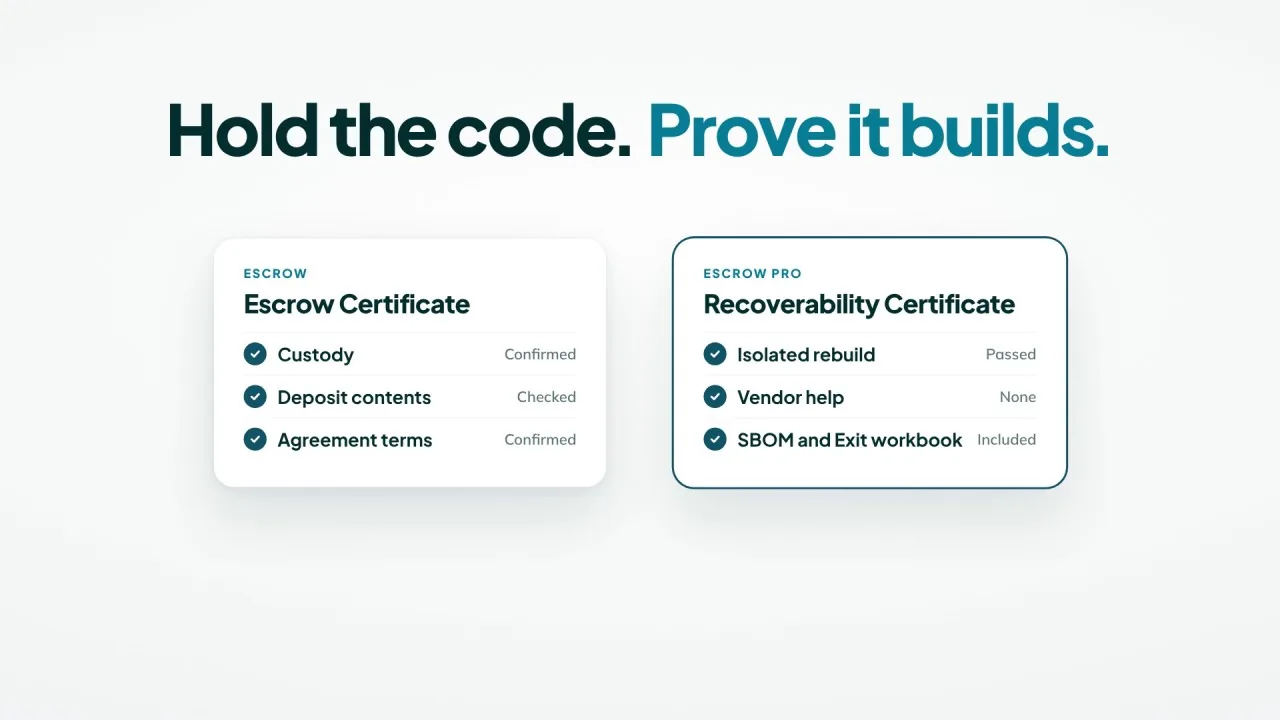
Escrow keeps its job, and gains a Pro level.
−Before
Escrow held the deposit in a neutral vault and released it to your team if a release condition was met. Proof that it would build was sold separately, as verification levels.
+Now
Escrow does the same job, and your team runs the recovery (Self-Run Recovery). Escrow Pro adds Agentic Verification, so the deposit goes through rebuild tests before a release is ever needed.
What it means for you: if your team, or a partner you choose, can rebuild the application, Escrow still fits. Choose Escrow Pro when an auditor, a client, or your board wants to see that it builds.
If a release condition was met, the deposit was released to you, and your team, or a partner you chose, had to rebuild and run the application.
+Now
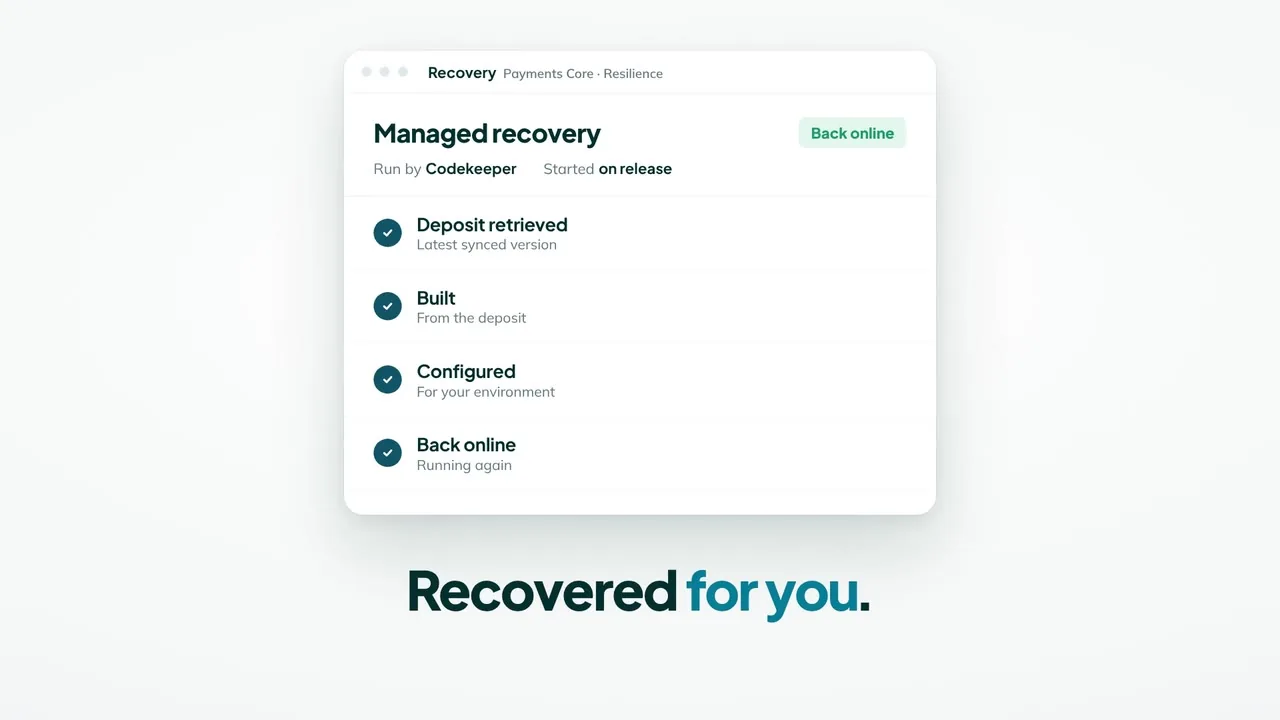
With Resilience, the deposit comes to Codekeeper instead, and our engineers run the recovery on a best-effort basis (Managed Recovery). Resilience Pro adds Agentic Verification, so a recovery starts from a deposit that has already been rebuilt.
What it means for you: if nobody on your side could rebuild the application, our engineers now run the recovery for you. A review that asks who would bring it back gets a clear answer.
It was called Continuity Escrow, and it kept a vendor's critical services running.
+Now
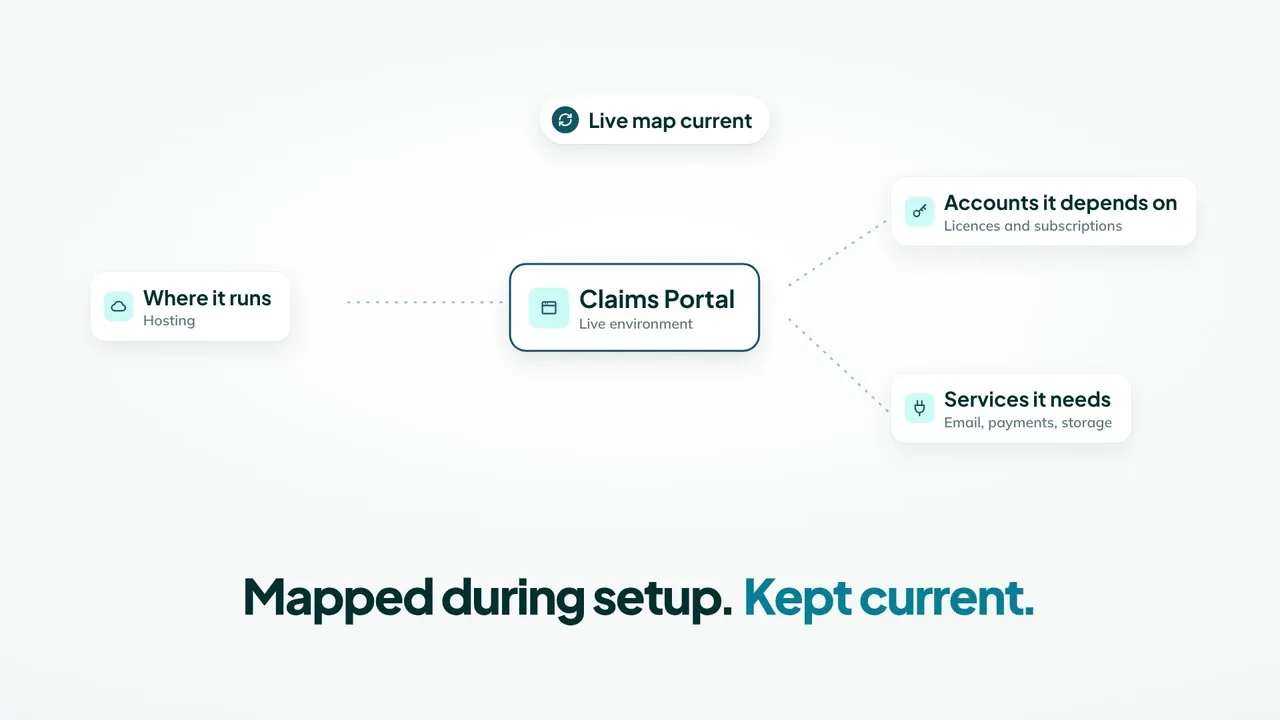
It sits on Escrow or Resilience, and Continuity Pro on Escrow Pro or Resilience Pro. The live environment is mapped at setup, and the map is kept current. If the vendor stops, the environment is kept paid and switched on for an agreed period, bills recharged at cost, while the application is recovered.
What it means for you: for an application that can't go dark while it's recovered, one plan now covers both jobs. Each month brings a Continuity Vault Report and Continuity Vault Certificate, and the plan comes with a Continuity Certificate.
Agentic Verification replaces the old verification levels.
−Before
Verification was done by hand, took weeks, and came as three separate levels: Validated, Verified, and Certified.
+Now
Every Pro plan includes Agentic Verification. Codekeeper's AI agents rebuild the deposit in the sealed Codekeeper AI Verification Lab, up to four times a year, on supported technology stacks. You start each run whenever you choose, and anything missing is flagged.
What it means for you: proof that the software builds is now part of each Pro plan, and every run that passes issues a Recoverability Certificate. Escrow, Resilience, and Continuity have no rebuilds; they keep the monthly automated check.
To test the exit itself, there's the Exit Exercise.
It's a human-run test, separate from Agentic Verification. Our specialists recover your software from the deposit alone, without the vendor or the original developers, bring the data back, deploy it, and test the business functions you nominate. The result, the gaps, and the date go into an Exit Exercise Report for your file. It's an add-on to any plan.



 European Union


 Global standards


 US

 UK

 Australia

 Netherlands


 Agentic Verification

 Escrow Pro

 Resilience

 Continuity

 Exit Exercise








 New levelEscrow