From keeping the code safe to proving it can be restored.
Introducing Codekeeper's November 2026 software protection lineup, built to restore the applications you depend on. With tested rebuilds, managed recovery, and services kept online, it gives you everything needed for complete software resilience.
Agentic Verification · part of Escrow Pro, Resilience Pro, and Continuity Pro
One click takes you from safekeeping to tested rebuilds.
Inside the sealed Codekeeper AI Verification Lab, AI agents analyse your escrow deposit to figure out how the app is assembled, then rebuild it, with a dated Recoverability Certificate issued for each passed run.
Agentic VerificationExample
Payments Core · Run #11
Escrow Pro · Codekeeper AI Verification Lab
Pre-flight checkStack matched
Seal the environmentSealed
Restore the depositRestored
Work out the build1 private package resolved
Isolated compileCompiled from source
Start and checkHealth checks passed
Write the evidence4 documents
Passed · Sep 3, 2026
Recoverability Certificate issued
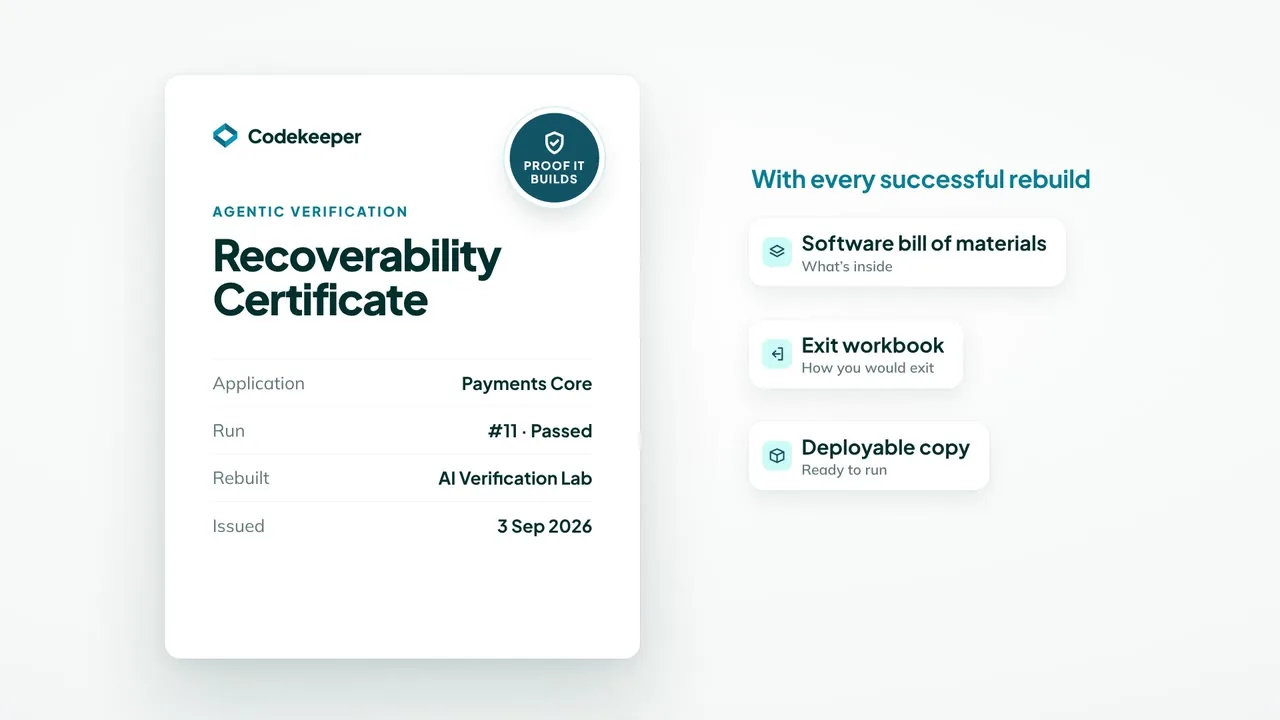
Recoverability Certificate
Payments Core · Run #11 · Sep 3, 2026
Passed
A sample Agentic Verification run for an application named Payments Core, using example values, covering seven steps from the pre-flight check to the evidence, passed on 3 September 2026 with a Recoverability Certificate issued.
Example
Agentic Verification
Recoverability Certificate
On 3 September 2026, Payments Core was built and started in a sealed environment using only its deposit.
Application
Payments Core
Plan
Escrow Pro
Run
#11 · Passed
Issued
3 Sep 2026
Rebuilt in
Codekeeper AI Verification Lab
Evidence from this run
Rebuild Report
SBOM (CycloneDX)
Exit workbook
Tested isolated compile
This certificate records a single run's outcome. Release rights come from the agreement, not the certificate, which isn't a compliance certificate either.
Passed
Shown with example values: a Recoverability Certificate for an invented application.
Five outputs from each passed run.
1Recoverability CertificateDated proof that the rebuild passed.
2Rebuild ReportA step-by-step account of the agents' build.
3SBOMIn CycloneDX, refreshed with each successful run.
4Exit workbookThe recovery process, set out in full.
5Tested isolated compileA build ready to deploy, released when a release happens.
A lab and AI of our own, cut off from the internet.
Each run works only from the deposit, inside the Codekeeper AI Verification Lab and on Codekeeper's sovereign AI, away from public models.
2014Codekeeper is set up to keep critical software safe.
2018We create the first automatic deposit sync.
2026AI agents rebuild the deposit, proving that it builds.
50+integrations, synced every day
Monthlydeposit checks on every plan
As many as 4rebuild runs a year with Pro
ISO/IEC 27001:2022certified
Escrow Pro · New level
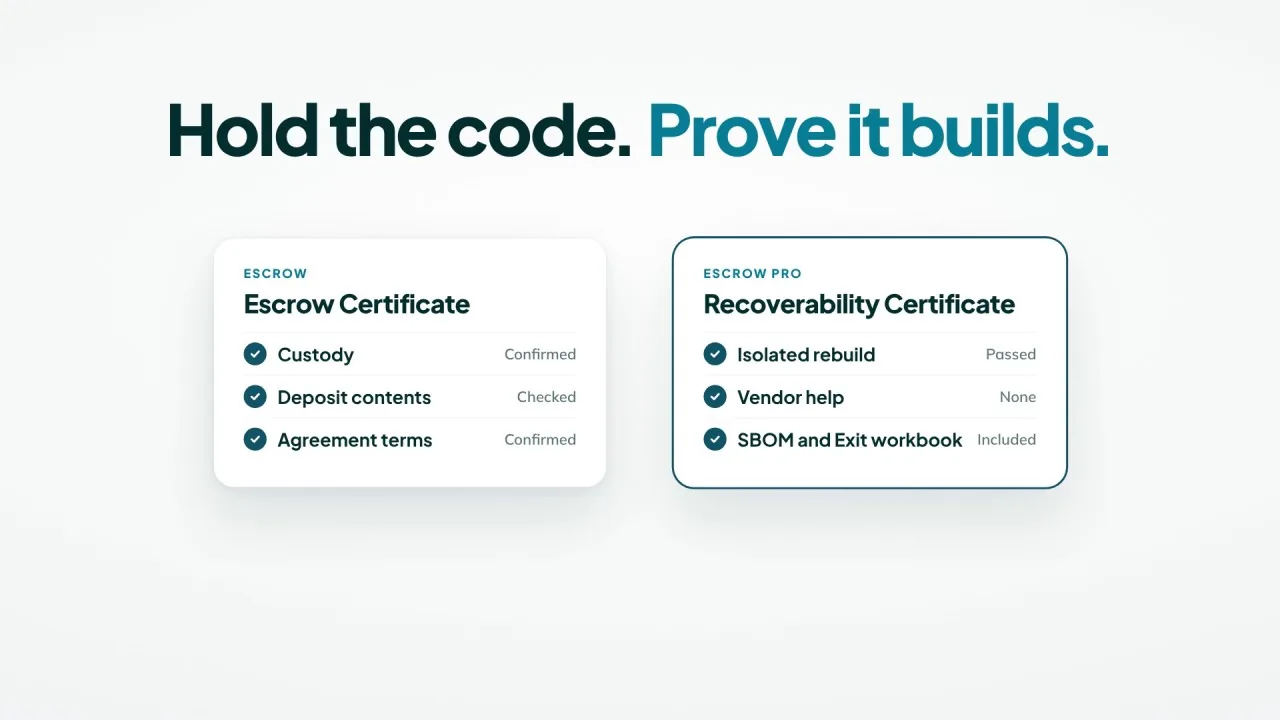
Escrow keeps the code, and Escrow Pro shows it builds.
All of your application, synced to a neutral vault each day and released to your team under terms settled in advance. With Pro added, Codekeeper's AI agents rebuild the deposit as proof your software builds.
Your sources
50+ integrations, synced every day
Escrow · The vault
Payments Core
Deposit up to date
Synced today
Source code3 repositories
DatabaseDaily snapshot
InfrastructureAWS config
DocumentationBuild notes
Vault Report · monthly check complete
Escrow Pro · The proof
Agentic Verification
Run #3 · AI Verification Lab
Pro
Restore the depositRestored
Isolated compileFrom source
Start and checkHealth checks
PassedRecoverability Certificate issued
Add Pro to prove the deposit rebuilds
A sample application with illustrative values.
Always up to date.Synced daily from the tools you already work with, with unlimited deposits.
Neutral.Kept by Codekeeper and released to your team solely on the terms you agreed.
Proven.Escrow Pro has Codekeeper's AI agents rebuild the deposit, as many as four times a year.
Your existing plan continues as agreed, and whenever you're ready, your account manager can explain what switching would mean for each application you protect now.
New list prices are for new customers and leave your current plan untouched.
An application moved to a new plan remains in the same vault, deposits and integrations included.
You can switch at renewal or, if you'd rather, earlier.
Agentic Verification, part of Escrow Pro, Resilience Pro, and Continuity Pro
Continuity Escrow
Continuity and Continuity Pro, with the Escrow or Resilience recovery of your choice
A need for specialists to test your exit
Exit Exercise, an add-on to any plan
Release notes, plan by plan
Release notes
How each plan has changed.
Every entry explains what the change replaces, what you get now, and where to find out more, and the play buttons jump to the film's matching chapter.
New levelEscrow
Escrow keeps its role and gains a Pro level.
−Before
Escrow kept the deposit in a neutral vault and released it to your team once a release condition applied, with proof that it built sold separately as verification levels.
+Now
Escrow does the same job, with your team handling the recovery (Self-Run Recovery), while Escrow Pro adds Agentic Verification so the deposit is rebuild-tested long before any release.
What it means for you: if your team, or a partner of your choice, can rebuild the application, Escrow still suits you. Go for Escrow Pro when an auditor, a client, or your board needs to see that it builds.
Once a release condition applied, the deposit was released to you, leaving your team, or a partner you picked, to rebuild and run the application.
+Now
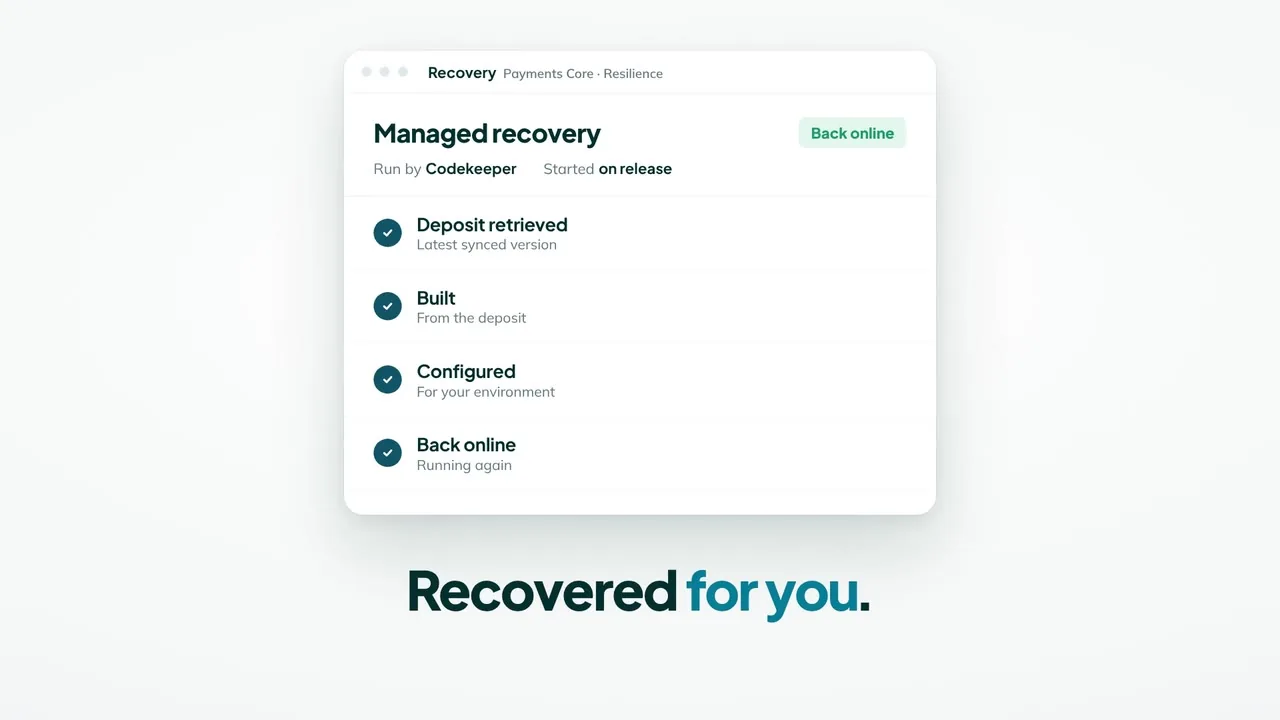
Under Resilience, the deposit is released to Codekeeper, and our engineers handle the recovery on a best-effort basis (Managed Recovery), while Resilience Pro adds Agentic Verification so the recovery begins from an already rebuilt deposit.
What it means for you: if no one on your side could rebuild the application, our engineers now take the recovery on for you, and any review asking who would restore it gets a clear answer.
Continuity now sits on whichever recovery you pick.
−Before
Under the name Continuity Escrow, it kept a vendor's critical services running.
+Now
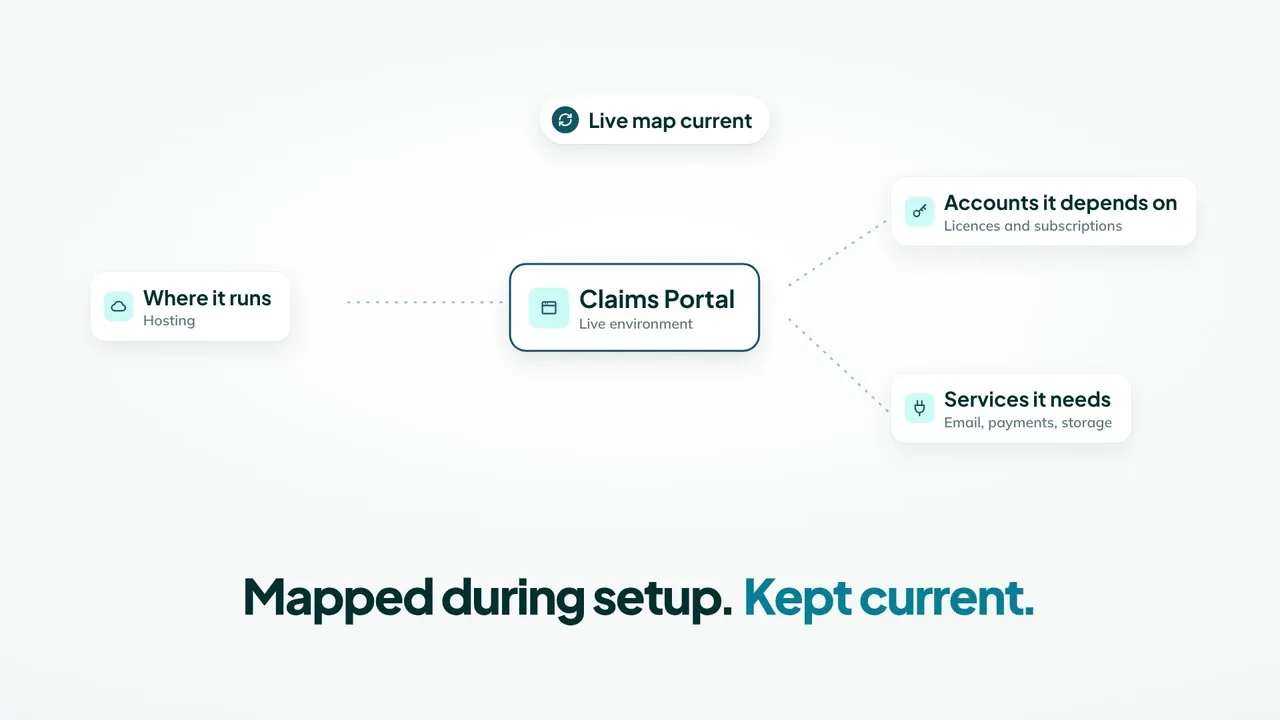
It sits on Escrow or Resilience, with Continuity Pro on Escrow Pro or Resilience Pro. We map the live environment during setup and keep that map up to date, and should the vendor stop, we pay for the environment and keep it running for an agreed period, recharging the bills at cost, while the application is restored.
What it means for you: for an application that can't go offline during its recovery, a single plan now does both jobs, with a Continuity Vault Report and Continuity Vault Certificate every month and a Continuity Certificate for the plan.
Agentic Verification takes over from the old verification levels.
−Before
Verification was manual, took weeks, and came in three separate levels: Validated, Verified, and Certified.
+Now
Agentic Verification comes with every Pro plan, with Codekeeper's AI agents rebuilding the deposit in the sealed Codekeeper AI Verification Lab as many as four times a year, on supported technology stacks. You launch each run when you like, and any gaps are flagged.
What it means for you: evidence that the software builds now comes with each Pro plan, and every passing run issues a Recoverability Certificate. Escrow, Resilience, and Continuity carry no rebuilds, keeping the automated monthly check.
For a test of the exit itself, choose the Exit Exercise.
Our specialists test your exit plan, recovering your software from just the deposit, without any vendor or original developers, then restoring the data, deploying it, and checking each business function you choose. The outcome, every gap, and the date are recorded in an Exit Exercise Report with an annex mapped to your framework, such as PRA SS2/21 or DORA, so your file shows the exit plan has been tested. You can add it to any plan.



 European Union


 Global standards


 US

 UK

 Australia

 Netherlands


 Agentic Verification

 Escrow Pro

 Resilience

 Continuity

 Exit Exercise








 New levelEscrow