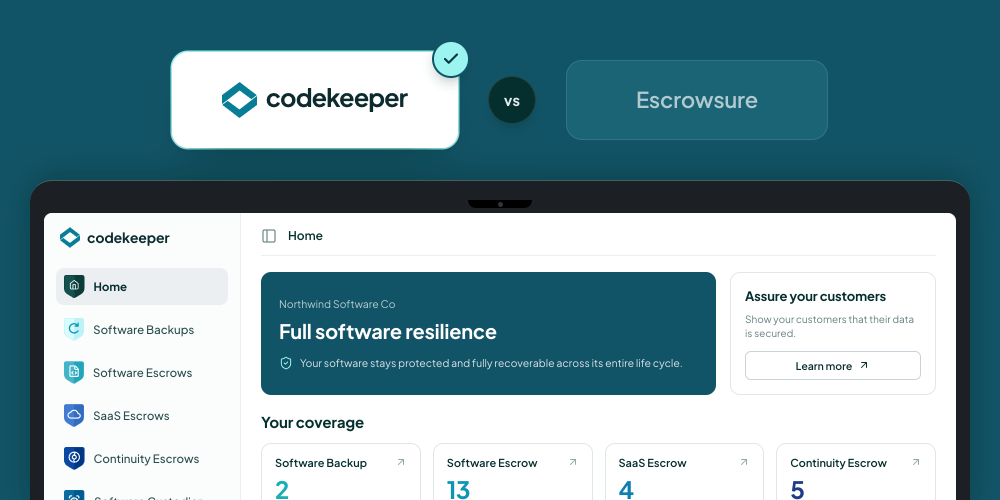
Codekeeper vs. Escrowsure: How do their escrow features compare?



Want more insights like this?
Subscribe Here!
Your operations depend on code you didn't write and can't see. When the vendor behind it fails, stalls, or gets acquired, the people who maintain that software won't be there anymore. That's the gap software escrow closes. It puts critical software assets back into your hands.
Escrowsure is a South African escrow specialist covering two situations: source code held on-premises and software delivered through the cloud. Codekeeper protects a wider set of software assets and offers transparent pricing for all levels of protection.
This comparison looks at where the two providers differ across cost, product range, integrations, verification, agreements, and support, so you can make your decision based on how much of your stack you need protected.
» Discover how to automate software resilience with modern software escrow.
Codekeeper vs. Escrowsure at a glance
Here's a quick overview of what each software escrow provider brings to the table:
| Pricing & value | Codekeeper | Escrowsure |
| Setup fee | ✅ $249 | ✖️ Not specified |
| Base storage | ✅ 1TB included | ✖️ Not specified |
| Monthly fee | ✅ From $129 | ✖️ Quote only |
| Transparent pricing | ✅ | ✖️ |
| Core features | ||
| Integrations | ✅ 50+ supported platforms | ✖️ Git + SFTP (no platform list) |
| Automated deposits | ✅ Daily OAuth sync | ✅ (deposit frequency not specified) |
| Unlimited repositories | ✅ | ✖️ Not specified |
| Agreements | ✅ Bi-, tri-, and multi-party escrows | ✅ Tri-party |
| Release processing | ✅ 24/7/365 | ✖️ Not specified |
| Assured recovery support | ✅ | ✖️ Not specified |
| Verification services | ||
| Validated verification (free) | ✅ | ✖️ Not specified |
| Verified verification | ✅ | ✅ |
| Certified verification | ✅ | ✅ |
| Software Resilience Certificate | ✅ | ✖️ Test reports |
| Scalability | ||
| Storage upgrades | ✅ Up to 5TB + custom | ✖️ Not specified |
| Multi-escrow options | ✅ 1, 5, unlimited | ✖️ Not specified |
| Enterprise solutions | ✅ | ✅ |
Codekeeper vs. Escrowsure: Costs
Signing off on escrow is difficult without total cost transparency. Codekeeper publishes fixed pricing for every product, so you can size a plan against your budget.
Codekeeper charges per solution, monthly or annually:
- Software Backup: From $99/month
- Software Escrow: From $139/month
- SaaS Escrow: From $199/month
- AI Escrow: From $549/month
- Continuity Escrow: From $459/month
Opting for annual billing over monthly takes up to 12% across all plans.
» Build a software resilience plan around your budget.
Escrowsure's site lists no product pricing, setup fee, or billing terms. Costs are arranged after consultations, so you'll need that conversation before you can line it up against your budget.
Codekeeper vs. Escrowsure: Solutions
Modern recovery needs extend beyond source code protection, running across cloud environments, AI systems, and hosting services. Codekeeper offers five software resilience solutions targeted at all aspects of software usage:
- Software Backup: Keeps versioned, immutable copies of your own code, data, and deployment assets, so your team can restore quickly after a failure.
- Software Escrow: Secures the source code, data, and documentation for on-premises software under a formal agreement with defined release triggers.
- SaaS Escrow: Extends software escrow's protection to cloud applications, capturing source code, configurations, deployment infrastructure, third-party dependencies, and credentials.
- AI Escrow: Protects the full AI stack, including models, deployments, prompts, agents, and workflows, so you can rebuild if a provider disappears.
- Continuity Escrow: Keeps critical hosting and supporting services online. You flag a missed payment, and Codekeeper steps in to cover it for up to 12 months while you plan a transition.
Each solution syncs daily across 50+ platforms, tests recoverability on an ongoing basis, and issues auditor-ready certificates.
Learn more about Codekeeper's software resilience solutions in this video:
Escrowsure focuses on two of these situations. Its Source Code Escrow covers on-premises and cloud source code with documentation, and its SaaS Escrow covers cloud-hosted applications, including access credentials, infrastructure documentation, and continuity arrangements.
Both providers protect source code and cloud software. The difference is range: Codekeeper adds internal backup, AI infrastructure, and hosting-payment continuity as separate products you can turn on as your risks grow.
Codekeeper vs. Escrowsure: Core features
Most headline capabilities look alike on both sides. The differences live in the details: what gets connected, what gets tested, and what you can adjust after you sign.
Integrations
The integration list decides how much manual work escrow adds to your week. Codekeeper connects to 50+ development platforms through secure OAuth, from code hosts like GitHub, GitLab, Bitbucket, Azure DevOps, and AWS CodeCommit to cloud platforms including AWS, Azure, and Google Cloud.
Connect a platform once, and daily syncs keep the vault in step with your live code.
Escrowsure also automates deposits, pulling from Git repositories through its Escrow Admin Portal or receiving them over SFTP. Its site names no specific platforms, publishes no integration count, and states no sync frequency, so confirming coverage for your stack, and how often it updates, means asking their team.
Both automate the deposit itself. Where they part ways is scope and cadence. Codekeeper's platform list is public and named, and a daily sync keeps what's in your escrow close to what's running, instead of drifting between updates.
Verification options
Escrow only pays off if the deposit actually works when you need it, and verification is how you know it will. Codekeeper runs three tiers, starting with a free one, each issuing a Software Resilience Certificate you can hand an auditor as evidence toward DORA, NIS2, ISO 27001, and similar requirements.
| Verification tier | Price | What it proves |
| Validated | Free | Shows every expected asset is present in the vault, encrypted and correctly stored. |
| Verified | From $29/month | Automatically checks deposit integrity and tracks development activity, with monthly reports in your dashboard. |
| Certified | From $329/month | Expert engineers rebuild your software in a clean environment and certify it can be recovered. |
» Match a verification tier to your regulator's requirements.
Escrowsure verifies thoroughly. It offers three source-code levels, from a basic completeness check up to a full rebuild and compile in a clean environment with documented build instructions, and four SaaS levels that run from access retrieval to a maintained failover environment. Each engagement produces a verification report and a governance certificate through its portal.
The contrast sits in cadence and entry point. Escrowsure tests per engagement at the level you choose, with no free tier stated and no ongoing monitoring published. Codekeeper starts free at Validated and then keeps watching your deposits automatically between reviews, so one doesn't sit unchecked until you commission the next test.
Add-on services
Most escrow contracts lock your scope in at signing. Codekeeper's add-ons enable you to add more control and protection to any plan:
-
Advanced Deposits: choose your storage region, set IP allowlisting, and keep your full deposit history instead of overwriting older versions.
-
Advanced Integrations: custom-built connections for proprietary or non-standard platforms, with automated deposit syncing.
-
Advanced Continuity Integrations: connects legacy or non-standard hosting and credential systems to Continuity Escrow.
-
Compliance Support SLA: hands-on help with recurring compliance documentation, security audits, and GDPR and HIPAA data handling.
-
Coverage Length SLA: extends your Continuity Escrow coverage window for a longer transition.
-
Assured Recovery: a standby technical team with a response under four hours to help rebuild your code and environments.
-
Liability SLA: raises liability limits to match enterprise procurement and contractual-risk requirements.
Escrowsure doesn't publish an add-on catalogue. Extra scope, like deeper verification, is built into the bespoke agreement rather than offered as separate items you select and price. Codekeeper's menu lets you start with a base plan and add exactly what you need, when you need it.
Storage and security
As your repositories multiply, storage terms decide whether your escrow costs climb with them. Every Codekeeper plan includes 1TB, scales to 5TB with custom capacity beyond, and sets no cap on deposits and no per-deposit fee.
Deposits sit in immutable vaults, encrypted with AES-256/512, and Codekeeper holds ISO 27001 certification.
Escrowsure stores deposits on encrypted hard media, vaulted both digitally and physically, and holds ISO 27001 certification alongside other ISO standards. Its site doesn't publish storage capacities, upgrade paths, or per-deposit terms, so you'd want to confirm how much you can hold and what it costs to grow.
Both meet ISO 27001, so this isn't a security-posture contest. It comes down to headroom and deposit economics. Codekeeper publishes a capacity you can grow into and charges nothing per deposit, so your costs hold steady as your repositories multiply.
» Discover how Codekeeper's security certifications meet your regulatory checklist
Agreements
Getting an agreement in place is where escrow often slows down, and how a provider handles it shapes your timeline. Codekeeper gives you two routes.
You can start from a tested template for bi-party, tri-party, and multi-party arrangements, previewed with an annotated sample so you see what each clause does before signing.
Or the in-house legal team drafts a custom agreement around your jurisdiction, release triggers, and liability terms, usually within a day, and manages the setup end to end.
Escrowsure works through its in-house legal counsel too, drafting bespoke agreements from standard clauses and tailoring release triggers to each client. Setup runs through a consultation where its team facilitates terms between you and your vendor.
The site publishes no template library, annotated sample, or drafting turnaround, so the consultative route is the only path, and the timeline depends on scope.
» See what's in a Codekeeper escrow agreement before you sign.
Codekeeper vs. Escrowsure: Customer support
A release event is the worst time to find out your provider is offline. Codekeeper offers support by phone, live chat, and email, assigns a technical specialist to your account, and processes releases 24/7/365, so recovery doesn't wait for office hours. Its teams work across regions, with offices in Europe and North America.
Escrowsure supports clients through its team in Somerset West, South Africa, reachable by phone, contact form, and booking page. Deposit reports stay available around the clock in the Escrow Admin Portal. What the site doesn't publish is support hours or release-processing times, so it's worth checking when someone is reachable in your time zone, especially during a release.
Codekeeper vs. Escrowsure: Which is right for you?
Your choice comes down to how much of your stack you need protected and how you prefer to buy.
Escrowsure is a focused specialist. It covers source code and SaaS escrow, backs them with thorough verification and bespoke agreements, and works through a consultative, quote-based process. For an organization that needs those two escrow types and wants a guided setup, it gets the job done.
Codekeeper is built for teams that want broader coverage and more visibility. You protect more than source code and cloud apps, reaching internal backups, AI infrastructure, and hosting-payment continuity.
You can see pricing, build a plan, and start on a template, or hand the whole setup to an in-house legal and technical team that keeps protection running once it's live.
So the practical divide is scope and control. Escrowsure gives you two escrow types through a guided quote. Codekeeper gives you the whole stack, published pricing, and the choice to self-start or have it managed for you.
» See how Codekeeper compares to the broader market
Choose the provider you won't outgrow
Most teams set up escrow once and leave it for years. That makes it a quieter decision than it feels. The provider you pick today sets the ceiling on what you can protect later without starting another vendor search.
Your stack won't hold still. A new AI system, another cloud dependency, a hosting arrangement that suddenly matters. Whatever you add next either fits under the coverage you already have or sends you back out to procure all over again.
Codekeeper is built to absorb that growth on a single plan, with pricing and setup you control from day one, so adding the next thing doesn't mean finding a new provider.
» Want a recovery solution you can count on? Book a call with a Codekeeper specialist, or explore Codekeeper.