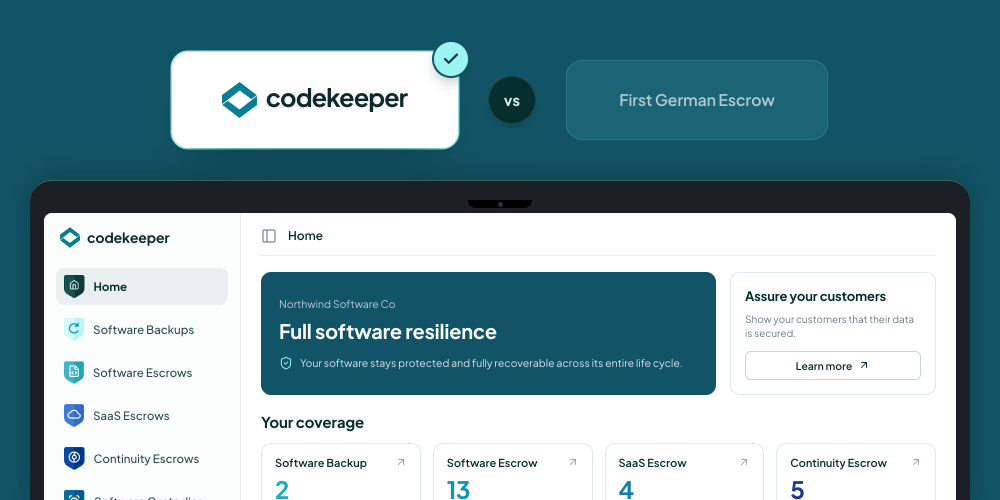
Codekeeper vs. First German Escrow: Which escrow provider should you choose?



Want more insights like this?
Subscribe Here!
When software fails, an escrow deposit is only worth what you can recover from it. The code has to be current, and it needs to rebuild successfully. A good software escrow provider needs to handle both with equal care.
First German Escrow is an independent escrow agent that arranges each deposit privately, one relationship at a time. Codekeeper runs software resilience as a published platform: priced openly, deposited automatically, and verified on tiers you can scope yourself.
This comparison covers pricing, coverage, automation, verification, storage, agreements, and support. It weighs a productized platform with full support against a private, agent-led arrangement, so you can pick the one that fits how your business runs.
» See how Codekeeper builds resilience across your whole stack.
Codekeeper vs. First German Escrow at a glance
Here's how the two providers line up across pricing, features, and verification:
| Pricing & value | Codekeeper | First German Escrow |
| Setup fee | ✅ $249 | ✖️ Not specified |
| Base storage | ✅ 1TB included | ✖️ Not specified |
| Monthly fee | ✅ From $139 | ✖️ Quote only |
| Transparent pricing | ✅ | ✖️ |
| Core features | ||
| Integrations | ✅ 50+ supported platforms | ✖️ Manual deposits, no integrations |
| Automated deposits | ✅ Daily OAuth sync | ✖️ |
| Unlimited repositories | ✅ | ✖️ Not specified |
| Agreements | ✅ Bi-, tri-, and multi-party escrows | ✅ Arrangement dependent |
| Release processing | ✅ 24/7/365 | ✖️ Not specified |
| Assured recovery support | ✅ | ✖️ Not specified |
| Verification services | ||
| Validated verification (free) | ✅ | ✖️ Not specified |
| Verified verification | ✅ | ✖️ Not specified |
| Certified verification | ✅ | ✖️ Not specified |
| Assured recovery support | ✅ | ✖️ Not specified |
| Scalability | ||
| Storage upgrades | ✅ Up to 5TB + custom | ✖️ Not specified |
| Multi-escrow options | ✅ 1, 5, unlimited | ✖️ Not specified |
| Enterprise solutions | ✅ | ✅ |
Codekeeper vs. First German Escrow: Costs
Your protection needs to meet your budget, and that's far easier to do when costs are transparent. Codekeeper prices every product openly, so you can size the cost of protection before making a choice:
- Software Backup: From $99/month
- Software Escrow: From $139/month
- SaaS Escrow: From $199/month
- AI Escrow: From $549/month
- Continuity Escrow: From $459/month
A one-time setup fee of $249 covers your agreement and onboarding, and opting for annual billing takes up to 12% off any plan.
» Compare Codekeeper's pricing with your escrow needs.
First German Escrow doesn't publish pricing. Each arrangement is quoted privately, shaped around the deposit and the parties involved, with no rate card, setup fee, or standard term listed on its site.
Codekeeper vs. First German Escrow: Solutions
The question behind any escrow choice is how much of your software estate it will cover. Codekeeper structures protection across five software resilience products that stack together to cover all software assets:
- Software Backup: keeps timestamped, immutable copies of your own repositories, data, and deployment assets, so your team can restore internally when something breaks.
- Software Escrow: protects installed third-party software under a formal agreement, releasing source code, data, and documentation when a trigger condition is met.
- SaaS Escrow: captures cloud applications in full — configs, environment variables, containers, and dependencies — so they can be redeployed again elsewhere.
- AI Escrow: secures the full AI stack, including models, deployment assets, prompts, agents, and workflows, so you can rebuild your AI operations if a service fails.
- Continuity Escrow: covers hosting and supporting services. You flag a missed payment, and Codekeeper steps in to keep those services running for up to 12 months while you transition.
All five sync daily across 50+ platforms, test recoverability in the background, and issue compliance certificates that auditors accept.
Learn more about Codekeeper's software resilience solutions in this video:
First German Escrow concentrates on source code escrow for installed and embedded software, organized into four service lines:
-
Peace of Mind Escrow covers standard licensor-licensee protection.
-
Active Escrow steps in when deposits or updates fall behind.
-
Investor Escrow secures a financier's stake in a software development project.
-
Industrial Escrow handles embedded control software and industrial know-how.
Each of those is a form of source code and IP protection for installed software. There's no SaaS or cloud escrow, no AI stack coverage, and no hosting-payment continuity.
Codekeeper vs. First German Escrow: Core features
At first glance, it might be difficult to gauge the difference in coverage scope. But what separates any escrow provider is how deposits are handled, how they're verified, and what level of control you have over your escrow.
Integrations
An escrow deposit is only useful if it matches what's running today. Codekeeper connects to more than 50 development platforms through secure OAuth, from GitHub, GitLab, and Bitbucket to cloud services like AWS, Azure, and Google Cloud.
You authenticate once, and deposits sync automatically every day, so what sits in escrow keeps pace with production. Deposits are unlimited, with no per-deposit fee.
First German Escrow works from manual deposits. The licensor sends source code to the agent, who confirms receipt and contents by email, at whatever cadence the parties agree, and the material is held physically rather than in the cloud.
That means your escrow stays current only when someone remembers to send the next update, and drifts from your live systems in between.
Verification options
A deposit you haven't tested is a guess about recovery, not proof of it. Codekeeper treats verification as a scale, so you can match the depth of proof to what your regulators and clients ask for:
| Verification tier | Price | What it proves |
| Validated | Free | Confirms your deposited assets are present, encrypted, and correctly stored in the vault. |
| Verified | From $29/month | Automatically monitors deposit integrity and development activity, with monthly reports in your dashboard. |
| Certified | From $329/month | A human expert rebuilds and tests your software, delivering the recovery evidence auditors expect. |
Each tier issues a Software Resilience Certificate, a dated artifact you can hand an auditor as evidence toward DORA, NIS2, ISO 27001, and other frameworks. Custom verification is available for architectures that don't fit the standard tiers.
First German Escrow considers a base check mandatory on every deposit and reviews each one for completeness and correctness before it's stored. That verification is real, but it sits at a single level. There's no free entry point, no continuous monitoring between deposits, and no named certificate to hand an auditor.
» Select the verification approach that matches your compliance obligations.
Add-on services
Protection needs change after setup, and adjusting them shouldn't mean reopening your contract. Codekeeper lets you extend a base plan with optional add-ons:
-
Advanced Deposits ($59/month): choose your storage region, set IP allowlisting, and keep your full deposit history instead of routine overwrites.
-
Advanced Integrations ($59/month): custom-built connections for proprietary or non-standard platforms, with automated syncing included.
-
Advanced Continuity Integrations ($89/month): links legacy or non-standard hosting and credential systems to Continuity Escrow.
-
Compliance Support SLA ($99/month): hands-on help with recurring compliance documentation, audits, and GDPR and HIPAA data handling.
-
Coverage Length SLA ($99/month): extends your Continuity Escrow coverage window for up to 12 months.
-
Assured Recovery ($199/month): a standby technical team with a prepared recovery profile ready to help you rebuild during a failure event.
-
Liability SLA (priced per agreement): raises liability limits to meet enterprise procurement requirements.
First German Escrow doesn't publish a modular menu, so any equivalent capability would be folded into the terms of the individual arrangement rather than added or dropped as a separate, priced option.
Storage and security
Codekeeper includes 1TB of storage with every single-escrow plan, scaling to 2TB, 5TB, or custom capacity. Deposits are kept in immutable vaults that can't be altered or deleted once written.
Data is encrypted with AES-256/512, access is protected by multi-factor authentication, and the platform is ISO 27001 certified. These specifics support compliance with GDPR, HIPAA, and other frameworks.
First German Escrow stores deposited material physically at a secure location rather than in the cloud, and commits to never using or selling what it holds. Its site doesn't publish certifications, encryption standards, storage capacity, or insurance details, so buyers with specific security or residency requirements would need to confirm those points directly.
» Verify Codekeeper's security certifications meet your regulatory checklist.
Agreements
The legal wrapper around your escrow decides whether a deposit is released when you need it. Codekeeper gives you two ways to get the legal specifics ironed out. Start from tested templates for bipartite, tripartite, and multi-party arrangements and set up a standard agreement quickly, or have our in-house legal team draft a fully custom one, usually within a day and without any need for external counsel or fees.
Either way, we handle the setup, from release triggers to jurisdiction, so your protection is live once terms are signed.
» Read an annotated agreement or download an agreement template.
First German Escrow drafts bespoke agreements in-house too, tailored to each deposit and built to hold up in insolvency. The difference is that bespoke is the only route on offer. There's no tested template to start from for a straightforward deal, and no published turnaround, so timing depends on each negotiation.
Codekeeper vs. First German Escrow: Customer support
Codekeeper gives every account a dedicated technical specialist for setup, integration, and training, plus an account manager for the life of the relationship.
Support runs by email, live chat, and callback, and release processing is staffed 24/7/365, so recovery doesn't wait for office hours. Most implementations go live within 24 hours, and the team spans offices in Europe and North America.
First German Escrow is a sole proprietorship represented by its founder, with a single phone number and email as its point of contact. That gives you direct access to an experienced agent, with more than two decades in the field behind it.
The site names no wider team and publishes no support hours or release process, so both availability and release handling appear to run through that single point of contact.
Codekeeper vs. First German Escrow: Which is right for you?
The choice comes down to how you want protection delivered, and how much of it you need to see and run without a conversation first.
First German Escrow suits a licensor who wants a single, experienced agent to handle a source code deposit privately, and doesn't mind that pricing, verification depth, and timing are settled case by case. It's a focused, relationship-led arrangement for installed software.
Codekeeper suits an organization that wants protection productized. You get open pricing, automatic deposits, tiered verification, and audit-ready certificates across source code, SaaS, AI, and hosting alike. You keep control through the dashboard, and once your setup is signed, we keep it live in the background.
Which fits you depends on where your risk actually lives. If it's one installed product and you want one person on it, the agent model works. If it runs across code, cloud, AI, and the services that keep them online, reach and continuity become the whole decision, whether you're a small team or a regulated enterprise.
» See how Codekeeper compares to other providers in the market.
Future-proof your software stack's protection
Software escrow used to mean a copy of source code for an installed product. Your business has moved on. It runs on cloud services, AI pipelines, and third-party infrastructure that a source code deposit alone can't cover — and that scope grows every quarter.
The deposit most likely to fail you is the one no one has tested and no one can see. Protection that updates only when someone remembers, and proves nothing until you trigger it, quietly falls behind the software it's meant to cover.
Codekeeper closes that gap by keeping every layer deposited, verified, and certified as your stack changes.
» Curious how digital escrow handles fast-moving code? Set up a call with a Codekeeper specialist, or explore Codekeeper directly.