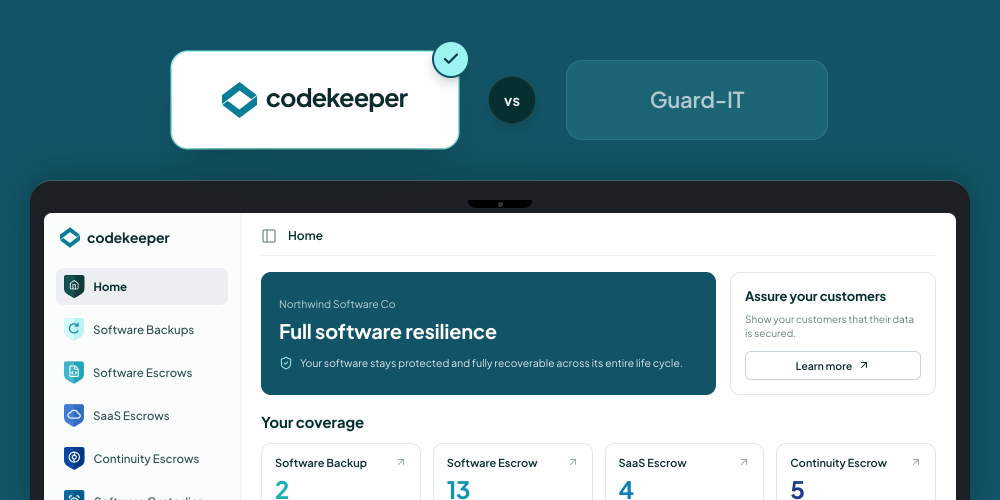
Codekeeper vs. Guard-IT: Escrow features, pricing, and verification compared



Want more insights like this?
Subscribe Here!
Software fails for all sorts of reasons, sometimes the provider gets acquired or drops support, or a ransomware breach compromises all your assets. Software escrow is how you keep access to clean copies of source code, data, and documentation, so you can always recover.
Both Codekeeper and Guard-IT protect those materials, but they run escrow in different ways. Guard-IT works as a traditional escrow agent, where setup, deposits, checks, and releases each move forward when you ask for them. Codekeeper takes a different approach. It keeps protection current and provable across more of your stack, and handles the legal and recovery work for you.
This comparison breaks down how the two providers differ on price, coverage, integrations, verification, agreements, and support, so you can decide which model fits how your team actually works.
» Discover how to automate software resilience with modern software escrow.
Codekeeper vs. Guard-IT at a glance
The table below sets the two providers side by side across pricing, coverage, verification, and support:
| Pricing & value | Codekeeper | Guard-IT |
| Setup fee | ✅ $249 | ✖️ Not specified |
| Base storage | ✅ 1TB included | ✖️ Not specified |
| Monthly fee | ✅ From $129 | ✖️ Custom quotes only |
| Transparent pricing | ✅ | ✖️ |
| Core features | ||
| Integrations | ✅ 50+ supported platforms | ✖️ Manual upload only |
| Automated deposits | ✅ Daily OAuth sync | ✖️ |
| Unlimited repositories | ✅ | ✖️ Not specified |
| Self-service portal | ✅ | ✅ Client Tools portal |
| Agreements | ✅ Bi-, tri-, and multi-party escrows | ✅ Bi-, tri-party escrows |
| Release processing | ✅ 24/7/365 | ✖️ Not specified |
| Assured recovery support | ✅ | ✖️ Not specified |
| Verification services | ||
| Validated verification (free) | ✅ | ✖️ Not specified |
| Verified verification | ✅ | ✖️ Not specified |
| Certified verification | ✅ | ✅ Rebuild available, but uncertified. |
| Software Resilience Certificate | ✅ | ✖️ Not specified |
| Scalability | ||
| Storage upgrades | ✅ Up to 5TB | ✖️ Not specified |
| Multi-escrow options | ✅ 1, 5, or unlimited | ✖️ Not specified |
| Enterprise solutions | ✅ | ✅ |
Codekeeper vs. Guard-IT: Costs
The price of escrow is one of the first things you have to defend to your procurement team, and that's hard when there are no concrete numbers to point to. Codekeeper lists its pricing in full, so you can size the cost of protection before hopping on a sales call:
- Software Backup: From $99/month
- Software Escrow: From $139/month
- SaaS Escrow: From $199/month
- AI Escrow: From $549/month
- Continuity Escrow: From $459/month
Plus, whenever you opt for annual billing, up to 12% is knocked off all plans.
» Compare Codekeeper's pricing with your escrow needs.
Guard-IT prices its escrow service by quote rather than published rates. The one figure it lists is Level I deposit verification at $1,000, but its escrow fees are set per agreement, then held for the life of that agreement and renewed each year.
Holding a fee for the life of an agreement gives you a stable rate over time. The trade-off is that the cost of a quote-based, annually renewing plan only becomes clear after you request it, so comparing options or defending a budget takes an extra step.
Codekeeper vs. Guard-IT: Solutions
Your software probably doesn't live in one place. Some of it runs on-premises. A lot now sits in the cloud, and a growing share leans on AI models and the hosting that keeps everything online. Escrow only helps when it fits how your software is actually built and delivered.
Codekeeper offers five products mapped to how software is delivered:
-
Software Backup keeps tamper-proof, versioned copies of your systems, data, and deployment assets, so your team can restore quickly after a failure or attack.
-
Software Escrow protects on-premises applications, holding source code, documentation, and data under a formal agreement with defined release triggers.
-
SaaS Escrow covers cloud applications in full, including deployment infrastructure, third-party dependencies, and credentials, so the service can be stood back up.
-
AI Escrow protects a working AI stack, including models, deployment assets, prompts, agents, and workflows, so you can rebuild it if a vendor falls away.
-
Continuity Escrow protects hosting and supporting services. If a payment to one lapses, you flag it and Codekeeper steps in to keep the service running while you arrange a fix.
Each solution syncs daily across 50+ platforms, tests recoverability on an ongoing basis, and issues auditor-ready certificates.
Learn more about how Codekeeper's products build software resilience in this video:
Guard-IT provides one escrow service for source code, intellectual property, and other digital assets, using the same agreement formats regardless of the software type. Its business continuity planning is asset preservation for release on a trigger, not payment coverage for hosting or third-party services.
Codekeeper vs. Guard-IT: Core features
The biggest differences between these two providers center around mechanics like how assets are deposited, how they're checked, and how coverage is shaped.
Integrations
A deposit only protects you if it matches the software you run today. Source code changes constantly, so the way deposits get updated decides whether your escrow keeps pace or quietly falls behind.
Codekeeper connects to more than 50 development and hosting platforms. That covers the code hosts your team already works in, like GitHub, GitLab, Bitbucket, Azure DevOps, and AWS CodeCommit, plus cloud platforms including AWS, Azure, and Google Cloud.
You link them once, and deposits then sync automatically every day, with no ongoing developer effort. The escrowed copy tracks your live system instead of drifting from it.
Guard-IT takes deposits through an encrypted upload form, and a deposit updates only when someone uploads a new version. No platform integrations are listed, so keeping the copy current falls to whoever remembers to do it.
Verification options
A deposit you've never tested is only an assumption about recovery, and you find out whether it holds on the worst possible day. Verification turns stored files into evidence that the software can be rebuilt and run when it matters.
Codekeeper runs verification in three tiers, each priced and visible up front:
| Verification tier | Price | What it proves |
| Validated | Free | Essential materials are present, encrypted, and correctly stored. |
| Verified | From $29/month | Deposits are monitored as your code changes, with integrity and structure checks. |
| Certified | From $329/month | Engineers rebuild your software in a clean environment and test deployment, backed by an annual expert review. |
Every tier issues a Software Resilience Certificate you can hand to auditors as evidence toward frameworks like DORA, NIS2, and ISO 27001. Verification also keeps running once it's set up, so the gap between your escrow and your live code never has time to open.
» Select the verification approach that matches your compliance obligations.
Guard-IT offers two verification levels, and you request each one when you want it, priced per instance. Level I costs $1,000 and returns a file inventory with checksums, while Level II rebuilds the software from source per the developer's build instructions and is quoted per project.
Guard-IT runs an expert rebuild test like Codekeeper too, so the difference here isn't whether software gets tested. It's the free entry point, the certificate issued at every tier, and checks that keep running instead of waiting for a request.
Add-on services
Codekeeper lets you extend any plan with modular add-ons, so you build the exact coverage your situation calls for instead of taking a fixed bundle.
-
Advanced Deposits ($59/month): storage-region selection, IP allowlisting, and access to your complete deposit history.
-
Advanced Integrations ($59/month): automated deposit syncing for custom or proprietary platforms the standard library doesn't cover.
-
Advanced Continuity Integrations ($89/month): connects legacy or non-standard hosting systems and syncs their credential stores.
-
Compliance Support SLA ($99/month): expert handling of routine compliance documentation, audit responses, and GDPR and HIPAA data processing.
-
Coverage Length SLA ($99/month): adds continuity coverage past the standard three months, up to a full year, when a transition runs long.
-
Assured Recovery ($199/month): a technical team on standby with a prepared recovery profile and a response time under four hours.
-
Liability SLA (priced per agreement): raises liability limits to match enterprise procurement requirements.
Guard-IT doesn't offer a modular add-on menu. Its enhancements are separate services, such as deposit verification or agreement consolidation, arranged on their own rather than layered onto a plan.
Storage and security
Escrowed code is a target as much as it is a safeguard. If an attacker can reach it, or a deposit can be overwritten, the copy meant to save you becomes one more thing to lose.
Both providers encrypt deposits in transit and at rest and log access to them. Codekeeper stores yours in an immutable vault, so a deposit can't be changed or deleted once it's written, which guards it against ransomware and accidental loss.
Codekeeper holds ISO 27001 certification, keeps complete timestamped audit trails, and provides unlimited storage with no per-deposit fees, so keeping your full version history costs nothing extra.
» Verify Codekeeper's certifications meet your regulatory checklist.
Guard-IT encrypts uploads over TLS, stores them redundantly in the cloud, logs access, and runs monthly penetration tests. It doesn't list a formal security certification such as ISO 27001, and it doesn't publish a storage capacity figure.
Agreements
An escrow agreement sets out who receives the code, under what conditions, and how fast, so getting it done correctly matters as much as the deposit.
Codekeeper covers both routes in-house. You can start from one of our tested templates written for common situations like software licensing, development outsourcing, and regulatory compliance. Or the legal team can draft a fully bespoke agreement for complex or multi-party needs within one to three days, but are often live within a day.
Either way, Codekeeper's own escrow specialists handle everything; there's no need for outside counsel. Agreements can be bipartite, tripartite, or multi-party, with your choice of jurisdiction and custom liability terms.
» Browse Codekeeper's software escrow agreement templates.
Guard-IT works from MS Word template agreements in single-user and multi-user formats, which clients use as-is or adjust on certain terms. It doesn't publish a drafting or execution timeline, so how soon protection goes live depends on scope.
Codekeeper vs. Guard-IT: Customer support
A vendor collapse doesn't wait for office hours. The moment a release is triggered, how fast your provider responds decides how long your systems remain unusable.
Codekeeper offers release processing 24 hours a day, every day of the year. When a trigger fires and you need the code in hand, a dedicated recovery team acts on it straight away rather than holding it for the next working day.
Codekeeper support is reachable by phone, live chat, and email. Every account gets a technical specialist who helps you configure your integrations, runs your first deposits, and handles the transition if you're moving from another provider.
Guard-IT supports clients by phone and email during business hours, Monday to Friday, from its team in Austin. A Client Tools portal handles self-serve setup, deposits, beneficiary enrollment, and payment. They don't publish a response time or an availability window for a release event, so how quickly a triggered release moves isn't stated.
When a release is the whole point of escrow, a staffed, around-the-clock response is the difference between recovering the moment you need to and waiting for someone to be back at their desk.
Codekeeper vs. Guard-IT: Which is right for you?
The decision here is less about a feature list and more about how you want escrow to run day to day.
Guard-IT suits an organization that wants a single, long-established escrow agent to hold source code at a fixed fee, and that's comfortable managing deposits, commissioning checks, and requesting agreements step by step.
Its paymaster and litigation-custody services may also matter if your needs reach past software.
Codekeeper suits teams that want total software resilience protection across their stack. It ensures protection stays current on its own, covers on-premises, cloud, AI, and hosting from one place, and proves recovery with a certificate at every verification tier. Published pricing, automated deposits, and in-house legal work keep the ongoing effort low.
» See how Codekeeper holds up against competitors.
Stop maintaining escrow and start trusting it
Software escrow used to mean a copy of source code locked in a vault and forgotten. Your business now runs on cloud platforms, AI systems, and the third-party services holding them up — and it changes every week. Protection that only reflects the day you signed doesn't cover the software you run now.
Codekeeper keeps your whole stack current on its own, proves recovery at every tier, and carries the upkeep so your team doesn't have to. You set it up once, and it stays ready in the background for the day you finally need it.
» Want escrow built around your growing business? Book a call with a Codekeeper specialist, or explore the Codekeeper site.