
Codekeeper vs. swissEscrow: Choosing the escrow provider that's right for you



Want more insights like this?
Subscribe Here!
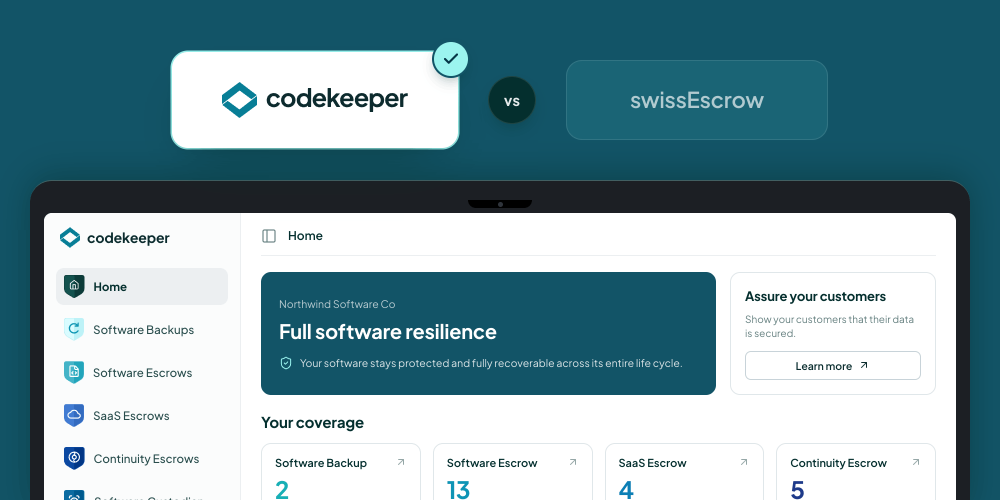
When software fails, the code that runs your business disappears with it. Software escrow answers that risk by placing source code and related materials with a neutral third party. Codekeeper and swissEscrow both do this, but they draw the line in different places.
swissEscrow works as a custodial escrow agent. It takes your deposit into trust, holds it securely in Switzerland, and releases it once an agreed condition is met. Codekeeper pulls constant updates on that deposit instead, keeping it current, testing that it rebuilds, certifying that recovery works, and showing you its state as it changes.
This comparison walks through where the two providers diverge on pricing, coverage, integrations, verification, and legal setup. The goal is to help you match a provider to your business needs.
» Discover how modern software escrow automates your software resilience.
Codekeeper vs. swissEscrow at a glance
The table below sets the two providers side by side across pricing, features, and verification.
| Pricing & value | Codekeeper | swissEscrow |
| Setup fee | ✅ $249 | ✖️ Not specified |
| Base storage | ✅ 1TB included | ✖️ Not specified |
| Monthly fee | ✅ From $139 | ✖️ Custom quotes only |
| Transparent pricing | ✅ | ✖️ |
| Core features | ||
| Integrations | ✅ 50+ supported platforms | ✖️ Not specified |
| Automated deposits | ✅ Daily sync | ✖️ Manual |
| Unlimited repositories | ✅ | ✖️ Not specified |
| Agreements | ✅ Bi-, tri-, and multi-party | ✅ Two- and three-party |
| Release processing | ✅ 24/7/365 | ✖️ Not specified |
| Assured recovery support | ✅ | ✖️ Not specified |
| Verification services | ||
| Validated verification (free) | ✅ | ✖️ |
| Verified verification | ✅ | ✖️ Not specified |
| Certified verification | ✅ | ✖️ Not specified |
| Software Resilience Certificate | ✅ | ✖️ |
| Scalability | ||
| Storage upgrades | ✅ Up to 5TB | ✖️ Not specified |
| Multi-escrow options | ✅ 1, 5, or unlimited | ✖️ Not specified |
| Enterprise solutions | ✅ | ✅ |
Codekeeper vs. swissEscrow: Costs
You can only plan an escrow budget when the numbers are out in the open. Codekeeper publishes fixed pricing for every product, so you can scope your protection and get finance to sign off without booking a sales call first.
Codekeeper charges per solution, monthly or annually:
- Software Backup: From $99/month
- Software Escrow: From $139/month
- SaaS Escrow: From $199/month
- AI Escrow: From $549/month
- Continuity Escrow: From $459/month
When you choose annual billing, all plans are eligible for up to 12% off.
» Find the Codekeeper plan that matches your risk and budget.
swissEscrow prices each arrangement on request. Its fees combine a one-time initialization fee for preparing and concluding the agreement, a recurring deposit fee, and additional services billed by time spent. None of these figures appear on its site, so you learn them through an individual quote.
Codekeeper vs. swissEscrow: Solutions
What you can protect depends on how each provider structures its services. Codekeeper built five software resilience products around how software is deployed and run today:
-
Software Backup gives your team an internal safety net. It connects to your repositories and infrastructure to create secure, versioned copies of source code, application data, and deployment assets, so you can roll back quickly when something breaks.
-
Software Escrow wraps third-party installed software in a formal agreement with clear release triggers. Automated deposits and verification keep the protected assets current and usable.
-
SaaS Escrow extends that protection to cloud applications. It captures code, databases, configurations, and dependencies, so you can stand the service back up on new infrastructure if the provider cannot.
-
AI Escrow protects the full AI stack, including models, deployments, agents and prompts, and workflows, so you can rebuild and redeploy your AI operations if a system fails or a vendor pulls away.
-
Continuity Escrow keeps applications online when a hosting or third-party payment lapses. You flag the missed payment, and Codekeeper steps in to cover it, holding continuity for up to 12 months while you resolve the issue.
Learn more about Codekeeper's software resilience solutions in this video:
swissEscrow organizes its service around asset types rather than deployment models, offering the same custodial arrangement applied to six different deposits:
-
Source Code Escrow holds the source code of installed software, released to the client when a predefined condition is met.
-
SaaS Escrow secures the source code of SaaS software, with the deposit released on the same condition-based basis.
-
Technology Escrow covers a third-party technology in the form of data or documents, such as machine or equipment control data.
-
IP Escrow holds intellectual property deposited as data or documents.
-
Data Escrow stores other business-critical data, whether submitted online or physically.
-
Document Escrow keeps important documents in custody under the same release terms.
swissEscrow has no product for AI infrastructure, and none for keeping services running when a payment lapses. Its SaaS escrow secures the source code of the SaaS software, while Codekeeper's captures the databases, configurations, dependencies, and credentials needed to actually run it again. And because each service is a separate deposit, protecting several asset types means several arrangements, where Codekeeper folds them into one plan.
Codekeeper vs. swissEscrow: Core features
Integrations
An escrow deposit is only worth as much as it is current. Codekeeper connects to 50+ development platforms through secure OAuth, from GitHub, GitLab, and Bitbucket to AWS, Azure, and Google Cloud. You authenticate once, and daily syncs keep your vault matched to production without anyone remembering to upload.
swissEscrow takes deposits through a secure, time-limited upload link and can set up a direct server connection on request for ongoing updates. It names no platform integrations and states no sync schedule, so how current the deposit stays depends on someone manually sending each new version.
Verification options
Holding critical assets in a deposit gives peace of mind. It does not prove the code will build and run when everything else has failed. That is where verification comes in. Codekeeper structures its verification around three tiers:
| Verification tier | Price | What it proves |
| Validated | Free | Confirms every expected asset is present and correctly stored in the vault. |
| Verified | From $29/month | Automatically monitors deposit integrity and development activity, with monthly reports in your dashboard. |
| Certified | From $329/month | Has expert engineers rebuild and test your software in a clean environment, then issues a formal recovery certificate. |
Every tier issues a Software Resilience Certificate, a dated record you can hand to an auditor as evidence toward DORA, NIS2, ISO 27001, and CPS 230.
» Select the verification approach that matches your regulatory requirements.
swissEscrow runs a standard check on what it receives, covering plausibility and a virus scan, and a beneficiary can inspect the delivery on site. That check happens once, at deposit. There is no tiered testing, no free entry point, no build or recovery test, and no certificate to put in front of a regulator.
Add-on services
Protection needs shift as you grow, so Codekeeper offers an add-on suite that lets you add capability without renegotiating your agreement:
-
Advanced Deposits ($59/month): choose your storage region, set IP allowlisting, and keep your full deposit history instead of overwriting older versions.
-
Advanced Integrations ($59/month): custom-built connections for proprietary or non-standard platforms, with automated deposit syncing.
-
Advanced Continuity Integrations ($89/month): connects legacy or non-standard hosting and credential systems to Continuity Escrow.
-
Compliance Support SLA ($99/month): hands-on help with recurring compliance documentation, security audits, and GDPR and HIPAA data handling.
-
Coverage Length SLA ($99/month): extends Continuity Escrow coverage beyond the default window, up to 12 months.
-
Assured Recovery ($199/month): a standby technical team with a four-hour response time to help rebuild your codebase and environments during a recovery.
-
Liability SLA (priced per agreement): raises liability limits to match enterprise procurement and contractual-risk requirements.
swissEscrow does not publish an add-on menu. Extra capability is arranged as an additional service billed by time spent, defined case by case rather than picked from fixed options. For a team that wants to start lean and layer on data residency, faster recovery, or longer continuity later, Codekeeper's priced building blocks offer greater flexibility.
Storage and security
Codekeeper includes 1TB of storage and scales to 5TB and beyond, with unlimited deposits and no per-deposit fees. Data is encrypted with AES-256/512 and written to immutable vaults that cannot be altered or deleted once stored. Deposits come with complete audit trails that timestamp every change.
Codekeeper also holds its own ISO 27001 certification, which supports compliance with frameworks such as DORA, NIS2, and CPS 230.
» Review whether Codekeeper's security certifications meet your regulatory needs.
swissEscrow stores online deposits encrypted on servers in Switzerland, keeps physical media in the vault of a Swiss bank, and backs data up daily. Its published material does not name an encryption standard or a storage allowance, and the ISO 27001, SOC 2, and related certifications it lists belong to the data centers it uses, rather than to swissEscrow itself.
Agreements
Escrow agreements are where deals often stall, with terms passing between lawyers for weeks before anyone signs. Codekeeper removes that wait by giving you two ways to reach a finished agreement.
For standard deals, you initiate bipartite, tripartite, and multi-party arrangements straight from your dashboard, starting from tested templates rather than a blank page. Our in-house legal team can also draft more specific terms with a custom agreement, usually within a day and without the cost of external counsel.
You can take a look at what our agreements look like before committing. Alongside the templates, Codekeeper publishes an annotated sample agreement that explains what each clause does and why it is there, so the terms are clear without a legal briefing.
» Download Codekeeper's software escrow agreement templates.
swissEscrow drafts each agreement individually through its own legal expertise, structured as a two-party or three-party arrangement. There is no tested template you can start from yourself, no stated drafting turnaround, and no multi-party structure described for deals with several beneficiaries.
Codekeeper vs. swissEscrow: Customer support
Support matters most at two moments: when setting up escrow, and the day you need a release to recover software. Codekeeper gives every account a dedicated technical specialist for setup and a dedicated account manager afterward, reachable by email, live chat, and phone. Deposits, versions, and certificates all sit in one dashboard you can open any time, and release processing runs 24/7/365, so recovery never waits for office hours.
swissEscrow assigns each client a single personal contact and takes questions by email, phone, and a contact form. Releases happen on the beneficiary's request, with the depositor notified in advance. Its site does not state support hours, a release-processing window, or a dashboard for tracking deposits between events.
Codekeeper vs. swissEscrow: Which is right for you?
Your decision comes down to how much you need after the deposit is made.
swissEscrow suits a buyer who wants trust-based custody under Swiss jurisdiction, with data held in-country and a personal legal contact running the arrangement. If your priority is a securely held deposit and Swiss residency, that is a coherent, focused offer.
Codekeeper suits a buyer who needs the deposit to stay usable. We keep it current through daily syncs, test that it rebuilds, certify recovery for auditors, and track it all in one place. You choose your storage region to meet data-residency requirements, and you protect more than source code, reaching SaaS environments, AI stacks, and hosting payments.
The practical difference is what you hold when a trigger fires. With swissEscrow, you receive what was deposited. With Codekeeper, you receive materials already tested to rebuild, with the evidence to prove it.
» Find out how Codekeeper's modern escrow solutions hold up against the broader market
Test recovery before you have to rely on it
Escrow works for you long before any trigger fires, satisfying auditors, reassuring enterprise buyers, and clearing procurement reviews. But all of that rests on one assumption, that the deposit will actually work when you finally need it. If the code has drifted from production, or will not build, that is the worst possible moment to find out. Around 90% of untested escrow deposits fail when they are triggered.
That is the line between these two providers. swissEscrow holds your deposit safely and returns it when the vendor falls away. Codekeeper makes sure that on the day it counts, what you get back actually runs.
» Want recovery you can prove, not just store? Arrange a call with a Codekeeper specialist, or look around codekeeper.co.