


 European Union


 Global standards


 US

 UK

 Australia

 Netherlands

 SaaS escrow. Keep the SaaS you depend on recoverable, down to the last credential.
A SaaS application's code is only part of what brings it back. Escrow stores the code, data, infrastructure, and credentials in a neutral vault, synced every day, while Escrow Pro proves the deposit builds.
From $279 /mo
- ISO/IEC 27001:2022 certified
- Daily syncs across 50+ integrations

 How SaaS escrow worksBooking Hub · SaaS · Escrow ProDeposit current
- The vendor depositsCode, data, infrastructure, and credentialsSynced daily
- Codekeeper holds itIn a neutral vault, checked every monthVault Report
- Codekeeper's AI agents rebuild itEscrow Pro · Codekeeper AI Verification LabPassed
- The customer receives itIf a release condition is metOn release
A sample, with made-up names.
Relied on by 3 500+ teams across more than 150 countries, from regulated enterprises to SaaS vendors growing at pace








Why SaaS escrow
Prepare the cloud stack your business runs on for a supplier failure.
Cloud services help your organisation move faster with fewer systems to run in-house, yet a failing vendor can take everything built on its service down too. SaaS escrow gives your team the whole cloud environment back, ready to run.
Your own cloud
Booking Hub, in your account
- CodeRestored
- DataImported
- InfrastructureProvisioned
- CredentialsHanded over
Hosted applications in escrow
SaaS escrow, in plain terms.
SaaS escrow is an agreement between a cloud software vendor, their customers, and a neutral escrow agent like Codekeeper. As the vendor runs the application, the deposit reaches past source code to the infrastructure, data, credentials, and connected services it needs, synced daily. Vendors rely on it to pass procurement and vendor risk reviews, and once a release condition applies, customers get the deposit to restore the service or move it to their own cloud accounts.
After more detail? Read our introduction to SaaS escrow
What SaaS escrow protects against
Losing access.
Recover the service's code and data after a shutdown or takeover.
Starting over.
Begin from the deposit rather than reverse-engineering a system whose code you never had.
Deals on hold.
Hand procurement and auditors the continuity plan they want before signing.
What goes into SaaS escrow
A SaaS application needs far more than its code to come back.
For installed software, code and build files do most of the recovery work, since it runs on your own servers. SaaS runs in the vendor's cloud, so the deposit needs every layer underneath.
Source code
Learn about source code escrow- What goes in
- The services, scripts, and libraries that make up the application.
- Without it
- Nothing exists to rebuild the service from, and it can't be fixed or changed.
Infrastructure and deployment
Learn about deployment assets escrow- What goes in
- Deployment packages, infrastructure definitions, and the server settings that bring the application up.
- Without it
- Nothing shows the environment the code belongs in.
- What goes in
- Database exports and datasets that restore the service's records.
- Without it
- No records come back with the application.
Credentials and access
Learn about credentials escrow- What goes in
- The passwords, access keys, and cloud account access needed to deploy, manage, or restore the application.Kept beside the code in an access-controlled vault.
- Without it
- Nobody can get into the cloud accounts the service runs in.
Third-party services
Learn about third-party dependency escrow- What goes in
- The external services and packages the application relies on to work as designed, like payments, email, and search.
- Without it
- The service runs, but any feature that depends on an outside service fails.
Documentation
Learn about document escrow- What goes in
- Setup and maintenance know-how, from architecture notes to runbooks.
- Without it
- Recovery engineers are left rediscovering what the original team knew.
A single connection through 50+ integrations links repositories, cloud platforms, and SaaS tools like Stripe, Shopify, and Chargebee, which then sync daily. See all integrations
How a recovery works
When a SaaS vendor stops, this is what follows.
Your team's recovery depends on the deposit, while your people depend on the live service every day. Escrow protects the deposit, and Continuity keeps the service going.
-
1
Every day before
Nothing has gone wrong yetThe depositSynced and checkedThe deposit syncs daily, and a monthly check documents which agreed items are there. On Escrow Pro, Codekeeper's AI agents also rebuild it when you choose.
The live serviceOnlineThe vendor runs it, in the vendor's cloud accounts, on the vendor's bills.
The live serviceOnline · mappedThe vendor still runs it. We map its live environment at setup and keep that map current.
-
2
The vendor stops
Insolvency, discontinued support, or a material breachThe depositReleased to youIf a release condition in your agreement is met, we check the request against it and hand the deposit to your team.
The live serviceAt riskThe bills stop with the vendor. Suspended hosting or a lapsed domain can take the service offline.
The live serviceKept onWe keep the mapped environment paid and switched on for an agreed period.
-
3
While it's recovered
Self-Run Recovery, by your teamThe depositRecovered by your teamYour team redeploys the service from the deposit, into cloud accounts you control. On Escrow Pro, it starts from the last passed run's exit workbook and tested isolated compile.
The live serviceNot coveredNothing keeps the vendor's environment on, so your people may wait until the redeployed service is up.
The live serviceStill switched onThe environment stays on, so the service can keep running while your team recovers it.
Decide who handles the recovery and whether the service keeps running.
Self-Run RecoveryEscrow This page
For the software your own team can bring back. Protect each layer of a critical SaaS application in a neutral vault, ready for your own team to redeploy once a release condition applies.
From $279
 Managed Recovery
Resilience
For the software you can't risk rebuilding yourself. Get a critical SaaS application running again after a failure, with Codekeeper's engineers rebuilding the service on your behalf. Explore Resilience
From $459
 Full Continuity
Continuity
For the services that just can't go offline. Protect the live service from a vendor's unpaid bills during the recovery, with its hosting and accounts running for an agreed period. Explore Continuity
From $1,479
Escrow or Escrow Pro
The same deposit. Escrow Pro proves it builds.
Both plans hold the same layers and release them to your team. Escrow Pro adds proof by rebuilding the deposit, so gaps surface early and each passed run adds to your evidence.
Escrow
From $279 per month
Everything you need to be protected.
Included
- Software held by a neutral party
- Syncs every day through 50+ integrations
- Missing files caught each month
- Deposit released to your team for recovery
Escrow Pro
RecommendedFrom $599 per month
Prove the rebuild before a recovery is ever needed.
Everything in Escrow, plus
- Agentic Verification, with as many as four rebuilds a year on supported technology stacks
- Sovereign AI agents in the Codekeeper AI Verification Lab
- Any missing files flagged during each rebuild
- A tested isolated compile you can deploy
- An exit workbook to guide the recovery
- Recoverability Certificates and SBOMs on file
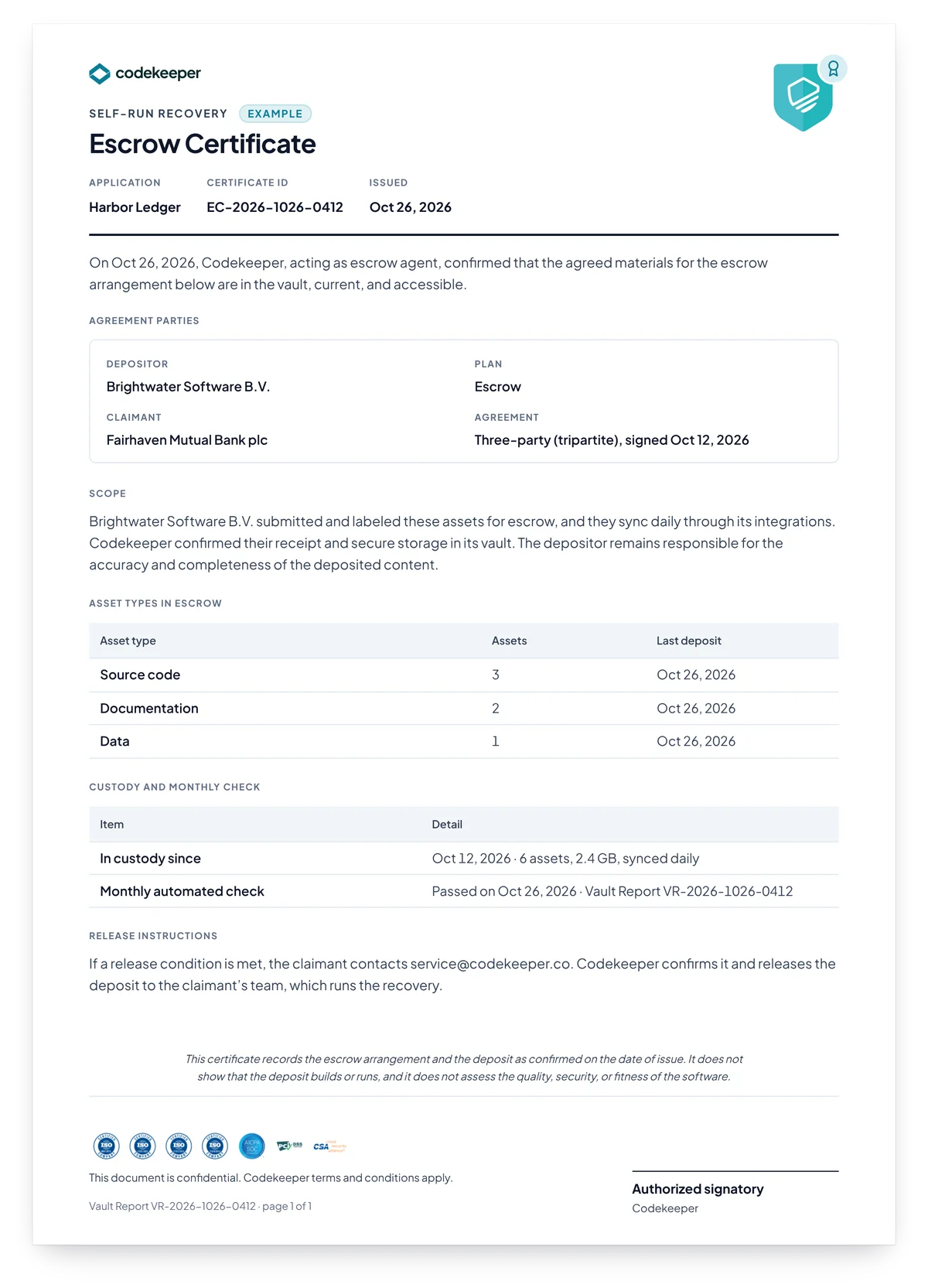 EscrowEscrow CertificateConfirms the deposit is held and lists its contents. Values are examples.
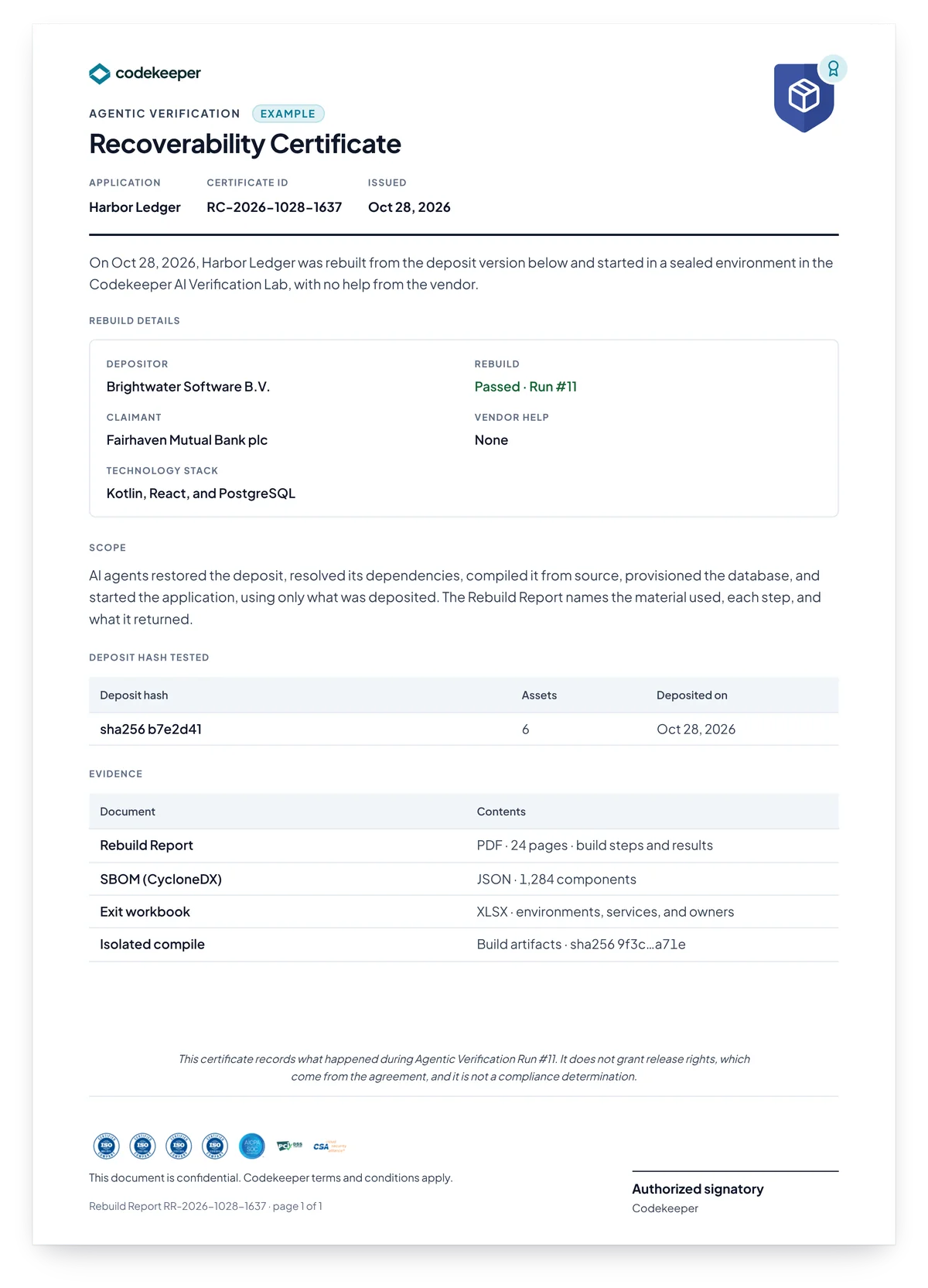 Escrow ProRecoverability CertificateRecords the rebuild and its outcome. Release rights stay with the agreement. Values are examples.
Included with SaaS escrow
Up to date, no matter how often your service changes.
Agreements that fit your deal.
Pick a two-party (bipartite), three-party (tripartite), or multi-party agreement under your preferred governing law, with our in-house counsel drafting and negotiating the terms.
A single deposit for every customer.
Vendors add each customer to the same deposit as they sign, under release conditions agreed individually, with no fresh deposit needed.
Daily syncs and manual uploads.
50+ integrations keep the deposit matched to the live service, and you can add runbooks or environment files yourself whenever you like.








Versions that can't be altered.
AES-256 encryption, MFA, and immutable storage protect every snapshot, so the release matches the last check.
A complete audit trail.
Each change, sync, and access request on the deposit is recorded, and every version is stamped with when it arrived.
Releases requested at any hour.
Phone, chat, or email us 24/7/365, and our team checks the condition is met before anything leaves the vault.
Other applications
Need to protect another type of system?
 Software escrowUsing installed software? Keep its source code, data, and documentation safe.From $189
- AI escrowCentred on a model? Keep the models, agents, prompts, and workflows that power it.From $599
 Software BackupHosting a service you built yourself? Keep versioned copies of its code, configuration, and data.From $89
Give every critical subscription a second life.
Find out from a SaaS escrow specialist what it would take to restore your services.
Frequently asked questions
Your SaaS escrow questions, answered.
Looking for answers on setup, agreements, or releases more broadly? See the full FAQ
How does SaaS escrow work?
SaaS escrow works by giving a cloud application's customers a route back to it should the vendor be unable to carry on. The vendor places the code, infrastructure, data, credentials, and service details with a neutral escrow agent such as Codekeeper, which holds them for both sides and releases them when a condition in the agreement applies.
Besides code, what goes into a SaaS escrow deposit?
Besides code, a SaaS escrow deposit takes in everything the application runs on: infrastructure definitions, deployment packages, data exports, cloud account credentials and access, a record of the third-party services it uses, and documentation. Each item is listed in the agreement, and the monthly check records the vault's contents.
Where do SaaS escrow and software escrow differ?
SaaS escrow and software escrow differ in what the deposit must cover. Software escrow protects applications installed on your own servers, where code, build files, and documentation do most of the recovery work. SaaS escrow must also cover what the vendor runs for you, including the cloud infrastructure, the data, and access to the accounts hosting the service.
When is a SaaS deposit released?
A SaaS deposit is released when a condition in your agreement applies, like the vendor's insolvency, discontinued support for the service, or a material breach, along with any terms the vendor and their customers add. Our team verifies the condition before anything is released.
Will the service stay up while it's recovered?
Yes, the service will stay up while it's recovered with Continuity. We chart the live environment during setup and keep the map up to date, and should the vendor stop, we pay for the environment and keep it running for an agreed period, recharging the bills at cost. Continuity sits on the Escrow or Resilience recovery you pick.
When does Escrow Pro need the vendor's help?
Escrow Pro needs the vendor's help only when something is missing. Codekeeper's AI agents rebuild the deposit as many as four times a year, on supported technology stacks, flagging gaps such as a missing environment variable mid-run, and the vendor's team fills them before the next run. Let us know what your service is built with, and we'll confirm the stack is supported before you begin.
Who covers the cost of SaaS escrow?
The cost of SaaS escrow is covered by whichever side the vendor and their customers agree on. Vendors frequently pay to pass vendor risk assessments on bigger accounts, while customers frequently pay because their operations rely on the service.
What's the price of SaaS escrow?
The price of SaaS escrow for one SaaS application starts at $279 per month on Escrow and $599 on Escrow Pro, with a one-off $499 setup fee per agreement. One beneficiary comes with each agreement, and more are available as an add-on. Should a release ever be requested, release processing costs $199 per hour. See Escrow pricing
Is SaaS escrow still necessary alongside a disaster recovery plan?
Yes, SaaS escrow is still necessary alongside a disaster recovery plan for services you subscribe to. The plan restores the systems you run, whereas the code and configuration behind a hosted service stay with its vendor. For a service your own team builds and hosts, Software Backup is the better match.