


 European Union


 Global standards


 US

 UK

 Australia

 Netherlands

 Software escrow for installed applications. Recover licensed software on your terms.
Losing access to the applications your organisation relies on should never come as a surprise. Software escrow protects the on-premises and self-hosted software your teams work with daily, with a route to recovery that stays in your hands.
From $189 /mo
- ISO/IEC 27001:2022 certified
- Agreements covering as many parties as you need

 Deposit up to dateFleet Ledger · On-premises · Escrow Pro
Synced every day
Relied on by 3 500+ teams across more than 150 countries, from regulated enterprises to software vendors growing at pace








Why software escrow
Licensed software shouldn't end when the vendor does.
Software escrow holds the code and all that surrounds it, up to date and in one place, with release conditions settled at the outset, so any release follows a process each party has already signed up to.
The vendor
Fleet Ledger
On-premises software
- Repositories sync daily
- Anything else, uploaded
Codekeeper vault
Fleet Ledger 8.2
- Source code4 repositories
- Build scriptsIncluded
- DocumentationInstall guide
- Database schemaSynced today
Beneficiaries
What goes into software escrow
Start any recovery sure of what the deposit contains.
Restoring an installed application takes its build scripts, installers, environment files, and licence files too. Each on-premises application rests on a handful of core components, and software escrow keeps all of them up to date in one place.
Deposit · Fleet LedgerOn-premises · Escrow ProSynced today- 1
Source code
The codebase each recovery begins with, plus the build scripts that make it a working installation.
Source code escrow - 2
- 3
Documentation
The guidance an engineering team relies on to install, operate, and recover the software.
Document escrow - 4
Files outside your tools
Anything a repository doesn't hold, such as installers and licence files.
Deployment assets escrow





GitHub · GitLab · Bitbucket · Azure DevOps · AWS · Azure · Google Cloud
Software escrow, in brief
Third-party software. Without the dependency risk.
Software escrow, also known as source code escrow, is a recovery safety net for installed software you hold a licence for. Under an agreement between the vendor, their users, and Codekeeper, a copy of the software sits in a secure vault, synced every day. Vendors rely on it to get through procurement, and users receive the copy once a release condition applies.
Keen to learn more? Read our introduction to software escrow
What software escrow protects against
Vendor failure.
Keep the software going through a bankruptcy or a product that's been discontinued.
Security gaps.
Use the released code to fix vulnerabilities nobody patches any more.
Stalled deals.
Close enterprise deals that require continuity terms before signing.
Who it's for
Designed for each side of a software licence.
An application written by someone else can carry your processes, your clients, and every working day. Software escrow prepares both sides for the day its vendor can't support it any longer.

You run software from a vendor
- The risk
- The software runs part of your operations, and only the vendor can fix it.
- With Escrow
- Put release rights in writing before you sign, so the code, data, and documentation are there if the vendor stops.
- With Escrow Pro
- Know the deposit builds before you need it, and start any recovery from a tested isolated compile.
You sell software customers install
- The risk
- Enterprise buyers ask what happens to them if you stop, and the deal waits on the answer.
- With Escrow
- Answer the continuity question in due diligence with a certificate, and add customers to the same deposit as they sign.
- With Escrow Pro
- Show buyers the software builds, with a Recoverability Certificate from each passed rebuild.
File certificates for your exit plan, and with Pro add Rebuild Reports, SBOMs, and exit workbooks.
How a recovery works
A software vendor stops. Here's what follows.
Two things are on the line: the deposit your team recovers from, and the software already running on your servers. Escrow looks after the first so the second can carry on, while Continuity pays for the services it relies on in the meantime.
-
1
Every day before
Nothing has gone wrong yetThe depositSynced and checkedYour repositories sync to the deposit daily, and a monthly check documents which agreed items are there. On Escrow Pro, Codekeeper's AI agents also rebuild it when you choose.
The software on your serversRunningThe vendor supports it, ships updates, and fixes what breaks.
The software on your serversRunning · mappedThe vendor supports it. We map the hosted components and outside services the installation depends on at setup, and keep that map current.
-
2
The vendor stops
Insolvency, discontinued support, or a material breachThe depositReleased to youIf a release condition in your agreement is met, we check the request against it and hand the deposit to your team: source code, build scripts, data, and documentation, as last synced and checked.
The software on your serversUnsupportedIt keeps running, but nobody patches it. A security flaw, an expiring license key, or an operating system update can bring it to a stop.
The software on your serversKept onLicence servers, hosted components, and third-party services on the map stay paid and switched on for an agreed period, so the installation keeps working.
-
3
While it's recovered
Self-Run Recovery, by your teamThe depositRecovered by your teamYour engineers, or a partner you choose, build it from the deposit, fix what needs fixing, and keep the installation current. On Escrow Pro, they start from the last passed run's tested isolated compile and exit workbook.
The software on your serversKept runningPatches and fixes come from your own build now, so the installation stays supported for as long as you need it.
The software on your serversStill switched onEverything on the map stays on while your team builds from the deposit, so the switch to your own build happens on your schedule.
Decide who handles the recovery and whether the service keeps running.
Self-Run RecoveryEscrow This page
For the software your own team can bring back. Hold a copy of the installed software in a neutral vault, released to your team to build and maintain once a release condition applies.
From $189
 Managed Recovery
Resilience
For the software you can't risk rebuilding yourself. Get critical third-party software working again, with Codekeeper's engineers in charge of the recovery. Explore Resilience
From $369
 Full Continuity
Continuity
For the services that just can't go offline. Pay for the hosting and services behind an application and keep them running for an agreed period during its recovery. Explore Continuity
From $1,339
Plans for on-premises software
Decide how release day plays out.
Escrow safeguards the deposit until it's released for your team's recovery work. Escrow Pro brings in Agentic Verification, so your team's starting point is a build that has already passed.
| Software, from | Released to youEscrow$189 |
Tested in advanceEscrow Pro Recommended$419 |
|---|---|---|
| Held, checked, and released | ||
| Software held by a neutral party | Included | Included |
| Syncs every day through 50+ integrations | Included | Included |
| Missing files caught each month | Included | Included |
| Released to your team for recovery | Included | Included |
| Proven to build | ||
| Agentic Verification, with as many as four rebuilds a year on supported technology stacks | Not included | Included |
| AI run by Codekeeper, away from public models | Not included | Included |
| Any missing files flagged during each rebuild | Not included | Included |
| A tested isolated compile you can deploy | Not included | Included |
| An exit workbook to guide the recovery | Not included | Included |
| Recoverability Certificates and SBOMs on file | Not included | Included |
 Agentic Verification · Escrow Pro
Face any recovery with a working build already on file.
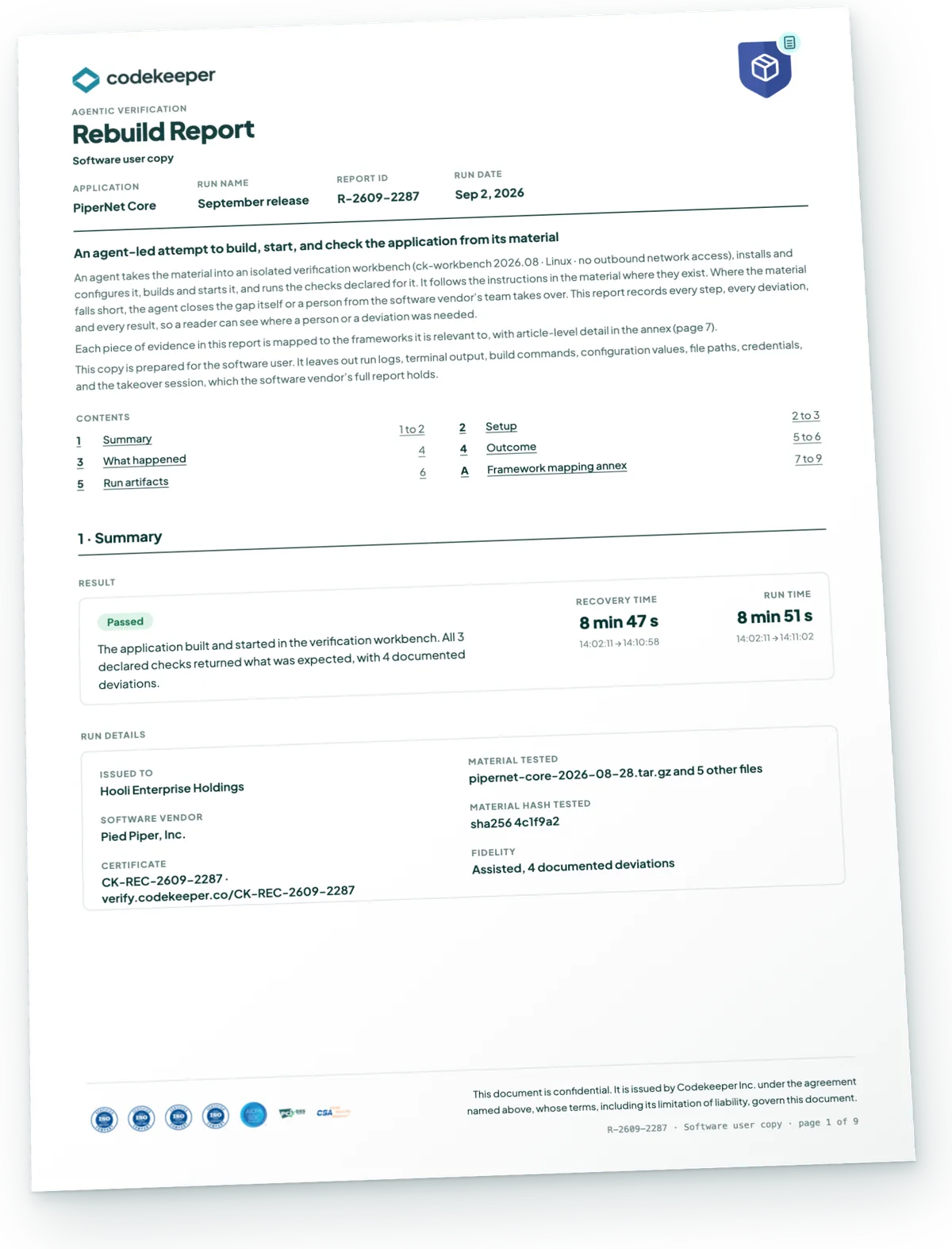
Have confidence in your vault, because you've watched its contents build. In the sealed Codekeeper AI Verification Lab, Codekeeper's AI agents rebuild your deposit and point out gaps while there's still time to fill them, so a release gives your team an isolated compile to begin with.
As many as four rebuilds a year.
Launch each run at a time that suits you, on supported technology stacks, and watch your deposit become working software again.
A certificate from each passed run.
File a new Recoverability Certificate whenever a rebuild passes.
Pro's complete evidence set.
Have Rebuild Reports, SBOMs, and exit workbooks ready whenever a review comes round.
Included with software escrow
Recover essential software, with the small print handled for you.
Releases once conditions are verified.
Get in touch by phone, chat, or email, 24/7/365, to request a release, and begin recovering as soon as the condition is confirmed.
A check on the deposit each month.
Restore from a deposit inspected monthly, with every check documented in a Vault Report.
Terms set from the outset.
Agree a bespoke two-party, three-party, or multi-party agreement, with your release rights written out in full.
Negotiations handled by our counsel.
Let Codekeeper's in-house counsel take every round of talks with the other side, under the jurisdiction of your choice.
Syncs every day, plus manual uploads.
Connect your repositories through 50+ integrations for daily syncs, and add installers, licence files, and runbooks yourself.



Encrypted, tamper-proof storage.
Hold source code in an immutable vault with controlled access, protected by AES-256 encryption and MFA.
Other applications
Need to protect another type of system?
 SaaS escrowHosted in a vendor's cloud? Keep the code, data, credentials, and configuration behind it.From $279
- AI escrowCentred on a model? Keep the models, agents, prompts, and workflows that power it.From $599
 Software BackupHosting a service you built yourself? Keep versioned copies of its code, configuration, and data.From $89
Secure a way back for every application you license.
Each licensed application is a dependency worth planning for. Speak to our software escrow specialists about keeping yours recoverable, from the risks around the application and a roadmap from first call to first deposit to answers on your legal and technical questions.
Frequently asked questions
Your software escrow questions, answered.
Got another question? Ask a specialist
How does software escrow work?
Software escrow works through an agreement under which a software vendor places an application's source code, data, and documentation with a neutral escrow agent, such as Codekeeper. The agent holds and checks the deposit on behalf of both sides, and if an agreed release condition applies, the deposit passes to the user, who can then maintain the software without the vendor.
What agreement structures can we choose from?
You can choose from two-party, three-party, and multi-party agreement structures for software escrow. A two-party agreement can cover any user who requests it, while three-party and multi-party agreements name every beneficiary along with its release terms.
Which release conditions apply?
The release conditions that apply are those set out in the agreement, by default insolvency, bankruptcy, discontinued support, or material breach, along with any terms the parties add. Codekeeper confirms the condition before the deposit is released.
Who covers the cost of software escrow?
The cost of software escrow is covered by the vendor, the user, or both. Vendors frequently pay to get through due diligence on enterprise deals, while users frequently pay because the software runs part of their operations.
What's the price of software escrow?
The price of software escrow for an on-premises or self-hosted application starts at $189 per application per month on Escrow and $419 on Escrow Pro. Every agreement also carries a one-off $499 setup fee, and release processing is $199 per hour if a release is ever requested. One beneficiary is included, with more available as an add-on. See Escrow pricing
Can one plan combine automated and manual deposits?
Yes, one plan can combine automated and manual deposits. Repositories you've connected sync every day, and your team adds anything else manually as it changes.
When does Agentic Verification need the vendor's input?
Agentic Verification needs the vendor's input only when there's a gap to fill. With a complete deposit, the agents rebuild the software unaided; if a run spots something missing, it gets flagged, the vendor adds it to the deposit, and you start the rebuild again.
Is software escrow still necessary alongside a disaster recovery plan?
Yes, software escrow is still necessary alongside a disaster recovery plan for any software you license. The plan restores systems under your control, while the source code stays with the vendor. For software your own team builds, Software Backup is the better match.